
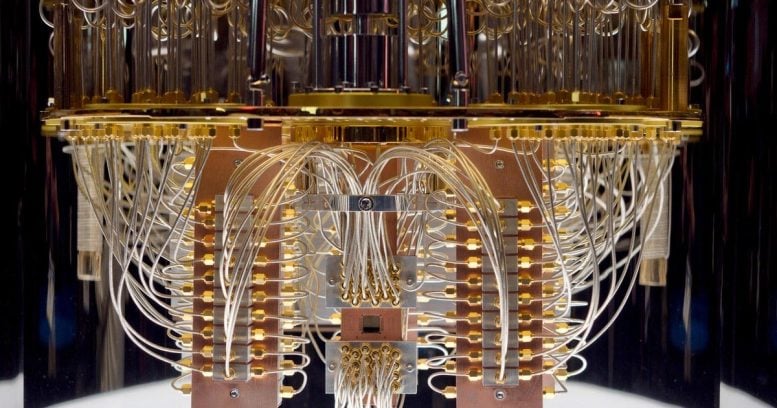
A new approach to quantum computing using magnetic-based gates may eliminate error-prone systems and make powerful simulations, like molecular modeling, a reality.
A research team that includes two University of Oregon physicists has outlined new techniques for controlling the building blocks of quantum computing, a potentially significant step toward making such computers more accurate and useful.
Physicists David Allcock and David Wineland are founders of the new Oregon Ions Laboratory, which was recently set up in the basement of Willamette Hall. They are among 12 authors of a new paper, which is based on an experiment at the National Institute for Standards and Technology in Boulder, Colorado. Both scientists previously worked at the Colorado lab and continued to collaborate on the project after coming to the UO in 2018.
Tackling Error Rates in Quantum Logic Gates
The techniques, described in the journal Nature, involve the use of trapped-ion quantum bits, or qubits, in quantum computing and simulations. They could lead to improvements in the operation of quantum computers, which still make too many computation errors to be effective tools, the physicists said.
The problem with quantum computers is that their logic gates — the tools used to perform basic logic functions in computing — “are really bad,” Allcock said.
“They fail about 1 percent of the time,” he said. “You can do about 100 (operations), then you get garbage out.”
Wineland added, “The whole field is in a stage now, because of errors that exist, that we can’t do lengthy calculations or simulations of practical value on our machines.”
The goal is to get to 10,000 operations without error and then add layers of checks to fix the errors as they happen, he said.
“We want to get to that point,” Allcock said. “Then you can use quantum computers for something useful. Right now they’re just toys.”
Advancing with Magnetic Over Laser Controls
Wineland said trapped ions are like a bowl of marbles that have certain magnetic properties. Physicists can apply forces to the ions with different methods, including lasers, Allcock said. But lasers are expensive and complex machines, whereas making logic gates using magnetic forces is cheaper and more practical because they can be generated directly with integrated circuits, he said.
“What we did here is show these techniques work as well as anyone has done logic gates before,” he said.
Google and IBM are among the commercial enterprises that have armies of engineers working on such problems, while academic physicists are trying to show there are better, more basic techniques for solving them.
“We’ve shown you can do it in a technically simpler way,” he said.
Potential Real-World Applications
If physicists and engineers can make quantum computers reliable and able to operate with large enough capacity, they could simulate other systems, Wineland said. For example, a quantum computer could simulate the action of a molecule used in drug therapy without having to synthesize it in a lab.
“There are some very practical, useful outcomes,” Wineland said. “We’re just scratching the surface.”
Quantum computing is based on the principles of quantum theory, which explains the behavior of matter on the atomic and subatomic levels. A quantum bit, or qubit, is the basic unit of information in quantum computing, just as a bit is the basic unit in conventional computing. Unlike a classic bit, which can be 1 or 0, a qubit can be both 1 and 0 at the same time.
Quantum computing has been around since about 1995, when a mathematician at the Massachusetts Institute of Technology named Peter Shor came up with an algorithm using quantum logic ideas that could efficiently break large numbers into a set of simpler equations, a process known as factoring, Wineland said. That was important because most modern encryption algorithms derive their security from the inability to factorize large numbers.
Reference: “High-fidelity laser-free universal control of trapped ion qubits” by R. Srinivas, S. C. Burd, H. M. Knaack, R. T. Sutherland, A. Kwiatkowski, S. Glancy, E. Knill, D. J. Wineland, D. Leibfried, A. C. Wilson, D. T. C. Allcock and D. H. Slichter, 8 September 2021, Nature.
DOI: 10.1038/s41586-021-03809-4
Allcock and Wineland joined the UO in 2018. Wineland was a co-recipient of the Nobel Prize in Physics in 2012 for his work on the manipulation and measurement of individual quantum systems. He holds the Philip H. Knight Distinguished Research Chair in the Department of Physics. Allcock is the principal investigator in the new Oregon Ions Laboratory.
Never miss a breakthrough: Join the SciTechDaily newsletter.
Follow us on Google and Google News.