
Close Menu
    Facebook X (Twitter) Instagram
    SciTechDaily
    • Biology
    • Chemistry
    • Earth
    • Health
    • Physics
    • Science
    • Space
    • Technology
    Facebook X (Twitter) Pinterest YouTube RSS
    SciTechDaily
    Home»Physics»Physicists Preserve Spin Information for Much Longer than Previously Possible
    Physics

    Physicists Preserve Spin Information for Much Longer than Previously Possible

    By Foundation for Fundamental Research on MatterAugust 25, 2014No Comments3 Mins Read
    Facebook Twitter Pinterest Telegram LinkedIn WhatsApp Email Reddit
    Share
    Facebook Twitter LinkedIn Pinterest Telegram Email Reddit
    Physicists Manipulate Spin Information in Graphene
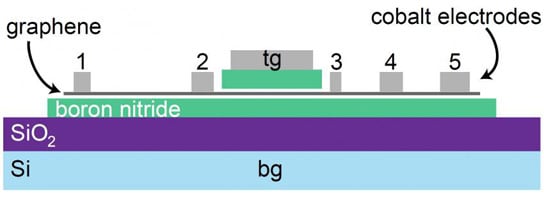
    A schematic side view of the spintronics device. The dark grey graphene flake is protected by boron nitride layers (green). Voltages applied to the bottom electrode (bg) and the top electrode (tg) generate the electric field used for spin manipulation. The cobalt electrodes (numbered 1 to 5) are used to generate and detect spin information. Credit: Foundation for Fundamental Research on Matter

    By isolating the spin information from the influence of the outside world in a nanoscale graphene device, physicists have found a way to preserve spin information for much longer than previously possible.

    Researchers from the FOM Foundation and University of Groningen have found a way to preserve spin information for much longer than previously possible. They isolated the spin information from the influence of the outside world in a nanoscale graphene device, in which they can easily manipulate the information with electric fields. This feature makes their device an attractive candidate for future computer data storage and for logic devices based on spins. The researchers published their results online on August 22, 2014 in Physical Review Letters.

    The nanoscale device consists of a flake of graphene (a one-atom-thick layer of carbon) which is protected from the environment by stacked insulating layers of boron nitride. Electrons inside the graphene carry information: they each have a spin value (up or down), which is determined by the direction of their intrinsic magnetic moment. The spin values can be considered as computer bits, which can be used to transfer or store information.

    A challenge is that electron spins usually lose their values over time (the spin relaxation time), which causes information to be lost. In graphene, this usually takes about 0.2 nanoseconds (one nanosecond is a billionth of a second). However, with their protected device, the researchers managed to increase the spin relaxation time in graphene to more than 2 nanoseconds.
    Physicists Manipulate Spin Information in Graphene with Electric Fields
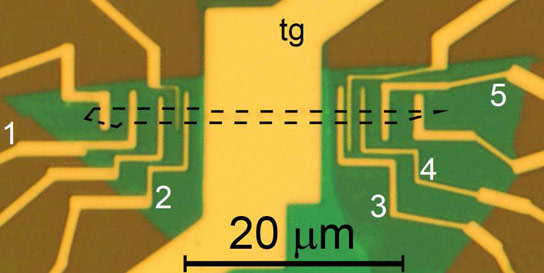
    An optical microscope image of the spintronic device (top view). The top electrode (tg) and cobalt electrodes (1 to 5) are yellow. The boron nitride layers (in green) encapsulate the graphene flake, which is outlined by the dotted line. Credit: Foundation for Fundamental Research on Matter

    Electric fields

    So far, physicists could only change the value of spins in graphene (and therefore the value of the ‘bits’) by using magnetic fields. Using two gate electrodes, the researchers now managed to manipulate the spin information in their device with electric fields instead. Since electric fields are much easier to generate in nanoscale devices, these results pave the way for future spintronic devices based on graphene.

    Spintronics

    In the field of spintronics (which stands for spin and electronics), spin is used to convey information instead of electrical charges. Spin-based devices have lower power consumption and are less volatile when compared to charge-based ones. For this reason spintronic devices have been considered as an alternative to computer components, for instance in memory technologies like M-RAM and STT-RAM.

    Reference: “Controlling Spin Relaxation in Hexagonal BN-Encapsulated Graphene with a Transverse Electric Field” by M. H. D. Guimarães, P. J. Zomer, J. Ingla-Aynés, J. C. Brant, N. Tombros and B. J. van Wees, 22 August 2014, Physical Review Letters.
    DOI: 10.1103/PhysRevLett.113.086602
    arXiv: 1406.4656


    Never miss a breakthrough: Join the SciTechDaily newsletter.
    Follow us on Google and Google News.

    Foundation for Fundamental Research on Matter Graphene Spintronics
    Share. Facebook Twitter Pinterest LinkedIn Email Reddit

    Related Articles

    Major Graphene Breakthrough: Magnet-Free Spin Currents Could Supercharge Quantum Computing

    A Magnetic Twist to Graphene Could Offer a Dramatic Increase in Processing Speeds Compared to Electronics

    Graphene Flagship Paves the Way for New Spintronic Logic Devices

    Electron-Electron Interactions are Critical to Graphene’s Extraordinary Properties

    Exploring Nanotube Growth and a Self-Healing Mechanism

    Graphene Submerged in Electrically Neutral Liquid Sets Mobility Record

    Researchers Discover Electrical Switch for Magnetic Current

    NIST Researches the Use of Switching Mechanisms in Advanced Computer Memory Device

    Physicists Measure Optical and Electronic Behavior of Graphene with Respect to Time

    Leave A Reply Cancel Reply

    • Facebook
    • Twitter
    • Pinterest
    • YouTube

    Don't Miss a Discovery

    Subscribe for the Latest in Science & Tech!

    Trending News

    Mezcal “Worm” in a Bottle Mystery: DNA Testing Reveals a Surprise

    New Research Reveals That Your Morning Coffee Activates an Ancient Longevity Switch

    This Is What Makes You Irresistible to Mosquitoes

    Shockingly Powerful Giant Octopuses Ruled the Seas 100 Million Years Ago

    Scientists Stunned by New Organic Molecules Found on Mars

    Rewriting Dinosaur Evolution: Scientists Unearth Remarkable 150-Million-Year-Old Stegosaur Skull

    Omega-3 Supplements Linked to Cognitive Decline in Surprising New Study

    First-of-Its-Kind Discovery: Homer’s Iliad Found Embedded in a 1,600-Year-Old Egyptian Mummy

    Follow SciTechDaily
    • Facebook
    • Twitter
    • YouTube
    • Pinterest
    • Newsletter
    • RSS
    SciTech News
    • Biology News
    • Chemistry News
    • Earth News
    • Health News
    • Physics News
    • Science News
    • Space News
    • Technology News
    Recent Posts
    • Scientists Map Thousands of Brain Connections With RNA Barcodes
    • This Gene Tweak Turns Strawberries Into Healthier, Tastier Superfruit
    • This New Chip Could Make GPUs Far More Efficient
    • This Tiny World in the Outer Solar System Should Be Airless, but It Has an Atmosphere
    • NASA’s Webb Space Telescope Reveals a Dark Airless Super-Earth That Looks Like Mercury
    Copyright © 1998 - 2026 SciTechDaily. All Rights Reserved.
    • Science News
    • About
    • Contact
    • Editorial Board
    • Privacy Policy
    • Terms of Use

    Type above and press Enter to search. Press Esc to cancel.