

A new global study reveals that ancient carbon, once thought securely stored in soils and rocks, is leaking into the atmosphere via rivers.
For the first time, researchers have confirmed that carbon trapped in landscapes for thousands of years or longer can return to the atmosphere as carbon dioxide escaping from river surfaces.
The study, led by scientists from the University of Bristol and featured as the cover story in Nature, suggests that plants and upper soil layers may be absorbing about one additional gigaton of CO2 annually to balance this release. This highlights an even more critical role for vegetation and soils in slowing climate change.
Lead author Dr Josh Dean, Associate Professor in Biogeochemistry and UKRI Future Leaders Fellow at the University of Bristol, said: “The results took us by surprise because it turns out that old carbon stores are leaking out much more into the atmosphere than previous estimates suggested. The implications are potentially huge for our understanding of global carbon emissions. Plants and trees take up CO2 from the atmosphere and can then lock this carbon away in soils for thousands of years.”
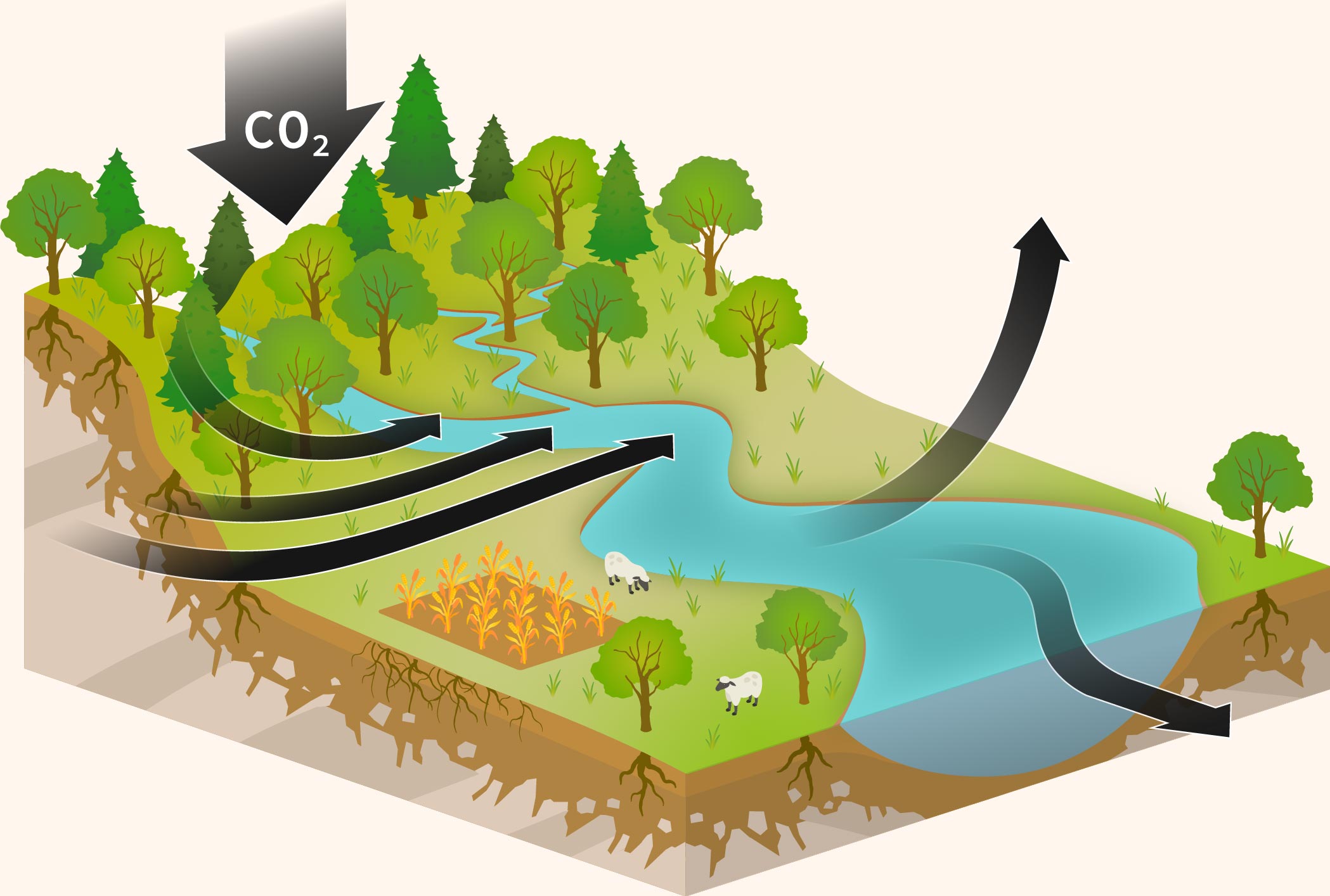
He continues, “Our findings show some of this old carbon, as well as ancient carbon from rocks, is leaking sideways into rivers and making its way back to the atmosphere. We don’t yet know how humans are affecting this flow of ancient carbon, but we do know plants and trees must be taking up more carbon from the atmosphere today to account for this unrecognized release of old carbon.”
Rivers as Ancient Carbon Gateways
Rivers transport and release methane and carbon dioxide as part of the global carbon cycle. Until now, scientists believed the majority of this was a quick turnover derived from the recycling of recent plant growth – organic material broken down and carried into the river system in the past 70 years or so. This new study indicates the opposite, with more than half – some 60% – of emissions being attributed to long-term carbon stores accumulated over hundreds to thousands of years ago, or even longer.
The international research team, led by scientists at the University of Bristol, University of Oxford, and the UK Centre for Ecology and Hydrology, studied more than 700 river reaches from 26 different countries across the world.
They took detailed radiocarbon measurements of carbon dioxide and methane from the rivers. By comparing the levels of carbon-14 in the river samples with a standard reference for modern atmospheric CO2, the team was able to date the river carbon.
Ancient Origins Confirmed
Co-author Prof Bob Hilton, Professor of Sedimentary Geography at the University of Oxford, explained: “We discovered that around half of the emissions are young, while the other half are much older, released from deep soil layers and rock weathering that were formed thousands and even millions of years ago.”
Co-author Dr Gemma Coxon, Associate Professor in Hydrology and UKRI Future Leaders Fellow at the University of Bristol, said: “Rivers globally release about two gigatons of carbon each year, compared to human activity that results in between 10-15 gigatons of carbon emissions. These river emissions are significant at a global scale, and we’re showing that over half of these emissions may be coming from carbon stores we considered relatively stable. This means we need to re-evaluate these crucial parts of the global carbon cycle.”
Further building on these findings, the researchers plan to explore how the age of river carbon emissions varies across rivers the study was not able to capture, as well as investigating how the age of these emissions may have changed through time.
Reference: “Old carbon routed from land to the atmosphere by global river systems” by Joshua F. Dean, Gemma Coxon, Yanchen Zheng, Jack Bishop, Mark H. Garnett, David Bastviken, Valier Galy, Robert G. M. Spencer, Suzanne E. Tank, Edward T. Tipper, Jorien E. Vonk, Marcus B. Wallin, Liwei Zhang, Chris D. Evans and Robert G. Hilton, 4 June 2025, Nature.
DOI: 10.1038/s41586-025-09023-w
The research was supported by funding from UK Research and Innovation (UKRI) Natural Environment Research Council (NERC).
Never miss a breakthrough: Join the SciTechDaily newsletter.
Follow us on Google and Google News.
9 Comments
This isn’t really news. It has been known for some time. The PBS TV series NOVA even had a special on Arctic methane a few years ago.
One very telling line in this article, “We don’t yet know how humans are affecting this flow of ancient carbon” encapsulates the stupidity of the climate cult.
Yep
Their first reaction is “How do we blame this on humans” From the picture, it doesn’t look like many humans are around.
Reminiscent of when scientists found the hole in the ozone layer. They saw it, and immediately thought it was a problem. Pseudoscience at best. This is the same thing. If this carbon is leaching into the atmosphere, it’s probably a natural process that has nothing to do with human activity.
Shocker the Earth is heading into another iceage. Just as expected. Milankovitch cycles do what they do.
Earth was much warmer. Sea levels lower and the trend will continue long after humans have been wiped out, just like the dinosaurs before them. 2032 Asteroid is on track to wipe out much of the population.
A lot of this you are talking about have been happening for millions of years so why the scare tactics on climate change when it’s a known fact that volcanos pollutes the planet and atmosphere more than cars and industry ever will but nobody ever blames volcanos it’s always what humans are doing just a money grabbing theft climate change the religion of the stupid minded
Climate Change and Global Warming are FAKE !
Proof: cvhoax.wixsite.com/mysite
Carbon Dioxide Fertilization Greening Earth, Study Finds
https://www.nasa.gov/centers-and-facilities/goddard/carbon-dioxide-fertilization-greening-earth-study-finds/