
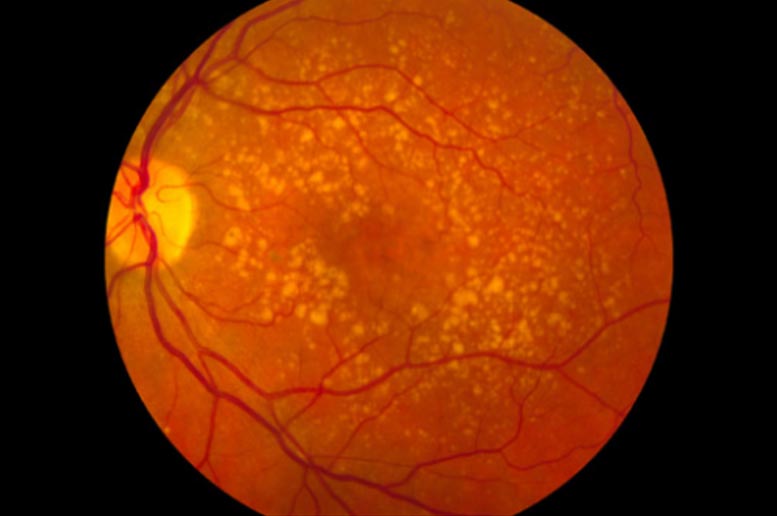
A team of scientists, including researchers from Queen Mary University of London, has discovered that the most common form of adult blindness is probably caused by a failure of at least one of five proteins to regulate the immune system.
The findings could one day herald the development of transformative treatments for developing age-related macular degeneration (AMD), which affects 600,000 people in the UK alone.
A test to determine which patients are at risk of developing the disease could also emerge, as the team estimate that 40-50 percent of patients have elevated levels of at least one of the five proteins, although more work still needs to be done.
The research, funded by Medical Research Council and a collaboration between scientists in London, Manchester, and Tübingen in Germany, is published today in the American Journal of Human Genetics.
The Role of Inflammation in Blindness
Scientists have long known that inflammation at the back of the eye plays a role in AMD development. A series of genes thought to regulate our immune defense against pathogens were identified in previous research as candidates that affect a person’s risk of developing the disease.
However, until now the role of these genes – Complement Factor H (CFH) and Complement Factor H-Related 1 to 5 (CFHR-1 to CFHR-5) – has been unclear.
But by studying the levels of the products of these genes in 604 blood plasma samples, the team was able to show for the first time that all five FHR proteins are at higher levels in people with AMD than in those without.
Part of the innate immune system, the complement pathway is our first line of defense against infections and clears damaged cells by marking them for destruction and recruiting and activating other immune cells. In AMD, the complement pathway is over-activated in the back of the eye, promoting an inappropriate and damaging inflammatory response.
‘A Hugely Important Study’
Dr. Valentina Cipriani, Lecturer in Statistical Genomics at Queen Mary’s William Harvey Research Institute, who led the data analysis, said: “For more than 15 years the focus for AMD has been on Complement Factor H and its protein FH. Our analysis clearly points beyond FH. By using an approach called a genome-wide association study that looks at genetic variants across the genomes of people with and without the disease, we were able to identify genetic variants that determine both higher FHR protein levels and increased risk of AMD.”
Dr. Richard Unwin from The University of Manchester’s Stoller Biomarker Discovery Centre said: “This is a hugely important study for people with AMD. Measuring the levels of these FHR proteins has been a big challenge over the last few years and is technically quite challenging as they are present at low levels in the blood and are very similar to each other.
“By using state-of-the-art mass spectrometry methods we can now confidently measure these proteins and show for the first time what is an important, if not the most important, factor in how AMD develops.
“It’s important to stress that studies over time need to be carried out before we can say with authority that these proteins are able to predict risk – and that will take time.”
Reference: “Beyond factor H: The impact of genetic-risk variants for age-related macular degeneration on circulating factor-H-like 1 and factor-H-related protein concentrations” by Valentina Cipriani, Anna Tierney, John R. Griffiths, Verena Zuber, Panagiotis I. Sergouniotis, John R.W. Yates, Anthony T. Moore, Paul N. Bishop, Simon J. Clark and Richard D. Unwin, 13 July 2021, American Journal of Human Genetics.
DOI: 10.1016/j.ajhg.2021.05.015
Never miss a breakthrough: Join the SciTechDaily newsletter.
Follow us on Google and Google News.