
Close Menu
    Facebook X (Twitter) Instagram
    SciTechDaily
    • Biology
    • Chemistry
    • Earth
    • Health
    • Physics
    • Science
    • Space
    • Technology
    Facebook X (Twitter) Pinterest YouTube RSS
    SciTechDaily
    Home»Physics»Quantifying Quantumness: A Mathematical Project of “Immense Beauty”
    Physics

    Quantifying Quantumness: A Mathematical Project of “Immense Beauty”

    By American Institute of PhysicsNovember 22, 20202 Comments3 Mins Read
    Facebook Twitter Pinterest Telegram LinkedIn WhatsApp Email Reddit
    Share
    Facebook Twitter LinkedIn Pinterest Telegram Email Reddit
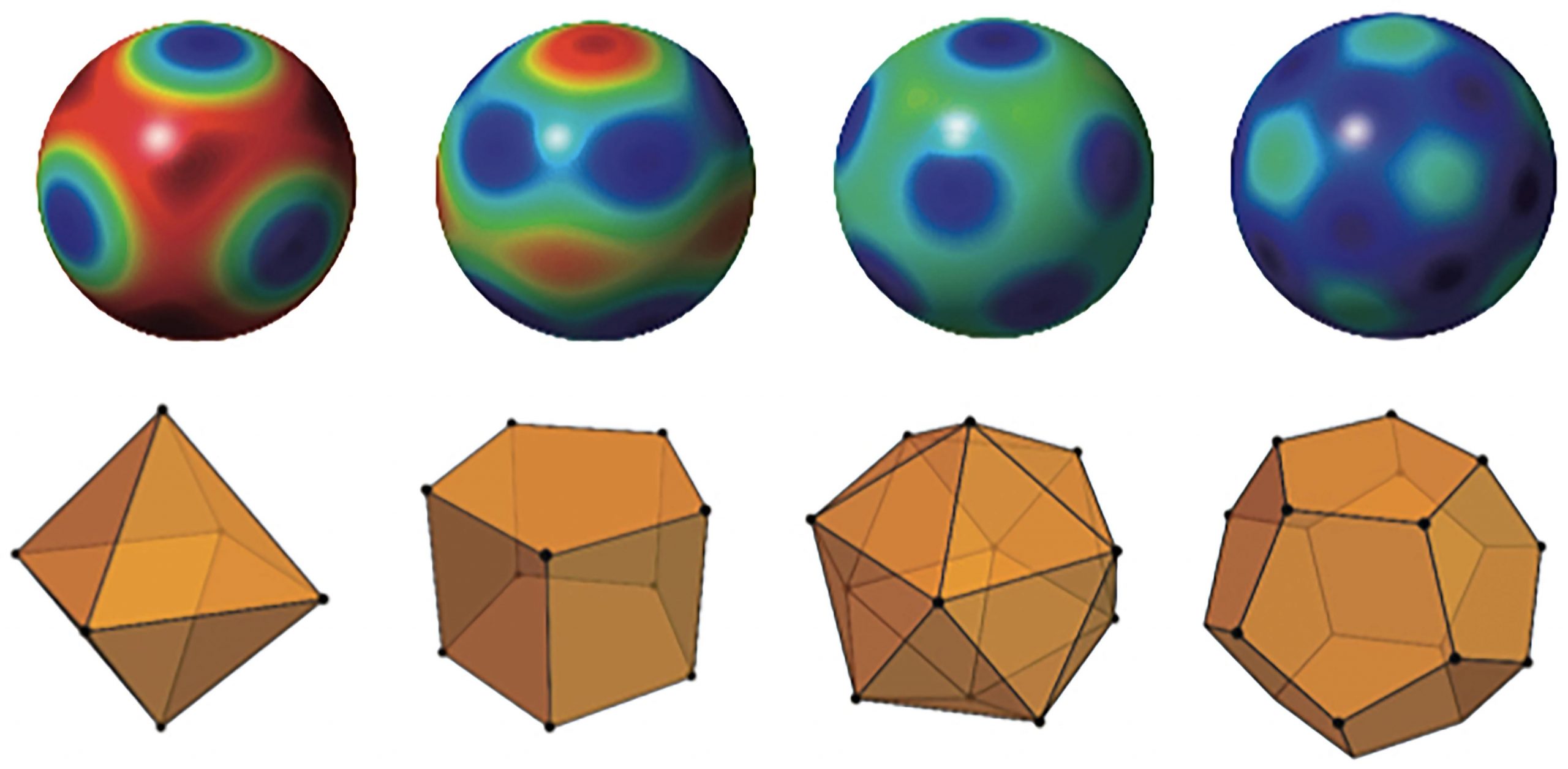
    Majorana Constellations
    Majorana constellations of some of the most quantum states in various dimensions. Credit: Luis L. Sánchez Soto

    Investigators develop a method to determine how quantum the state of a system is.

    Large objects, such as baseballs, vehicles, and planets, behave in accordance with the classical laws of mechanics formulated by Sir Isaac Newton. Small ones, such as atoms and subatomic particles, are governed by quantum mechanics, where an object can behave as both a wave and a particle.

    The boundary between the classical and quantum realms has always been of great interest. Research reported in AVS Quantum Science, by AIP Publishing, considers the question of what makes something “more quantum” than another — is there a way to characterize “quantumness?” The authors report they have found a way to do just that.

    The degree of quantumness is important for applications such as quantum computing and quantum sensing, which offer advantages that are not found in their classical counterparts. Understanding these advantages requires, in turn, an understanding of the degree of quantumness of the physical systems involved.

    Rather than proposing a scale whose values would be associated with the degree of quantumness, the authors of this study look at extrema, namely those states that are either the most quantum or the least quantum. Author Luis Sanchez-Soto said the idea for the study came from a question posed at a scientific meeting.

    “I was giving a seminar on this topic when someone asked me the question: ‘You guys in quantum optics always talk about the most classical states, but what about the most quantum states?'” he said.

    It has long been understood that so-called coherent states can be described as quasi-classical. Coherent states occur, for example, in a laser, where light from multiple photon sources are in phase making them the least quantum of states.

    A quantum system can often be represented mathematically by points on a sphere. This type of representation is called a Majorana constellation, and for coherent states, the constellation is simply a single point. Since these are the least quantum of states, the most quantum ones would have constellations that cover more of the sphere.

    The investigators looked at several ways that other scientists have explored quantumness and considered the Majorana constellation for each way. They then asked what the most evenly distributed set of points on a sphere for this approach is.

    As Sanchez-Soto and his colleagues considered the question of quantumness, they realized it was a mathematical project “of immense beauty,” in addition to being useful.

    Reference: “Extremal quantum states” by Aaron Z. Goldberg, Andrei B. Klimov, Markus Grassl, Gerd Leuchs and Luis L. Sánchez-Soto, 17 November 2020, AVS Quantum Science.
    DOI: 10.1116/5.0025819

    Never miss a breakthrough: Join the SciTechDaily newsletter.
    Follow us on Google and Google News.

    American Institute of Physics Mathematics Nanotechnology Quantum Physics
    Share. Facebook Twitter Pinterest LinkedIn Email Reddit

    Related Articles

    “Proximity Magnetism” Could Be a Building Block for Quantum Computers

    Physicists Demonstrate Control of a Two-Qubit System

    Researchers Track Interactions Between Individual DNA Molecule Segments

    Superabsorption Can Be Achieved and Sustained in Simple Nanostructures

    New Quantum Dots Design for Solotronics

    Breakthrough in Quantum Cryptography Demonstrates “Perfectly Secure” Bit Commitment

    PEPs Might Make Quantum Condensation Possible at Room Temperature

    Scientists Reveal Quantum Behavior in Fluid Dynamics

    “Schrödinger’s Hat” Conceals Matter Waves Inside an Invisible Container

    2 Comments

    1. xABBAAA on November 24, 2020 6:06 am

      “Small ones, such as atoms and subatomic particles, are governed by quantum mechanics, where an object can behave as both a wave and a particle.”
      Yes, that is well known thing, but why? … And how that is affecting the equations, …

      Reply
    2. Second distribution stability on November 24, 2020 8:39 pm

      We are effect bilions years of evolution of stars,we are the second generation, it means everything already did the circle. And now we are. Think of compexity as evolution.

      Reply
    Leave A Reply Cancel Reply

    • Facebook
    • Twitter
    • Pinterest
    • YouTube

    Don't Miss a Discovery

    Subscribe for the Latest in Science & Tech!

    Trending News

    Scientists Discover Cheap, Natural Remedy for High Blood Pressure

    Earth’s Upper Atmosphere Is Cooling Fast and Scientists Finally Know Why

    32,000 Olympic Pools of Magma Nearly Erupted Beneath Atlantic Island

    Exercise Changes the Heart in a Way Researchers Never Expected

    Too Much Sleep May Age Your Body Faster, New Study Warns

    Scientists Uncover Promising New Strategy To Stop Parkinson’s in Its Tracks

    Experts Reveal the Surprising Cancer Link Behind a Common Vitamin

    This Strange “Golden Orb” Found 2 Miles Deep Stumped Scientists for Years

    Follow SciTechDaily
    • Facebook
    • Twitter
    • YouTube
    • Pinterest
    • Newsletter
    • RSS
    SciTech News
    • Biology News
    • Chemistry News
    • Earth News
    • Health News
    • Physics News
    • Science News
    • Space News
    • Technology News
    Recent Posts
    • Massive Genetic Study Reveals Hidden Causes of Pregnancy Sickness
    • Scientists Discover Surprising Way Cranberry Juice Could Fight Antibiotic Resistance
    • Researchers Discover the Body’s Hidden “Off Switch” for Inflammation
    • Scientists Discover Metformin Doesn’t Work the Way We Thought
    • Tea or Coffee? Your Daily Choice Could Affect Osteoporosis Risk
    Copyright © 1998 - 2026 SciTechDaily. All Rights Reserved.
    • Science News
    • About
    • Contact
    • Editorial Board
    • Privacy Policy
    • Terms of Use

    Type above and press Enter to search. Press Esc to cancel.