

By blending digital control with analog simulations, scientists have created a powerful new quantum simulator that pushes beyond traditional limitations.
This hybrid system allows precise manipulation of quantum states while naturally modeling real-world physics, enabling breakthroughs in fields like magnetism, superconductors, and even astrophysics.
Breakthrough in Quantum Simulation
Physicists working in Google’s laboratory have developed a new type of digital-analog quantum simulator, capable of studying complex physical processes with unprecedented precision and adaptability. Two researchers from PSI’s Center for Scientific Computing, Theory, and Data played a crucial role in this breakthrough.
Consider the simple act of pouring cold milk into hot coffee — how does it spread and mix? Even the most advanced supercomputers struggle to model this process with high accuracy because the underlying quantum mechanics are incredibly complex. In 1982, Nobel Prize-winning physicist Richard Feynman proposed an alternative: instead of using classical computers, why not build quantum computers that can directly simulate quantum physical processes? Now, with rapid advancements in quantum computing, Feynman’s vision is closer than ever to becoming reality.
A Milestone in Quantum Computing
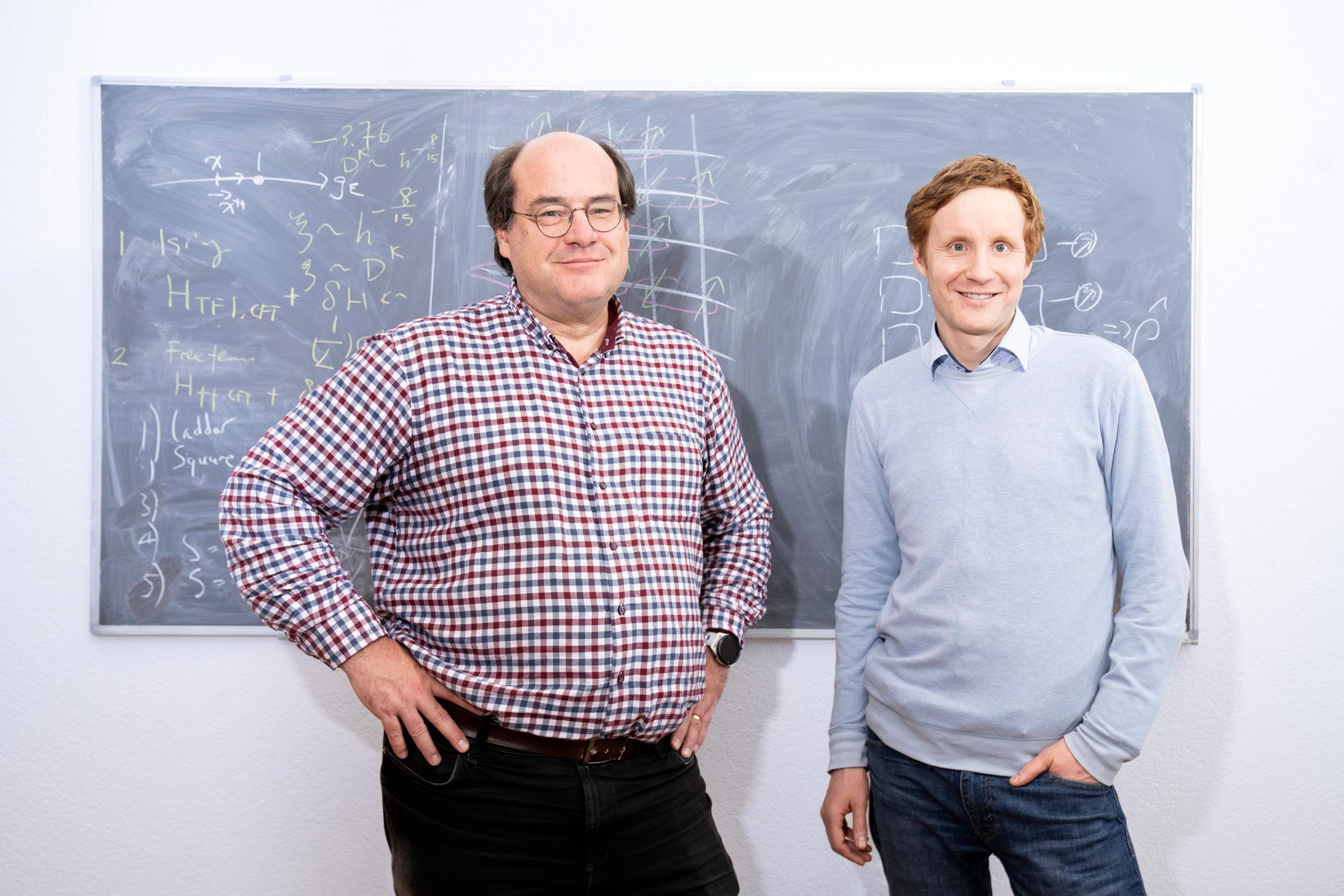
Together with researchers from Google and universities in five countries, Andreas Läuchli and Andreas Elben, two theoretical physicists at PSI, have built and successfully tested a new type of digital-analog quantum simulator. This represents a milestone because their simulator calculates physical processes not only with unprecedented precision; their concept is also particularly flexible, meaning that it can be applied to many different problems – from solid-state physics to astrophysics. Their findings were published today in the renowned scientific journal Nature.
Combining Analog and Digital
A key aspect of the new quantum processor is that the 69 superconducting quantum bits (qubits) on the quantum chip developed by Google permit both digital and analog operating modes. Digital quantum computers perform their operations using universal quantum gates, similar to the logic gates in classical computers. The difference is that, thanks to quantum mechanical superposition, qubits can not only assume the states 0 and 1 but also a multitude of intermediate states.
Although such purely digital quantum computers are already very powerful, their potential as quantum simulators is still limited. Analog quantum simulators, on the other hand, rely on the direct simulation of physical processes, realistically modeling the interactions between the different particles, for example to study magnetic properties in solids. These two approaches – digital and analog – have now been successfully combined for the first time in an experiment that brings together the strengths of both worlds.
Simulating Complex Physical Processes
To do this, the physicists define discrete initial conditions, such as introducing heat into a solid – this is the digital mode. This allows the starting conditions to be defined precisely and flexibly. In the coffee-cup analogy, for example, this would be a milk jug pouring drops of milk in a specified and controlled manner in a hundred different places, all at the same time. The subsequent process by which the milk spreads out in the coffee corresponds to the analog mode. The interaction between the qubits simulates the physical dynamics, such as heat propagation or the formation of magnetic domains, as they occur in real solids.
“We can watch the quantum simulator as it reaches thermal equilibrium – or in the coffee analogy: the milk is distributed in the coffee and the temperature is equalized in the process,” says Andreas Elben, a tenure-track scientist at PSI. “Our research demonstrates that it is possible to create superconducting analog-digital quantum processors on a chip and that these are suitable as quantum simulators,” Andreas Läuchli points out.
Heading Towards a Universal Quantum Simulator
However, thermalization – the process of reaching thermal equilibrium – is just one of many exciting questions that can be answered using the new quantum simulator. The concept demonstrated here paves the way for a universal quantum simulator and is to be used in a wide range of different areas of physics. It extends beyond the capabilities of existing analog quantum simulators, each of which is only suitable for a specific physical problem.
One topic that can be studied in this way is magnetism, Läuchli’s speciality. The qubits in Google’s quantum chip are arranged in the shape of a rectangle, and in the initial state the directions of their magnetic fields alternate strictly. But what happens if the chip is triangular? This could disrupt the tidy arrangement because the qubits are unable to adjust their magnetic orientation in the regular pattern they naturally adopt. This phenomenon is known as frustrated magnetism and is of interest, for example, in connection with computer chips that switch and store bits based not on the charge of the electrons but on their magnetic spins. This leads to a much higher memory density and a higher computational speed.
Expanding Applications: From Superconductors to Black Holes
Further applications are opening up in the development of new materials, such as high-temperature superconductors, and even medicines that can be used more precisely and cause fewer side effects. Quantum simulators are even in demand in astrophysics. One example is the so-called information paradox, which states that no information may be lost in quantum physics. However, astrophysicists believe that black holes do in fact destroy information about their formation – new types of quantum simulators might clarify the situation.
The Future of Quantum Simulators
“Our quantum simulator opens the door to new research,” promises Andreas Läuchli. Although the project with Google has come to an end, many other physical questions await him and his team at PSI. At the Quantum Computing Hub of ETHZ and PSI and beyond, quantum computers and quantum simulators are being developed on various technological platforms, including trapped ions, superconducting qubits, and Rydberg atoms. These systems will soon make it possible to study exciting questions posed by quantum physics at PSI.
Andreas Läuchli: “We also serve as a source of ideas for new experiments at PSI’s large research facilities. And we offer our support to researchers carrying out their experiments at the facilities when it comes to interpreting surprising results. And in the future, we will increasingly be using quantum simulators for this purpose.”
Reference: “Thermalization and criticality on an analogue–digital quantum simulator” by T. I. Andersen, N. Astrakhantsev, A. H. Karamlou, J. Berndtsson, J. Motruk, A. Szasz, J. A. Gross, A. Schuckert, T. Westerhout, Y. Zhang, E. Forati, D. Rossi, B. Kobrin, A. Di Paolo, A. R. Klots, I. Drozdov, V. Kurilovich, A. Petukhov, L. B. Ioffe, A. Elben, A. Rath, V. Vitale, B. Vermersch, R. Acharya, L. A. Beni, K. Anderson, M. Ansmann, F. Arute, K. Arya, A. Asfaw, J. Atalaya, B. Ballard, J. C. Bardin, A. Bengtsson, A. Bilmes, G. Bortoli, A. Bourassa, J. Bovaird, L. Brill, M. Broughton, D. A. Browne, B. Buchea, B. B. Buckley, D. A. Buell, T. Burger, B. Burkett, N. Bushnell, A. Cabrera, J. Campero, H.-S. Chang, Z. Chen, B. Chiaro, J. Claes, A. Y. Cleland, J. Cogan, R. Collins, P. Conner, W. Courtney, A. L. Crook, S. Das, D. M. Debroy, L. De Lorenzo, A. Del Toro Barba, S. Demura, P. Donohoe, A. Dunsworth, C. Earle, A. Eickbusch, A. M. Elbag, M. Elzouka, C. Erickson, L. Faoro, R. Fatemi, V. S. Ferreira, L. Flores Burgos, A. G. Fowler, B. Foxen, S. Ganjam, R. Gasca, W. Giang, C. Gidney, D. Gilboa, M. Giustina, R. Gosula, A. Grajales Dau, D. Graumann, A. Greene, S. Habegger, M. C. Hamilton, M. Hansen, M. P. Harrigan, S. D. Harrington, S. Heslin, P. Heu, G. Hill, M. R. Hoffmann, H.-Y. Huang, T. Huang, A. Huff, W. J. Huggins, S. V. Isakov, E. Jeffrey, Z. Jiang, C. Jones, S. Jordan, C. Joshi, P. Juhas, D. Kafri, H. Kang, K. Kechedzhi, T. Khaire, T. Khattar, M. Khezri, M. Kieferová, S. Kim, A. Kitaev, P. Klimov, A. N. Korotkov, F. Kostritsa, J. M. Kreikebaum, D. Landhuis, B. W. Langley, P. Laptev, K.-M. Lau, L. Le Guevel, J. Ledford, J. Lee, K. W. Lee, Y. D. Lensky, B. J. Lester, W. Y. Li, A. T. Lill, W. Liu, W. P. Livingston, A. Locharla, D. Lundahl, A. Lunt, S. Madhuk, A. Maloney, S. Mandrà, L. S. Martin, O. Martin, S. Martin, C. Maxfield, J. R. McClean, M. McEwen, S. Meeks, K. C. Miao, A. Mieszala, S. Molina, S. Montazeri, A. Morvan, R. Movassagh, C. Neill, A. Nersisyan, M. Newman, A. Nguyen, M. Nguyen, C.-H. Ni, M. Y. Niu, W. D. Oliver, K. Ottosson, A. Pizzuto, R. Potter, O. Pritchard, L. P. Pryadko, C. Quintana, M. J. Reagor, D. M. Rhodes, G. Roberts, C. Rocque, E. Rosenberg, N. C. Rubin, N. Saei, K. Sankaragomathi, K. J. Satzinger, H. F. Schurkus, C. Schuster, M. J. Shearn, A. Shorter, N. Shutty, V. Shvarts, V. Sivak, J. Skruzny, S. Small, W. Clarke Smith, S. Springer, G. Sterling, J. Suchard, M. Szalay, A. Sztein, D. Thor, A. Torres, M. M. Torunbalci, A. Vaishnav, S. Vdovichev, B. Villalonga, C. Vollgraff Heidweiller, S. Waltman, S. X. Wang, T. White, K. Wong, B. W. K. Woo, C. Xing, Z. Jamie Yao, P. Yeh, B. Ying, J. Yoo, N. Yosri, G. Young, A. Zalcman, N. Zhu, N. Zobrist, H. Neven, R. Babbush, S. Boixo, J. Hilton, E. Lucero, A. Megrant, J. Kelly, Y. Chen, V. Smelyanskiy, G. Vidal, P. Roushan, A. M. Läuchli, D. A. Abanin and X. Mi, 5 February 2025, Nature.
DOI: 10.1038/s41586-024-08460-3
Never miss a breakthrough: Join the SciTechDaily newsletter.
Follow us on Google and Google News.
17 Comments
One example is the so-called information paradox, which states that no information may be lost in quantum physics. However, astrophysicists believe that black holes do in fact destroy information about their formation.
Ask the researchers:
Why are there so many information paradoxes in physics?
Scientific research guided by correct theories can enable researchers to think more.
According to the Topological Vortex Theory (TVT), spins create everything, spins shape the world. There are substantial distinctions between Topological Vortex Theory (TVT) and traditional physical theories. Grounded in the inviscid and absolutely incompressible spaces, TVT introduces the concept of topological phase transitions and employs topological principles to elucidate the formation and evolution of matter in the universe, as well as the impact of interactions between topological vortices and anti-vortices on spacetime dynamics and thermodynamics.
Within TVT, low-dimensional spacetime matter serves as the foundation for high-dimensional spacetime matter, and the hierarchical structure of matter and its interaction mechanisms challenge conventional macroscopic and microscopic interpretations. The conflict between Quantum Physics and Classical Physics can be attributed to their differing focuses: Quantum Physics emphasizes low-dimensional spacetime matter, whereas Classical Physics centers on high-dimensional spacetime matter.
Subatomic particles in the quantum world often defy the familiar rules of the physical world. The fact repeatedly suggests that the familiar rules of the physical world are pseudoscience. In the familiar rules of the physical world, two sets of cobalt-60 can form the mirror image of each other by rotating in opposite directions, and should receive the Nobel Prize for physics.
Please witness the grand performance of some so-called peer review publications (including PRL, PNAS, Nature, Science, etc.). https://scitechdaily.com/microscope-spacecrafts-most-precise-test-of-key-component-of-the-theory-of-general-relativity/#comment-854286. Some so-called academic publications (including PRL, PNAS, Nature, Science, etc.) are addicted to their own small circles and have deviated from science for a long time.
As the background of various material interactions and movements, space exhibits inviscid, absolutely incompressible and isotropic physical characteristics. It may form various forms of spacetime vortices through topological phase transitions. Hence, vortex phenomena are ubiquitous in cosmic space, from vortices of quantum particles and living cells to tornados and black holes. Stars and radioactive elements are one of the most active topological nodes in spacetime. Utilizing them is more valuable and meaningful than simulating them. Small or micro power topology intelligent batteries may be the direction of future energy research and development for human society.
Under the topological vortex architecture, science and pseudoscience are clear at a glance. Topological Vortex Theory (TVT) can play a crucial role in elucidating the foundations of physics, establishing its principles, and combating pseudoscience. Therefore, TVT has been strongly opposed and boycotted by traditional so-called peer review publications (such as PRL, PNAS, Nature, Science, etc.).
These so-called peer review publications (including PRL, PNAS, Nature, Science, etc.) mislead the direction of science and are known for their various absurdities and wonders. They collude together, reference each other, and use so-called Impact Factor (IF) or the Nobel Prize to deceive people around.
Ask the so-called peer review publications (including PRL, PNAS, Nature, Science, etc.):
1. What are your criteria for distinguishing science from pseudoscience?
2. Is your Impact Factor (IF) the standard for distinguishing science from pseudoscience?
3. Is the Nobel Prize the standard for distinguishing science from pseudoscience?
4. What is the most important aspect of academic publications?
5. Is the most important aspect of academic publications being flashy and impractical articles?
Pseudo academic publications (including PRL, PNAS, Nature, Science, etc.) are neither inclusivity nor openness, nor transparency and fairness, and have already had a serious negative impact on the progress of science and technology. Some so-called peer review publications (including PRL, PNAS, Nature, Science, etc.) are addicted to their own small circle and no longer know what science is. They hardly know what is dirty and ugly.
Publications that mislead the public under the guise of scholarship are more reprehensible than ordinary publications. The field of physics faces an ongoing challenge in maintaining scientific rigor and integrity in the face of pervasive pseudoscientific claims. Fighting against rampant pseudoscience, physics still has a long way to go.
While my comments may be lengthy, they are necessary to combat the proliferation of rampant pseudoscience and to promote the advancement of science and technology, and also is all I can do.
Appreciate the SciTechDaily for its inclusivity, openness, transparency, and fairness. If the researchers are truly interested in Universe, please read: A Brief History of the Evolution of Cosmic Matter (https://scitechdaily.com/microscope-spacecrafts-most-precise-test-of-key-component-of-the-theory-of-general-relativity/#comment-873523).
Here’s something you will think is ignorant. There was no initial super dense object. All energy/matter was present in the same coordinate except beside each other. Because they didn’t have mass. So space was literally just 0x0y0z axis everything was by itself at that position. Pure energy with no mass does what all by itself? Speed around in a universe the exact same size as the energy itself? Since it has no mass it occupies no space right? And with no mass or can occupy the same space as something’s else with no mass. You can have an infinite units of individual energy all in the same place. But the. God created light. He looked upon it, and by observing it entangled it to reality, the entanglements of his observations is called the higgs field. It instantly gave everything mass. Suddenly everything’s was all trying to share the same tiny spacial volume all at once but had mass. We know what happens when something tries to pack electrons tighter than they like to be. The violently repel. And so all that energy/matter had to suddenly fluff itself out in order to be acceptable to laws of physics. That is your big bang. God knows everything because he entangled every single shlepton all at once, so he knows their spin and color and attitude etc he has the capacity to forecast their interactions allowing him to accurately forecast existence from the begging to end. The Bible sounds stupid because some primitive Jewish guy was shown a vision of what actually happened and he lacks the capacity to fully comprehend what he observed and his language lacked the vocabulary to accurately describe what he observed in a way that would be relatable to a slave 6000 years ago. So he has to paraphrasing in terms that were relevant in that era. Days means passages of time. Not actual 24 hour periods, there wherever even planets at the start so a “day” is effective meaningless at that point. Or just means an era, or a period of time distinct from the next. The many worlds theory is almost correct but it’s backwards. Initially there were infinite alternate potential realities, but as choices were made by free will opportunies became no longer fulfillable. So as quantum superpositions become locked and entangles to reality, any universe that doesn’t follow that configurations suffers a wave function collapse, effectively being uncreated because it can no longer be fulfilled. It lost its opportunity. So then alternate realities are being shaved off of the remaining bundle of timelines at a exponential rate. Eventually the very last few willed entity will make the very last choice and at that time every reality except for the one that was fulfilled because it matched all the observed configuration, will have collapsed. Leaving only the one timeline that is true from begining to end. So it will retroactively validate itself as the predetermined destiny that cause and effect suggests. But which configuration was the right one all along depends on the choices made by every single free willed entity. The only one that survives will be the one that matched every single choice you made and every single choice I made and every choice of every one exactly. Some things are so inevitable that no matter what dimension turns out to be the right one, there will be things they all have In common. We don’t know exactly how or why it will occur. But there is no remaining timeline in which it doesn’t happen. Yep. That’s existence for you. It’s an extension of God’s will that allows us to be creators of a reality by applying our wills to it cumulatively. He purposely avoids detection in order to prevent us from being locked into a narrow set of timelines. Because things behave differently if they are actively observed. We are an extension of him, a randomizer to introduce novelty to a system so it’s not so strictly predetermined. The burden of proof is not on me. There is no burden of proof you can’t even prove this isn’t a simulation, so so don’t wag your finger at me like you know better. You don’t. Ohh and black holes don’t destroy data that’s stupid. They archive data. God probably exists within them. The time dilation is the difference in experience between our size and his size. Like how microorganisms experience time differently than we do. He’s the same way but to the opposite extreme. Gravity wouldn’t work on something that had absolutely no mass. Energy has mass. .
Luckily a short time after reading this we all died. But every universe in which I didn’t write it collapsed it’s wave function, so lucky for you I wrote it or else the you that is you wouldn’t exist because his whole reality wouldn’t exist. Your welcome.
So glad to see the schizophrenic deity-praisers are partaking in quantum computing papers. Exactly what we need in science!! More sky daddy!!!
Aziz! More light. Fifth Element.
You are using evidences to demonstrate that some so-called peer review publications (including PRL, PNAS, Nature, Science, etc.) have a shocking and chilling impact on public scientific literacy.
@Hteaven sawking
Empty or non-existent, more inclined towards a philosophical concept or thinking. It is not the same concept as the space studied in physics. Physics studies the physical properties and evolution of inviscid, incompressible, and isotropic spaces.
Do you realize, the future will look at you and wonder how otherwise intelligent people can simply overlook what’s right in front of them? That this is how you forge your reputation and epitaph? The first thing you should ask: “What’s wrong with this picture?”
And yes, all your little peer group will not want the cosmology they’re invested in, thrown off. Even though that is exactly what they’re supposed to hope for.
In the vast universe, everyone and everything is insignificant stardust, like shooting stars crossing the night sky. Thank you for your browsing and understanding. Thank you for your insightful advice on social reality. Appreciate the SciTechDaily for its inclusivity, openness, transparency, and fairness. After the vicissitudes of life, no need for an epitaph, perhaps the SciTechDaily can leave traces of shooting stars, or return to the silence of spacetime background with human society.
Throughout the vicissitudes of life, no epitaph is required. Perhaps SciTechDaily can remember the marks of shooting stars and the transient probable profound impact of this moment, or it may silently dissolve into the quietude of the spacetime background, alongside the tapestry of human civilization.
The cradle rocks above an abyss, and common sense tells us that our existence is but a brief crack of light between two eternities of darkness
Seems unimaginable, but extremely exciting, how superposition allows us to exist in more than one space. To think how we, as humans could exist identically in infinite numbers of space and dimensions at the same time, with each experiencing every different possibility that could happen throughout life, and you could travel between them to make the best outcome. How we could potentially be able to manipulate, observe and experience each one in space however we wish. Quantum computing will discover why we are here and it’s absolutely gonna be a game changer in every field. Also, I feel like humans are comparable to a quantum supercomputer, when I do anything, I imagine every realistic possibility that could occur in physical space and I narrow it down to the very greatest possibility, and if people are involved, I do the same thing, however, I for some reason am able to feel others emotions powerfully when I interact with them. This helps me to understand their emotions, movements, what they are doing in every moment and break down every possible scenario the individual could experience down to the emotion. I continue to break that down were feel like I enter their thoughts to the point I can hear them in my head. Oftentimes I can even determine what they are going to say and even lead them to say things that I have already predicted in my mind. I do this very quickly, as if everything has happened already. This is why I have become so fascinated with quantum theories, it’s helping me to see that I am not crazy or mad like so many people think, I just understand things differently. Having said all that, I theorize that human beings are eerily similar to a quantum computer, A very low-emissions, self sustaining, highly efficient, biological quantum supercomputer. An incredibly remarkable creation by my very good friend, God.
GOOD!
You have said quantum so many times. Please consider: Do you understand the physical reality of quantum? Quantum mechanics is mathematics. Where is the intersection between mathematics and the real physical world? Is geometry a physical reality? Is topological vortex a geometric shape?
Inviscid, incompressible, and isotropic space forms the fundamental framework and provides the contextual background against which all things in the universe move and evolve. Quantum mechanics or relativity discuss the rotation, entanglement, or interaction of topological vortices from different perspectives. Topological spins create everything and shape the world, not God.
Lol I would have to agree with the hteven sawking guy. The funny thing about the atheist religion is how severely it has to ignore it’s own logic in order to try to justify itself. Atheist’s are the most faithful, blind worshiping folks you will ever meet. Newton, Galileo, Einstein, Planck, these men are the ones you place your blind faith in. And if someone said they were just completely wrong about their theories you would rigorously defend them. Yet each of those men believed in God, but in that regard you think your smarter than they are…. You have never physically seen an atomic bomb in person, but you believe in them. Everything you base your understanding of the world in, you take on Faith. Your favorite argument is that if there is a God then the burden is on the one who believes to prove, bit that’s a complete copout and should be regarded as an admittance to hypocrisy. If you The truly applying the scientific method and rationality to your beliefs, then it should be obvious that atheism is statistically less likely to be valid. Let’s say there is a 50/50 if God exists or not. Since he can’t be proven or disproven. Knowing that when something is observed it changes the behavior of the subject, so we prefer to observe things without their being aware of our scrutiny? Of course we do. Because we want to see what they do when no one is looking. There is a possibility that God recognizes the same concept. Like he’s aware that if he was a giant sky daddy head in place of the sun, that it would prevent us from using our free will because we would be certain we were always under scrutiny. So even if that’s a 1% possiblity that God would grasp a simple concept like that, the it’s already more likely God exists 51/49%. Now what if you believe In the many worlds theory? Wouldn’t that mean that on one of the worlds, there would have evolved a complex intelligence that had no physical form, and that that entity could have the ability to reach into multiple dimensions? So if many worlds is true, then there must be a God created in it’s infinite variations, and that variation of God would have to be capable of consolidating himself throughout all parallel realities. The probably of multiverse is accepted as 50% and if multiverse is true it would spawn God. So 76% for and 24% against so far. Atheists can’t even say for certain that this isn’t all a simulation. And if it is a simulation, then obviously the device running the games engine has a function that fulfils the criteria of being God. I could go on and on. But really there is no point. Atheist’s are unshakable in their blind faith and will ignore their own understanding of science in order to try to retain the stance that God isn’t real. In my opinion, they are either desperate to consider themselves elevated over others, for knowing the truth while declaring everyone else to be fools. Which is pretty sad and broken. Or they just like to go with whatever is popular, since atheism is trendy right now. Or lastly, it’s wishful thinking because they want to believe that the crappy things they have done will never come back to them.
Hey! We are aligned. Contact me! joshamaphone.gov which is at Gmail dot com. I wrote my rant before i even saw yours. Refreshing to see someone who grasps the Truth.
Thank you for browsing and understanding.
Fighting against rampant pseudoscience requires more individuals or groups like you to participate.
Is any of this responsible for the Mandela effect? I wish somebody would confess the truth instead of trying to blame it on memory.
Mandela is just a psyop to undermine our belief in our own memories. Trying to condition us to accept whatever we are told is true even when we know it’s clearly not. Just normalizing obedience to the ai mastermind without the confidence to call bs on it.