

A new quantum-classical approach speeds up the discovery of photochromic materials.
A joint research team has developed an innovative quantum-classical computing approach to design photochromic materials—light-sensitive compounds—offering a powerful tool to accelerate material discovery. Their findings were published in Intelligent Computing.
Building on their previous work in the same journal, the researchers introduced a computational-basis variational quantum deflation method as the foundation of their approach.
To validate its effectiveness, the team conducted a case study in photopharmacology, screening 4,096 diarylethene derivatives. They identified five promising candidates that exhibited two critical properties: large maximum absorbance wavelengths and high oscillator strengths. These characteristics are crucial for applications such as light-controlled drug delivery in photopharmacology.
Photopharmacology is an emerging field in medicine. It uses light to activate or deactivate specialized molecules, enabling targeted drug delivery. Among the materials used for this, diarylethene derivatives are especially promising because they change color in response to light and are stable at different temperatures.
Quantum and Machine Learning-Driven Discovery
To identify the optimal diarylethene derivatives, the team began by generating molecular structures and performing quantum chemistry calculations on 384 diarylethene derivatives to predict their properties. Using these results, they trained a machine learning model to predict properties for a set of 4,096 derivatives.
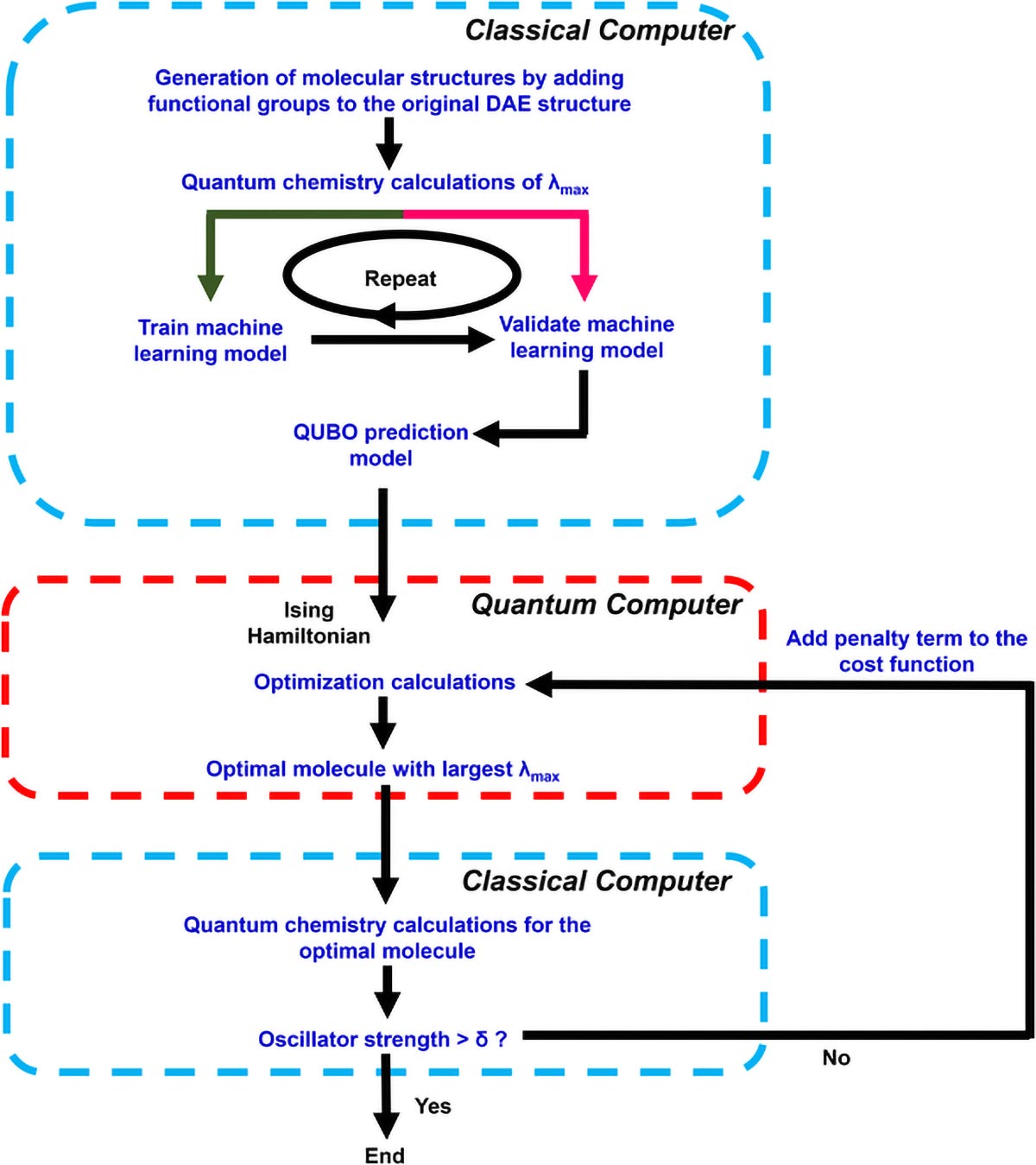
A quantum computer was then used to optimize these predictions, identifying molecules with the largest maximum absorbance wavelengths based on an Ising Hamiltonian, a mathematical model used to describe the system. Finally, quantum chemistry calculations on classical computers verified the properties of the top candidates, ensuring they met the desired criteria for further development.
Quantum Optimization and Validation
During the quantum optimization, a 12-qubit quantum calculation was used to efficiently simulate the ground state, the lowest energy state, and the four excited states of the Ising model. This step helps identify diarylethene derivatives with the largest and second- to fourth-largest absorbance wavelengths. Subsequently, quantum chemistry calculations were utilized to analyze the contribution of molecular orbitals to the absorbance. This step guides the design of new diarylethene derivatives with not only exhibit large absorbance wavelengths but also high oscillator strengths.
When tested on a quantum simulator, the new method showed strong agreement with results from an exact eigensolver, a computational tool that calculates the energy levels of a Hamiltonian system (in this case, an Ising Hamiltonian). Remarkably, even on real quantum devices, the method produced results with accuracy comparable to those from the simulator, thanks to advanced error suppression and mitigation techniques.
Recently, the integration of quantum chemistry calculations with machine learning has demonstrated significant potential in accelerating the discovery of novel materials. While this hybrid approach consumes fewer resources and less time compared to traditional methods, it still faces fundamental challenges. These include limitations in the size and quality of training datasets, as well as difficulties in effectively exploring large chemical spaces using discrete optimization techniques. The new quantum-classical method has proven itself capable of addressing these challenges, and offers a possible means of discovering other types of useful materials in the future.
Reference: “A Quantum-Classical Method Applied to Material Design: Photochromic Materials Optimization for Photopharmacology Applications” by Qi Gao, Michihiko Sugawara, Paul D. Nation, Takao Kobayashi, Yu-ya Ohnishi, Hiroyuki Tezuka and Naoki Yamamoto, 20 December 2024, Intelligent Computing.
DOI: 10.34133/icomputing.0108
Never miss a breakthrough: Join the SciTechDaily newsletter.
Follow us on Google and Google News.