
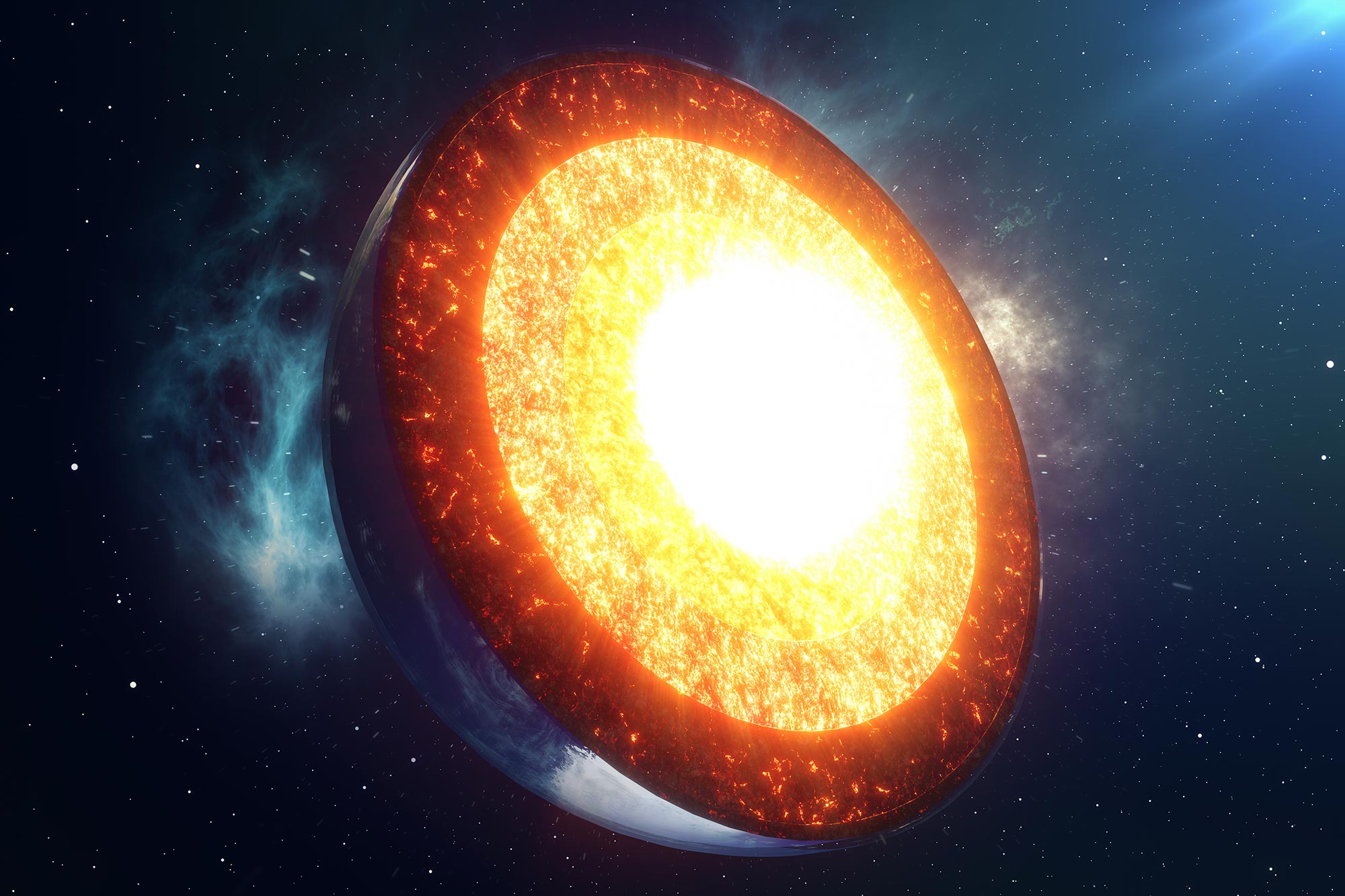
Exploring the mechanics and thermodynamics of (Mg,Fe)O grain boundaries under extreme pressure.
Mantle convection and plate tectonics on Earth-like planets are influenced by how the mantle rocks deform. This deformation happens as defects move within the crystal structures of minerals. Therefore, understanding how these defects behave under pressure is crucial for grasping the dynamics of planets similar to Earth.
A collaborative team of researchers, led by Dr. Sebastian Ritterex, a former post-doc of the Geodynamics Research Center, at Ehime University and now a researcher at the Department of Earth Sciences, Utrecht University, applied massive parallel high-performance computer simulations based on quantum mechanical atomic-scale modeling to shed new light on the enigmatic behavior of grain boundaries under the extreme pressures that prevail in planetary interiors. This theoretical methodology, called “ab initio simulations”, enables us to compute chemical bonding very accurately. It is a powerful tool for determining material properties under extreme conditions in the interior of planets where it is difficult to conduct experiments.
Examining Ferropericlase in Planetary Mantles
Based on the above theoretical mineral physics approach, the team examined the mechanical behavior and thermodynamic properties of high-angle tilt grain boundaries in (Mg,Fe)O ferropericlase, the second most abundant mineral in the Earth’s lower mantle and possibly in the mantles of super-Earth exoplanets. In this study, in addition to the standard density functional theory, the internally consistent LDA+U method was applied to reproduce the electronic structure of iron more accurately.

The results of the mechanical behavior indicate that the very high-pressure conditions in terrestrial planets have a strong effect on the mechanisms of grain boundary motion which govern intercrystalline deformation. The research proved for the first time that structural transformations of grain interfaces, induced by pressure with increasing depth in planetary mantles, trigger a change in the mechanism and in the direction of grain boundary motion.
The team also demonstrated that significant mechanical weakening of grain boundaries can develop under multi-megabar pressures. This is counterintuitive because it is usually thought that with increasing pressure, atomic arrangements in materials become more closely packed, making them harder. This phenomenon of grain boundary weakening is caused by a change in the transition state structure of grain boundaries during their motion under extremely high pressures.
Analyses of their data presented in the Journal of Geophysical Research: Solid Earth published in April 2024 identify grain boundary weakening in ferropericlase as one of the potential mechanisms for viscosity reductions with increasing depth in the mantle of super-Earth exoplanets.
Iron Partitioning and Spin States
The team performed additional thermodynamic modeling of the iron partitioning behavior between bulk and grain boundaries. They determined that grain size is an important factor in controlling the grain boundary segregation of iron in polycrystalline ferropericlase in the hot and dense lower mantle. It is well known that the incorporation of substitutional Fe(II) in bulk MgO has a significant effect on its physical properties such as density and seismic wave velocities, since Fe(II) undergoes an electronic spin transition at high pressure in the Earth’s interior. There had been no previous information about the spin states of Fe(II) within grain boundaries. Our modeling now shows that the electronic spin state of Fe(II) within ferropericlase tilt grain boundaries is controlled by structural grain boundary transformations at high pressure in the Earth’s lower mantle.
This mechanism influences the pressure conditions of the iron spin crossover in polycrystalline (Mg,Fe)O with micrometer or smaller grain sizes. The findings indicate that the iron spin crossover pressure in ferropericlase may increase by several tens of GPa due to pressure-induced structural grain boundary transitions in dynamically active fine-grained lower mantle regions compared to more thermodynamically stable regions in the lower mantle.
The group is very happy with these breakthroughs, however more systematic data from theoretical modeling as well as from experiments and electron microscopy observations will be needed to achieve better insights into the collective effects of grain boundaries on the rheological and thermodynamic properties of polycrystalline ferropericlase at the appropriate pressures and temperatures in planetary mantles.
Reference: “Atomic-Scale Study of Intercrystalline (Mg,Fe)O in Planetary Mantles: Mechanics and Thermodynamics of Grain Boundaries Under Pressure” by Sebastian Ritterbex, Taku Tsuchiya, Martyn Drury and Oliver Plümper, 26 April 2024, Journal of Geophysical Research: Solid Earth.
DOI: 10.1029/2023JB028375
The study was funded by the Japan Society for the Promotion of Science, the High Performance Computing Infrastructure of Japan, and the European Research Council.
Never miss a breakthrough: Join the SciTechDaily newsletter.
Follow us on Google and Google News.