
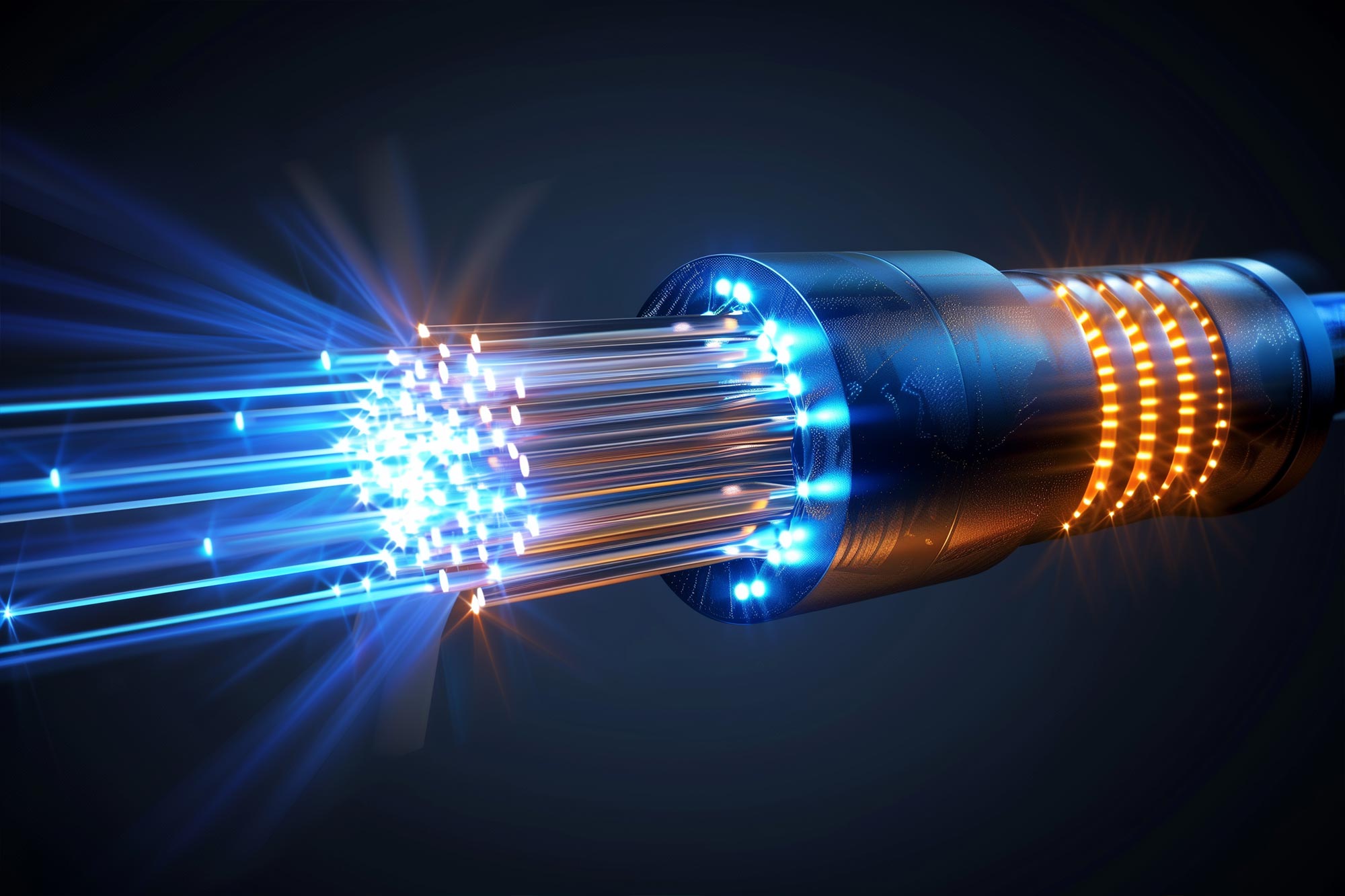
Researchers at Northwestern University have achieved a significant milestone by successfully demonstrating quantum teleportation using a fiber optic cable that also carries regular Internet traffic.
This innovation simplifies the potential integration of quantum and classical communications, offering a path toward shared infrastructure. The experiment proved that quantum information could be transmitted alongside conventional data without interference, promising more efficient and secure communication technologies.
Breakthrough in Quantum Teleportation
Northwestern University engineers have achieved a groundbreaking milestone by successfully demonstrating quantum teleportation over a fiber optic cable already transmitting regular Internet traffic.
This breakthrough suggests that quantum communication could be integrated with existing Internet infrastructure, eliminating the need for dedicated networks and simplifying the technology required for quantum computing and sensing applications.
The team’s findings will be published today (December 20) in the journal Optica.
“This is incredibly exciting because nobody thought it was possible,” said Northwestern’s Prem Kumar, who led the study. “Our work shows a path towards next-generation quantum and classical networks sharing a unified fiber optic infrastructure. Basically, it opens the door to pushing quantum communications to the next level.”
An expert in quantum communication, Kumar is a professor of electrical and computer engineering at Northwestern’s McCormick School of Engineering, where he directs the Center for Photonic Communication and Computing.
The Mechanics of Quantum Teleportation
Only limited by the speed of light, quantum teleportation could make communications nearly instantaneous. The process works by harnessing quantum entanglement, a technique in which two particles are linked, regardless of the distance between them. Instead of particles physically traveling to deliver information, entangled particles exchange information over great distances — without physically carrying it.
“In optical communications, all signals are converted to light,” Kumar explained. “While conventional signals for classical communications typically comprise millions of particles of light, quantum information uses single photons.”
Innovations in Photon Management
Before Kumar’s new study, conventional wisdom suggested that individual photons would drown in cables filled with the millions of light particles carrying classical communications. It would be like a flimsy bicycle trying to navigate through a crowded tunnel of speeding heavy-duty trucks.
Kumar and his team, however, found a way to help the delicate photons steer clear of the busy traffic. After conducting in-depth studies of how light scatters within fiber optic cables, the researchers found a less crowded wavelength of light to place their photons. Then, they added special filters to reduce noise from regular Internet traffic.
“We carefully studied how light is scattered and placed our photons at a judicial point where that scattering mechanism is minimized,” Kumar said. “We found we could perform quantum communication without interference from the classical channels that are simultaneously present.”
Future Prospects and Expanding the Experiment
To test the new method, Kumar and his team set up a 30-kilometer-long fiber optic cable with a photon at either end. Then, they simultaneously sent quantum information and regular Internet traffic through it. Finally, they measured the quality of the quantum information at the receiving end while executing the teleportation protocol by making quantum measurements at the mid-point. The researchers found the quantum information was successfully transmitted — even with busy Internet traffic whizzing by.
Next, Kumar plans to extend the experiments over longer distances. He also plans to use two pairs of entangled photons — rather than one pair — to demonstrate entanglement swapping, another important milestone leading to distributed quantum applications. Finally, his team is exploring the possibility of carrying out experiments over real-world inground optical cables rather than on spools in the lab. But, even with more work to do, Kumar is optimistic.
“Quantum teleportation has the ability to provide quantum connectivity securely between geographically distant nodes,” Kumar said. “But many people have long assumed that nobody would build specialized infrastructure to send particles of light. If we choose the wavelengths properly, we won’t have to build new infrastructure. Classical communications and quantum communications can coexist.”
Reference: “Quantum teleportation coexisting with classical communications in optical fiber” by Prem Kumar, Gregory S. Kanter, Fei I. Yeh, Joe J. Mambretti, Jordan M. Thomas, Scott J. Kohlert and Jim Hao Chen, 19 December 2024, Optica.
DOI: 10.1364/OPTICA.540362
The study was supported by the U.S. Department of Energy (grant number DE-AC02-07CH11359).
Never miss a breakthrough: Join the SciTechDaily newsletter.
Follow us on Google and Google News.
24 Comments
Why not find a way to get rid of wires, instead of finding new ways to use them? It’d be nice to distribute power, and information without wires.
The best suggestion (about anything) that I’ve seen in a long time. Congratulations! You win all of the internets today! 🤓
Yes, just like Nicola Tesela was working on: the transmission of electricity without wires.
Soon we.can send entangled photon on space ship and get instant comms with it. See Martian communication.
That’s true. Everything at it’s time. We enjoy this now. Then we get to reach that. You two comlete each other.
We hope that infrastructures should be wireless in quantum and US wants to use FiberOptics. Through lessers crossover we make it possible but why don’t they do.
They better not botch it this time…
Will this new transmission method survive microwave hops and data satellite uplinks and downlinks?
Yes – because it’s instantaneous- all other wave particles are transmitted at slower frequencies. Except light.
The physical part of using this has been proven , could the transformation of the light entangle photons go as far to be used in communications in space , like a radio transmitting to a receiver a new path to distance enhancing of the signal by sharpening the wave to shorter oscillations wave height , make the signal more compatible to the medium that radio signal is transmitted through , the space between communication points .
The author is perpetuating some very popular inaccuracies about what quantum entanglement does. No it will not allow teleportation of data.
Why this is monumental is because it allows an additional way of transferring data through network cables. E.g. it will allow much higher throughput at the end of the day, because you can encode information using conventional 1’s and 0’s (e.g. alternating ON and OFF optical signals) while you can now also encode information within each photon itself by using entanglement. So you won’t get a lower ‘ping’ but you will get a non-trivial increase to how much data you can transfer every minute.
Thank you. Frustrating to read what you know must be misinformation with an interesting real story underneath.
For years scientists have told us there are fundamental physics issues with teleporting usable information via entanglement or any other method that propagates faster than the speed of light, so if true that doesn’t just disappear because you figured out an engineering problem with fibre optic cables.
@quantum Soup- it’s the first scientific admission that teleportation is possible- military industrial complex has already teleported things- like humans…
You and I both know you are speaking gibberish 😂😂😂
@quantum Soup- it’s the first scientific admission that teleportation is possible- military industrial complex has already teleported things- like humans…
This has to be the silliest thing I’ve read in a while: “Only limited by the speed of light, quantum teleportation could make…” That’s the whole point of quantum entanglement, that it has implications to provide communications faster than light, and potentially without cabling. Who wrote this dumpster fire? 🤣🤣
Exactly my thought.
Photons traveling in a fiber optic cable are already moving at C.
If this “new” method is limited by C, then how is it better? 🤷
Nothing to see here folks. 😒
The author is perpetuating some very popular inaccuracies about what quantum entanglement does. No it will not allow teleportation of data.
Why this is monumental is because it allows an additional way of transferring data through network cables. E.g. it will allow much higher throughput at the end of the day, because you can encode information using conventional 1’s and 0’s (e.g. alternating ON and OFF optical signals) while you can now also encode information within each photon itself by using entanglement. So you won’t get a lower ‘ping’ but you will get a non-trivial increase to how much data you can transfer every minute.
I agree with Felix. This sounds like they are just hopping on the quantum “bandwagon” to get noticed.
TLDR: there is no actual teleportation of anything and even with quantum entanglement based comms, data DOES have to physically travel through a wire
Some inaccuracies in the article:
“Only limited by the speed of light, quantum teleportation could make communications nearly instantaneous.”
– True, but not much more instantaneous than electrons going through copper, because that’s at 2/3 the speed of light. Light going through fiber optical cables is ALSO 2/3 the speed of light. Light and electrons both travel slower because they’re going through a physical medium (copper or fiber optic).
“The process works by harnessing quantum entanglement, a technique in which two particles are linked, regardless of the distance between them.”
– A bit misleading here because for the particles or photons to BECOME linked they have to come in contact. Then you send one away to someone else and they can glean information from it, a.k.a. data transfer.
“Instead of particles physically traveling to deliver information, entangled particles exchange information over great distances — without physically carrying it.”
– This part is incorrect — the particles do physically carry the information. They were entangled by being brought in proximity to one another, then one was physically moved to another location to be ‘read’. In laymen’s terms, the ‘spooky’ thing is that you just don’t know which one is 1 and which one is 0, simply because nobody measured either of them after they were entangled. Once you measure one of them, and find out it’s a 1, then you KNOW that the other one is a 0, because that is what entanglement does. There are multiple ways you can entangle particles and their innate physical properties to achieve this effect.
I agree with most of what you said I would also like to bring up the question of the definition of quantum entanglement as I understood it was that the change of state required no mechanism or pathway(that we are able to perceive)to be transferred over any distance with entangled particles. And by using fiber optic cable to transfer data as they’re saying from one particle that is entangled with another one that is the exact opposite of the current definition of entanglement. I was understanding the whole benefit of quantum entanglement being that no mechanism or identifiable connection linked the two particles to facilitate the change of state but this article leads me to believe that the scientists are saying they have achieve quantum entanglement with two particles over
Analogous to a bicycle and an automobile traveling through a tunnel, is it possible that the fiber optic cable may serve as a conduit, allowing faster than light communications to travel through it?
Let “C” = CRAP (as in bovine egest) rather than the constant = speed of light! What does Bell Labs have to say about this? 🤵
Just another grant awardee getting paid for bad science results – did the Highlands Forum read this ?