
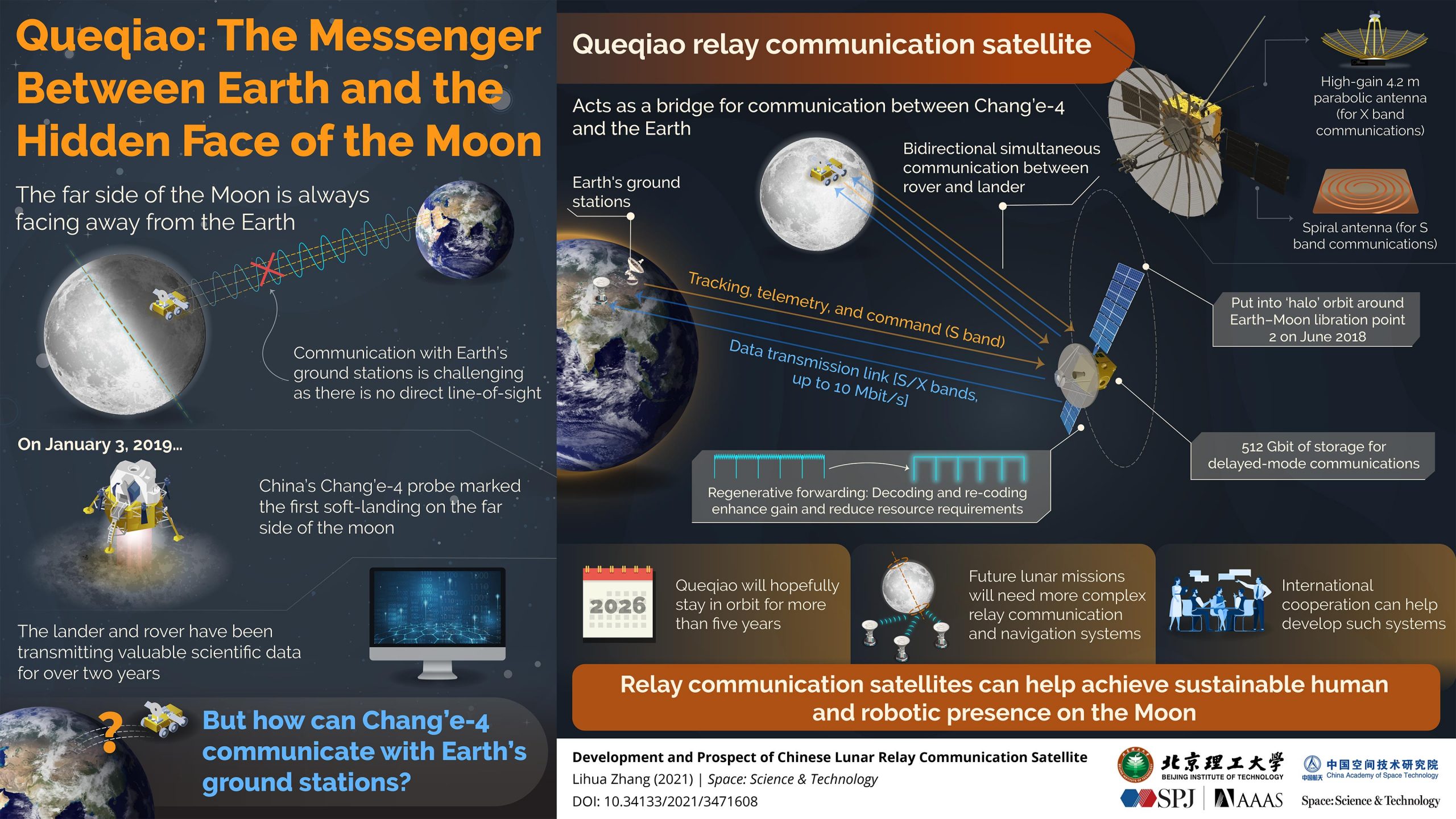
Researchers explain the design of the relay communication satellite that enabled us to peek at the hidden face of the moon.
Because of a phenomenon called gravitational locking, the Moon always faces the Earth from the same side. This proved useful in the early lunar landing missions in the 20th century, as there was always a direct line of sight for uninterrupted radiocommunications between Earth ground stations and equipment on the Moon. However, gravitational locking makes exploring the hidden face of the moon–the far side–much more challenging, because signals cannot be sent directly across the Moon towards Earth.
Still, in January 2019, China’s lunar probe Chang’e-4 marked the first time a spacecraft landed on the far side of the Moon. Both the lander and the lunar rover it carried have been gathering and sending back images and data from previously unexplored areas. But how does Chang’e-4 probe communicate with the Earth? The answer is Queqiao, a relay communications satellite, explains Dr. Lihua Zhang from DFH Satellite Co., Ltd., China.
Queqiao: The Bridge to the Hidden Moon
As explained by Dr. Zhang in a review paper recently published in Space: Science & Technology, Queqiao is an unprecedented satellite designed specifically for one purpose: to act as a bridge between Chang’e-4 probe and the Earth. Queqiao was launched in 2018 and put into orbit around a point ‘behind’ the Moon. This point is known as the Earth-Moon Libration point 2, where a special case of gravitational balance allows Queqiao to maintain an orbit such that it has almost constant direct line of sight with both the far side of the Moon and the Earth. Getting the satellite into this peculiar orbit required careful planning and maintenance management, and the success of this operation set a precedent for future attempts at putting satellites in orbit around other Earth-Moon libration points.
From its stable place in space, Queqiao helped guide the soft-landing and surface operations of Chang’e-4 probe and has been our intermediary with it ever since. The satellite is equipped with two different kinds of antennas: a parabolic antenna and several spiral antennas. The former, which has a large diameter of 4.2 m (13.8 ft), was designed to send and receive signals on the X band (7-8GHz) to and from the rover and lander on the surface of the Moon. Its large size is related the expected noise levels and the low intensity of the transmissions that are sent by surface equipment.
On the other hand, the spiral antennas operate on the S band (2-4 GHz) and communicate with Earth ground stations, forwarding commands to the lunar surface equipment and exchanging telemetry and tracking data. Most notably, all these different links can transmit and receive simultaneously, making Queqiao highly versatile. The review paper addresses other important design considerations for Queqiao and future relay satellites, such as the use of regenerative forwarding, the various link data rates involved, and data storage systems for when no Earth ground station is accessible.
Over two years of exploration, a great amount of data has been received from the rover and lander through Queqiao. “Scientists in both China and other countries have conducted analysis and research based on the retrieved data, and they have produced valuable scientific results. The longer the operational life of Queqiao, the more scientific outcomes will be achieved,” remarks Dr. Zhang. Based on current predictions, Queqiao should be operable on mission orbit for at least five years.
Infrastructure for Future Lunar Missions
Dr. Zhang also addressed the prospects for future lunar missions and how relay communication systems should evolve to support them. Many unexplored areas on the Moon, such as the largest crater at the South Pole, call for multiple relay satellites to maintain constant communication links, which poses an expensive and time-consuming challenge. But what if relay satellites were suitable for more than a single mission?
“A sustainable communication and navigation infrastructure should be established to benefit all lunar missions rather than dealing with each mission independently,” comments Dr. Zhang, “This infrastructure should adopt an open and extensible architecture and provide flexible, interoperable, cross-supportable, and compatible communications services, which are critical to the success of future lunar explorations.” It’s likely that future endeavors on the far side of the Moon will be a test on how well we can cooperate to unveil the secrets of our natural satellite.
Reference: “Development and Prospect of Chinese Lunar Relay Communication Satellite” by Lihua Zhang, 25 April 2021, Space: Science & Technology.
DOI: 10.34133/2021/3471608
Never miss a breakthrough: Join the SciTechDaily newsletter.
Follow us on Google and Google News.
4 Comments
Of course it does, because it’s a light. And you folks are liars and decievers. And btw no one has ever landed on the moon. Dam liars
Please see my reply to your comment.
You can sit there in your chair and make any claim that you want. I know that man has landed on the moon multiple times and I know this with absolute certainty. There are people who have vast amounts of highly accurate information and there are people who have information and knowledge levels that are more akin to what an animal understands regarding their environment. Do you think that a bear understands that a water molecule is composed of two hydrogen atoms and an oxygen atom? Do you think that a whale understands that the planet Jupiter exists? Continue to wallow in your cesspool of complete uncomprehending ignorance. You do not direct ITER, CERN, the Cleveland Clinc, the Jet Propulsion Laboratory in Pasadena, California, the Mayo Clinic, the Intel Corporation, Microsoft, Spacex, Bank of America, J. P. Morgan Chase ad infinitum. All you are capable of accomplishing is making comments that reveal the depths of your ignorance. “Dam liars” should be “Damn liars”. You do not know the basics of the Englisn language. A dam is a constructed or natural barrier that restricts the flow of some liquid.
Well said, Joseph.