
Close Menu
    Facebook X (Twitter) Instagram
    SciTechDaily
    • Biology
    • Chemistry
    • Earth
    • Health
    • Physics
    • Science
    • Space
    • Technology
    Facebook X (Twitter) Pinterest YouTube RSS
    SciTechDaily
    Home»Space»Rainbow “Rubber Duck” Comet With a Heart of Sponge
    Space

    Rainbow “Rubber Duck” Comet With a Heart of Sponge

    By European Space AgencySeptember 7, 2020No Comments3 Mins Read
    Facebook Twitter Pinterest Telegram LinkedIn WhatsApp Email Reddit
    Share
    Facebook Twitter LinkedIn Pinterest Telegram Email Reddit
    Rainbow Comet
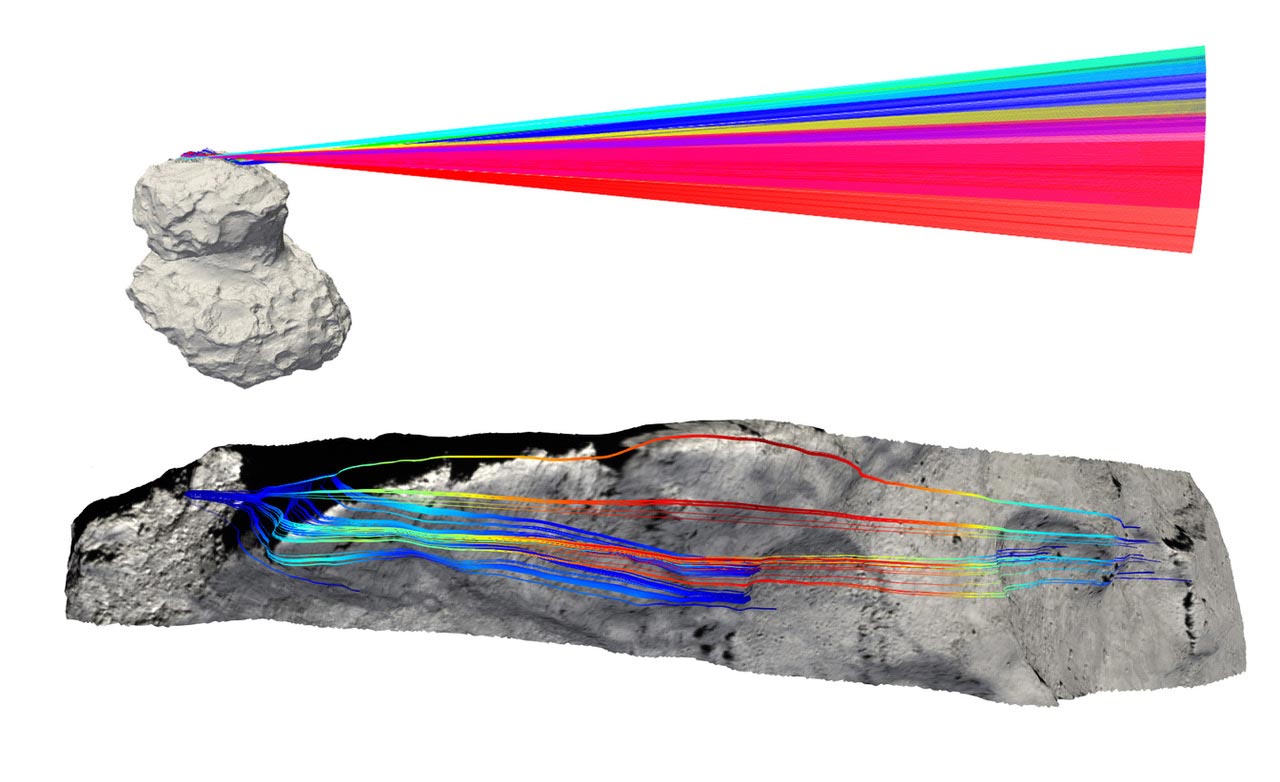
    The graphic shows the signal connecting the CONSERT instrument on Philae, on the surface of the comet, to the one on the Rosetta orbiter. The fan like appearance is a result of the motion of Rosetta along its orbit, with the colors marking the separate signal paths as the orbit evolves. The image below shows the signals in more detail, propagating inside the comet from Philae to the points from where they leave the comet to the orbiter. The curving is a result of the projection of its paths on the bumpy surface of the comet. Credit: ESA/Rosetta/Philae/CONSERT

    A permeable heart with a hardened facade — the resting place of Rosetta’s lander on Comet 67P/Churyumov-Gerasimenko is revealing more about the interior of the ‘rubber duck’ shaped-body looping around the Sun.  

    A recent study suggests that the comet’s interior is more porous than the material near the surface. The results confirm that solar radiation has significantly modified the comet’s surface as it travels through space between the orbits of Jupiter and Earth. Heat from the Sun triggers an ejection and subsequent falling back of material.  

    Location, location, location. That was key for the radar instrument on the Rosetta spacecraft and its Philae lander, which was designed to probe the comet’s nucleus. The CONSERT experiment involved two antennas sending precise signals to each other. But when Philae went missing upon landing in November 2014, scientists had to work with estimated values.

    Philae operated for over two days on the surface – 63 hours, to be precise.

    “We managed to define the region where the lander was with a margin of about 150 m. The real landing site was in this region,” explains Wlodek Kofman, emeritus principal investigator of CONSERT.

    It took nearly two years to find out where Philae was. In September 2016 the exact position of Philae was retrieved within the area identified by CONSERT.

    Precise 3D models of the comet with Philae in the picture “allowed us to revisit the measurements and improve our analysis of the interior,” says Wlodek.

    The graphic shows the signal connecting the CONSERT instrument on Philae, on the surface of the comet, to the one on the Rosetta orbiter. The fan like appearance is a result of the motion of Rosetta along its orbit, with the colors marking the separate signal paths as the orbit evolves.

    The image below shows the signals in more detail, propagating inside the comet from Philae to the points from where they leave the comet to the orbiter.  The curving is a result of the projection of its paths on the bumpy surface of the comet.

    The bluer color indicates more shallow paths (just a few centimeters), while the redder tones show where the signals penetrated below 100 m in depth.

    The time for the signal to travel between the two radars offers insights into the comet’s nucleus, such as porosity and composition. The team discovered that rays propagated at different velocities, indicating varying densities within the comet.

    The discussion is still open, but Wlodek believes that “this strongly suggests that the less dense interior has kept its pristine nature.” Known as the most primitive objects in our cosmic neighborhood, comets might hold, deep inside, valuable clues about the formation of our Solar System.

    Reference: “The interior of Comet 67P/C–G; revisiting CONSERT results with the exact position of the Philae lander” by Wlodek Kofman, Sonia Zine, Alain Herique, Yves Rogez, Laurent Jorda and Anny-Chantal Levasseur-Regourd, 15 July 2020, Monthly Notices of the Royal Astronomical Society.
    DOI: 10.1093/mnras/staa2001

    Never miss a breakthrough: Join the SciTechDaily newsletter.
    Follow us on Google and Google News.

    Astronomy Comet European Space Agency
    Share. Facebook Twitter Pinterest LinkedIn Email Reddit

    Related Articles

    Astronomy & Astrophysics 101: Structure of a Comet

    SOHO Tracks Comet C/2023 A3’s Spectacular Flight Through Space With Rare Anti-Tail [Video]

    Rare Glimpse of “Doomed” SOHO Comet During Solar Eclipse

    Infographic: Anatomy of a Comet

    ESA’s Comet Interceptor Approved for Construction

    Astronomy & Astrophysics 101: Comet

    Solar Orbiter Spacecraft Catches a Second Comet by the Tail

    A Christmas Comet for Solar Orbiter: Heliospheric Imager Captures Comet Leonard

    Don’t Miss: Comet Leonard May Be Visible to the Naked Eye Today

    Leave A Reply Cancel Reply

    • Facebook
    • Twitter
    • Pinterest
    • YouTube

    Don't Miss a Discovery

    Subscribe for the Latest in Science & Tech!

    Trending News

    Massive Study Warns Marijuana Use in Teens Is Linked to Serious Mental Illness

    Scientists Discover a Completely Unexpected Way T Cells Kill Cancer

    Scientists Just Found the Solar System’s Original “Planet Factory”

    Study Warns Widely Used Food Preservatives Linked to High Blood Pressure and Heart Disease

    New Treatment Could Reverse Osteoarthritis Within Weeks

    Physicists Have Measured “Negative Time” in Bizarre Quantum Experiment

    The Deadly Tapeworm Spreading Across America Has Reached the Pacific Northwest

    Could Low Vitamin D Be Making Your Pain Worse?

    Follow SciTechDaily
    • Facebook
    • Twitter
    • YouTube
    • Pinterest
    • Newsletter
    • RSS
    SciTech News
    • Biology News
    • Chemistry News
    • Earth News
    • Health News
    • Physics News
    • Science News
    • Space News
    • Technology News
    Recent Posts
    • Stanford’s Revolutionary New Microscope Reveals Living Cells in Stunning Detail
    • Scientists Discover a Sea Slug Smaller Than a Sesame Seed in Taiwan
    • Wasp Colonies Explode Into Violence After Losing Their Queen
    • Antarctica Suddenly Became Far More Sensitive to Climate Change 1 Million Years Ago
    • A Hidden Arctic Ocean Crisis Is Unfolding Beneath the Melting Ice
    Copyright © 1998 - 2026 SciTechDaily. All Rights Reserved.
    • Science News
    • About
    • Contact
    • Editorial Board
    • Privacy Policy
    • Terms of Use

    Type above and press Enter to search. Press Esc to cancel.