
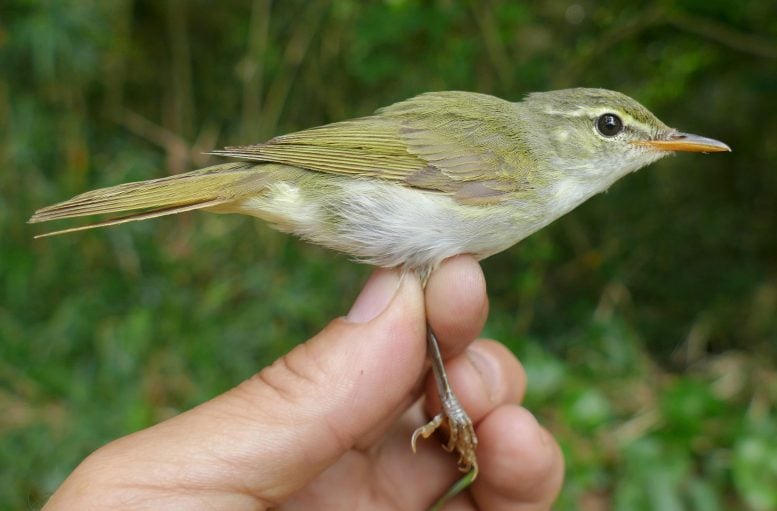
A new species, the Tokara Leaf Warbler, was identified using DNA and song differences, splitting the Ijima’s Leaf Warbler into two rare and vulnerable species needing conservation.
Scientists have identified a previously unrecognized species of leaf warbler in Japan, revealing that what was once considered a single species, the Ijima’s Leaf Warbler, is actually two distinct species. While new bird species are described each year around the world, this case stands out because physical appearance alone did not reveal the difference. Instead, DNA analysis provided the decisive evidence that two species exist.
“This shows how important it is to use genetic methods to reveal hidden biodiversity at a time of global biodiversity crisis. These methods can help provide more complete knowledge on which to base future nature conservation efforts,” says Per Alström at Uppsala University, one of the researchers who have discovered the new species Tokara Leaf Warbler.
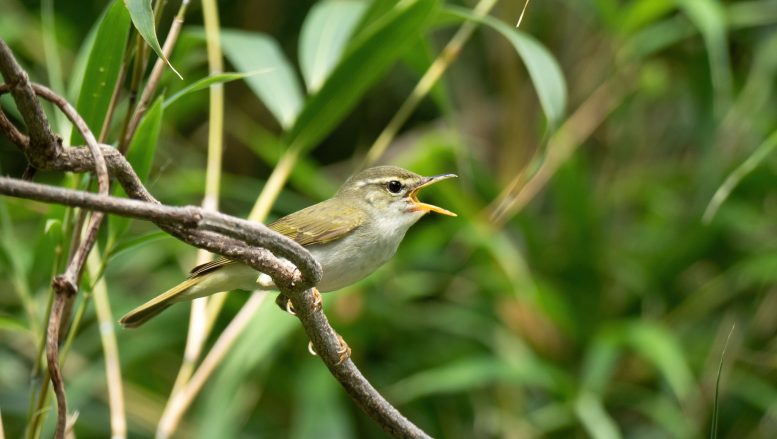
The Ijima’s Leaf Warbler (Phylloscopus ijimae) is a rare migratory bird that lives only on the Izu Islands south of Tokyo, Japan, and on the Tokara Islands about 1,000 km to the southwest.
DNA Evidence Reveals Distinct Island Populations
Researchers first found clear genetic differences between birds on the two island groups a decade ago when they examined their DNA. This discovery prompted further investigation, including fieldwork on the islands, analysis of museum specimens, and detailed laboratory studies.
Whole genome comparisons confirmed that the Tokara Island birds are significantly different from those on the Izu Islands, and these findings were supported by careful analysis of their songs.

Scientists from Uppsala University, the University of Gothenburg, and two Japanese institutions have now formally identified the Tokara Leaf Warbler (Phylloscopus tokaraensis) as a separate species.
The previous discovery of a new bird species in Japan dates back to 1982, when the Okinawa Rail (Gallirallus okinawae) was described.
“The new species is a little cryptic and tricky to define. In terms of appearance, it doesn’t differ from the Ijima’s Leaf Warbler. It is DNA analyses and differences in song that show that this is a separate species,” Alström says.

Small Populations, Low Genetic Diversity, and Conservation Risks
The birds inhabit small island groups, which limits their population sizes. The Tokara Islands cover just over 100 square kilometers in total, smaller than Fårö (an island off the coast of Gotland), and are spread across twelve islands.
Both species have very low genetic diversity, which may increase their susceptibility to environmental changes and disease. At the same time, there are indications that their populations may have partially recovered after earlier declines.
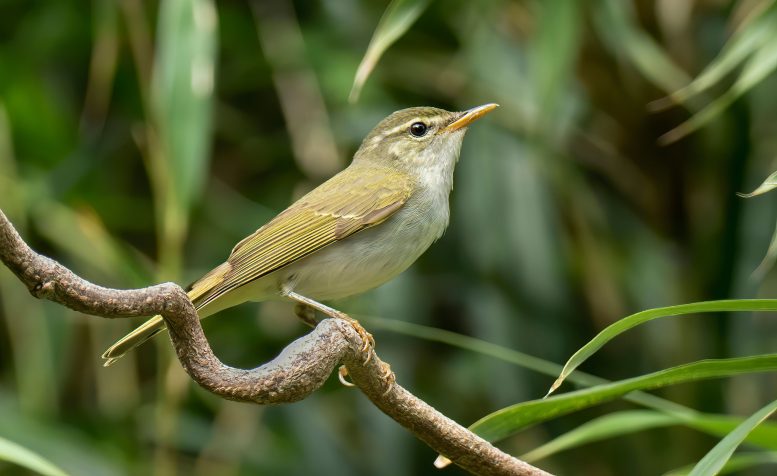
The Ijima’s Leaf Warbler is already classified as vulnerable by the International Union for Conservation of Nature and is protected as a Japanese “Natural Monument.”
Because the Tokara Leaf Warbler appears to be just as rare, researchers recommend that both species receive Vulnerable status and ongoing monitoring to track any future changes in their populations.
Reference: “Discovering and protecting cryptic biodiversity: A case study of a previously undescribed, vulnerable bird species in Japan” by Takema Saitoh, Daria Shipilina, Canwei Xia, Lijun Zhang, Shin-Ichi Seki, Urban Olsson and Per Alström, 17 March 2026, PNAS Nexus.
DOI: 10.1093/pnasnexus/pgag037
Never miss a breakthrough: Join the SciTechDaily newsletter.
Follow us on Google and Google News.
1 Comment
Universal song bird it’s beautiful