

Addressing one of the longstanding challenges in gastrointestinal drug delivery, Virginia Tech researchers have transformed gut bacteria into tiny protein factories. These engineered microbes continuously produce and release targeted proteins within the lower intestine, offering a sustained and precise therapeutic effect.
Hundreds of different microbial species live, laugh, and love in your gut. In the future, one of them might take on a new role: a microscopic in-house pharmacist.
A study published on February 18th in the journal Nature Biotechnology demonstrates how gut bacteria can be programmed to produce and release proteins within the lower gastrointestinal tract—overcoming a significant obstacle in delivering drugs to that part of the body.
Oral medication is the most common and practical method of drug administration, but the stomach acts as a formidable barrier, breaking down most substances before they can pass through. While this is good when it comes to things like foodborne pathogens, but gut-focused therapies are regularly deactivated and flushed out.
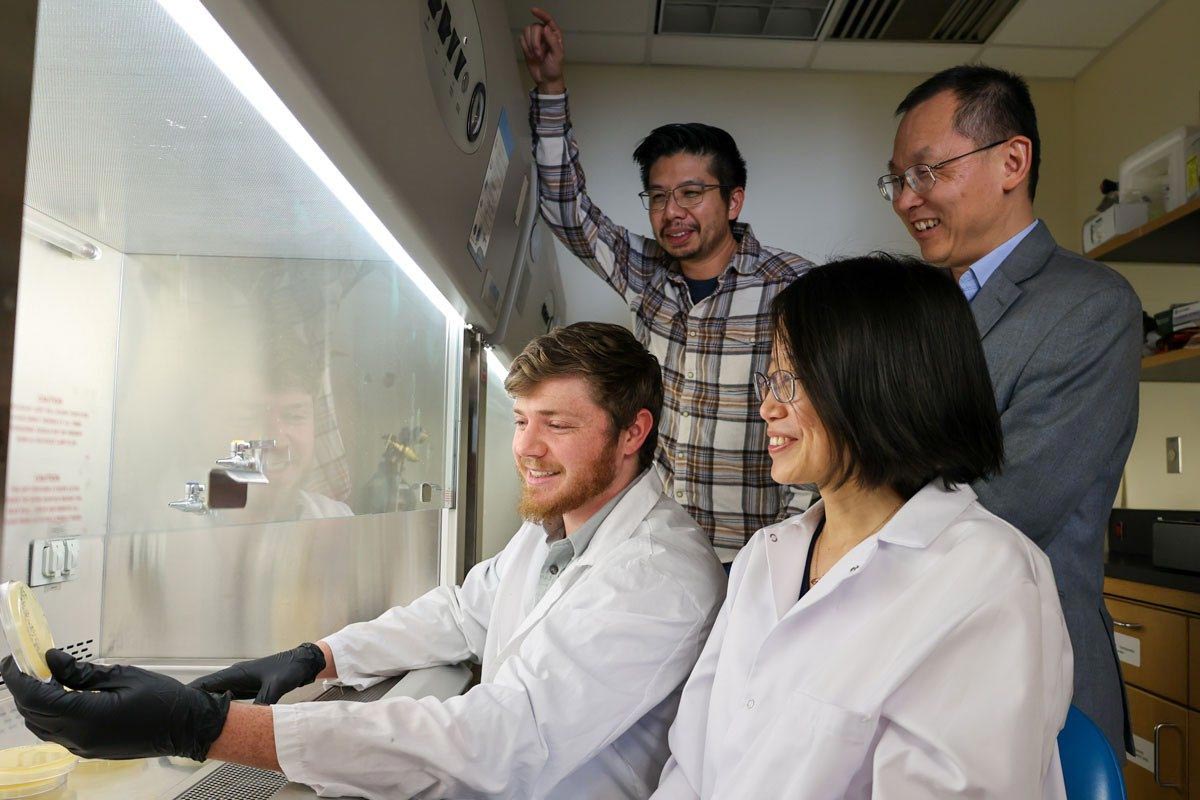
In an unprecedented workaround, biologist Bryan Hsu’s team engineered bacteria-eating viruses called phages to infect and reprogram bacterial cells to produce and release a sustained flow of a protein-based drug.
Collaborating with immunologist Liwu Li, Hsu’s research team showed that this approach can be used to potentially treat chronic diseases.
Embrace your inner spider alien
Bacteriophages (phages for short) are viruses that naturally infect bacteria. Phages are harder to classify than bacteria and therefore less understood, but we do know how they attack bacteria.
After attaching to a bacterial cell, phages inject their own DNA and reprogram the cell so that it manufactures more phages — agents of the cell’s own destruction. When the bacterial cell eventually succumbs, it explodes into a flood of new phages in a process called lysis. Millions of these events happening simultaneously produce a constant supply of a targeted protein inside the lower intestine.
Even though phages act (and look) like spider aliens, they are regular players on the gut-microbiome home team. In fact, their ubiquity is what prompted Hsu to explore using them to introduce and deliver therapeutic proteins.
Zachary Baker, a doctoral student in the Hsu Lab, engineered special phages that inject a little extra genetic material into the bacterial cell.
In addition to making a flurry of new phages, the instructions prompt the cell to produce a tagalong protein that can lend itself to targeted therapies inside the lower intestines.
Engineered proteins reduced inflammation, obesity in mice
To prove their technique, Baker and research assistant professor Yao Zhang successfully applied these engineered phages to tackle symptoms associated with two separate diseases in mice:
- Reduced inflammation by releasing a protein that inhibited an enzyme associated with inflammatory bowel disease.
- Reduced obesity by releasing a protein that induced a feeling of satiety in mice given a high-fat diet that is typically associated with Western diets, which are often linked to an increased risk of obesity.
With these results, Hsu’s team demonstrated proof-of-concept for a new drug-delivery method. They are currently exploring the commercial potential of this innovation through the National Science Foundation I-Corps program and the Fralin Commercialization Fellowship.
But the drug-delivery problem has at least two parts. Hsu’s next challenge involves getting drugs absorbed from the gut into systemic circulation.
“It’s like we’re Amazon. We got the stuff there, we dropped it off on the doorstep,” Hsu said. “Now we need to figure out how to ring the doorbell.”
Reference: “Sustained in situ protein production and release in the mammalian gut by an engineered bacteriophage” by Zachary R. Baker, Yao Zhang, Haiyan Zhang, Hollyn C. Franklin, Priscila B. S. Serpa, Teresa Southard, Liwu Li and Bryan B. Hsu, 18 February 2025, Nature Biotechnology.
DOI: 10.1038/s41587-025-02570-7
This work was funded by the National Institute of General Medical Sciences, the National Institute of Allergy and Infectious Diseases, and the Lay Nam Chang Dean’s Discovery Fund, which is awarded by the Virginia Tech College of Science.
Never miss a breakthrough: Join the SciTechDaily newsletter.
Follow us on Google and Google News.