
Close Menu
    Facebook X (Twitter) Instagram
    SciTechDaily
    • Biology
    • Chemistry
    • Earth
    • Health
    • Physics
    • Science
    • Space
    • Technology
    Facebook X (Twitter) Pinterest YouTube RSS
    SciTechDaily
    Home»Health»Bacteria Can ‘Outsmart’ Programmed Cell Death Overriding an Immune System Defense Mechanism
    Health

    Bacteria Can ‘Outsmart’ Programmed Cell Death Overriding an Immune System Defense Mechanism

    By University of CologneDecember 29, 2019No Comments3 Mins Read
    Facebook Twitter Pinterest Telegram LinkedIn WhatsApp Email Reddit
    Share
    Facebook Twitter LinkedIn Pinterest Telegram Email Reddit
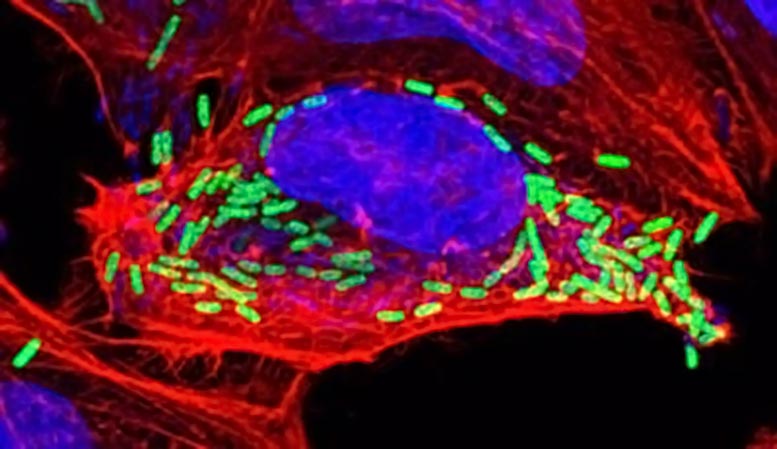
    Shigella Bacteria
    Shigella bacteria can override programmed cell death, thereby establishing a niche to spread. Credit: Hamid Kashkar, University of Cologne

    Certain bacteria can override a defense mechanism of the immune system, so-called programmed cell death, through inhibition of death effector molecules by their outer membranes components. Shigella bacteria, which cause diarrhea, use lipopolysaccharides (LPS) on their surface to block the effector caspases. Lipopolysaccharides are a component of the bacterial outer membrane. This strategy enables the bacteria to multiply within the cell. This is the result of a study conducted by the molecular immunologist Professor Hamid Kashkar and his team in the Institute for Medical Microbiology and Immunology at the CECAD Cluster of Excellence in Aging Research at the University of Cologne. The article ‘Cytosolic Gram-negative bacteria prevent apoptosis by inhibition of effector caspases through LPS’ by Günther et al. appeared in the current issue of Nature Microbiology.

    Various bacterial pathogens can escape our immune system by staying and multiplying within our body cells (intracellularly). The intracellular propagation of pathogens later leads to cell breakdown and the release of microorganisms that infect neighboring cells, spread and cause tissue damage and infectious disease. However, the body has a response to this bacterial strategy: programmed cell death, or apoptosis, reacts to cellular stress situations during infections and causes quick suicide of the infected cells.

    Due to this rapid self-destruction program of our body cells, pathogens cannot multiply – the immune system successfully eliminates them. Scientists have observed in the past that pathogens can effectively block apoptosis, allowing them to reproduce and spread intracellularly. However, the molecular mechanism responsible for how these bacteria ‘outsmarted’ the immune system was largely unknown.

    Kashkar lab has now shown that the pathogen that causes shigellosis (Shigella), a typical cause of acute inflammatory diarrhea, blocks apoptosis by efficiently blocking certain enzymes, so-called caspases, which act as engines that initiate apoptosis.

    The biologists showed that lipopolysaccharides bind and block the caspase. Bacteria without complete LPS, on the other hand, spark apoptosis, which blocks them from reproducing intracellularly. They are successfully eliminated by the immune system and thus no longer able to cause infectious diseases. Kashkar lab’s work has thus deciphered an important bacterial strategy to prevent the rapid death of the host cell and establish a niche to spread.

    Reference: “Cytosolic Gram-negative bacteria prevent apoptosis by inhibition of effector caspases through lipopolysaccharide” by Saskia D. Günther, Melanie Fritsch, Jens M. Seeger, Lars M. Schiffmann, Scott J. Snipas, Maria Coutelle, Thomas A. Kufer, Paul G. Higgins, Veit Hornung, Maria L. Bernardini, Stefan Höning, Martin Krönke, Guy S. Salvesen & Hamid Kashkar, 23 December 2019, Nature Microbiology.
    DOI: 10.1038/s41564-019-0620-5

    Never miss a breakthrough: Join the SciTechDaily newsletter.
    Follow us on Google and Google News.

    Bacteria Cell Biology Microbiology University of Cologne
    Share. Facebook Twitter Pinterest LinkedIn Email Reddit

    Related Articles

    “Jumping Genes” – Human Gut Bacteria Have Sex to Share Vitamin B12

    “Hidden” Genes in Bacteriophages Could Be Key in Development of New Antibiotics

    Lesions of Doom – How a Parasitic Bacterium Disrupts Blood Vessels in the Human Body

    Microbes Have Memory: Surprising Parallels Between Simple Microrganisms and Sophisticated Neurons

    Light Driven Proton Pump Discovered in Distant Relative

    Eating Yogurt May Help Lessen the Risk of Breast Cancer – Here’s Why

    Warning: Deadly Superbugs Lurking in More Than 90% of Make-Up Bags

    ‘Poison Arrows’ Launched by Warring Bacteria Could Lead to New Antibiotics

    Copper Hospital Beds Are Real Killers, but That’s a Good Thing

    Leave A Reply Cancel Reply

    • Facebook
    • Twitter
    • Pinterest
    • YouTube

    Don't Miss a Discovery

    Subscribe for the Latest in Science & Tech!

    Trending News

    Scientists May Have Found the Key to Jupiter and Saturn’s Moon Mystery

    Scientists Uncover Brain Changes That Link Pain to Depression

    Saunas May Do More Than Raise Body Temperature – They Activate Your Immune System

    Exercise in a Pill? Metformin Shows Surprising Effects in Cancer Patients

    Hidden Oceans of Magma Could Be Protecting Alien Life

    New Study Challenges Alzheimer’s Theories: It’s Not Just About Plaques

    Artificial Sweeteners May Harm Future Generations, Study Suggests

    Splashdown! NASA Artemis II Returns From Record-Breaking Moon Mission

    Follow SciTechDaily
    • Facebook
    • Twitter
    • YouTube
    • Pinterest
    • Newsletter
    • RSS
    SciTech News
    • Biology News
    • Chemistry News
    • Earth News
    • Health News
    • Physics News
    • Science News
    • Space News
    • Technology News
    Recent Posts
    • Ancient “Rock” Microbes May Reveal How Complex Life Began
    • Hidden “Trade Winds” Inside Cells Could Explain Cancer Spread
    • Humans Owe Their Eyes to a Tiny One-Eyed “Cyclops”
    • Researchers Capture Quantum Interference in One of Nature’s Rarest Atoms
    • Ancient DNA Reveals Irish Goats Have a 3,000-Year-Old Lineage Still Alive Today
    Copyright © 1998 - 2026 SciTechDaily. All Rights Reserved.
    • Science News
    • About
    • Contact
    • Editorial Board
    • Privacy Policy
    • Terms of Use

    Type above and press Enter to search. Press Esc to cancel.