
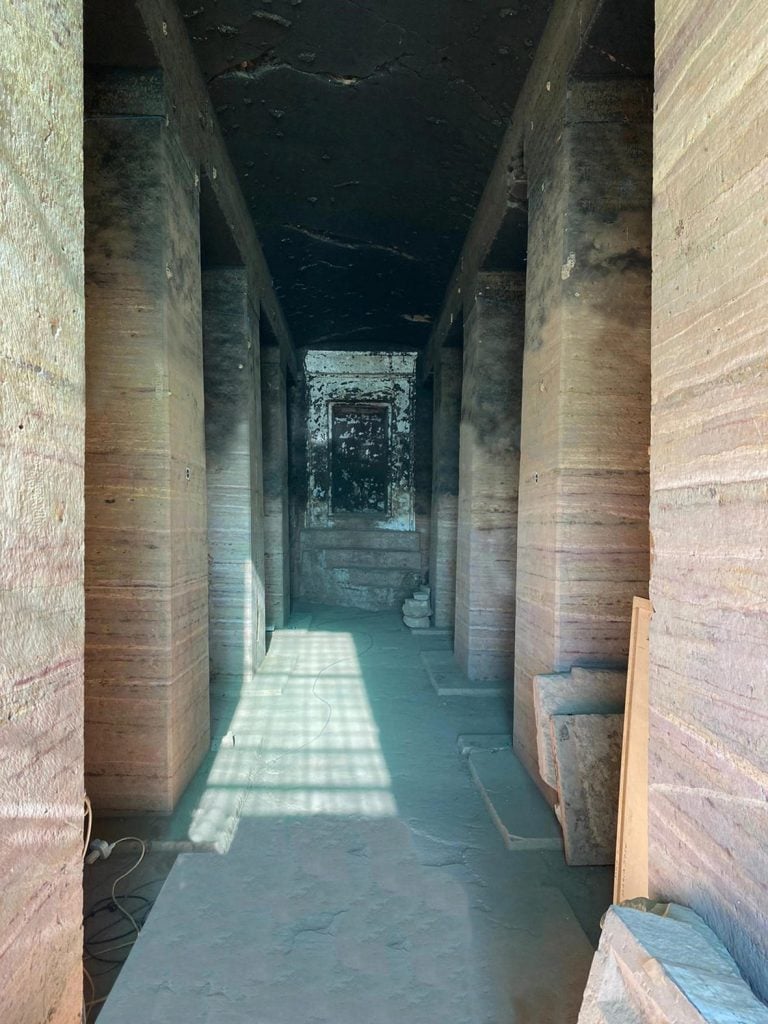
Perched in the necropolis of Qubbet el-Hawa, the structure is precisely oriented to the winter solstice sunrise, allowing the sun’s rays to shine upon the intended resting place of a governor of the city of Elephantine.
A team of researchers from the University of Malaga (UMA) and the University of Jaen (UJA) has uncovered Egypt’s oldest tomb aligned with the winter solstice. The tomb, situated in the necropolis of Qubbet el-Hawa in Aswan, is perfectly oriented towards the sunrise of the winter solstice, bathing the tomb with light and marking the final resting place of a governor of the city of Elephantine, who lived during the end of the XII Dynasty, around 1830 B.C.
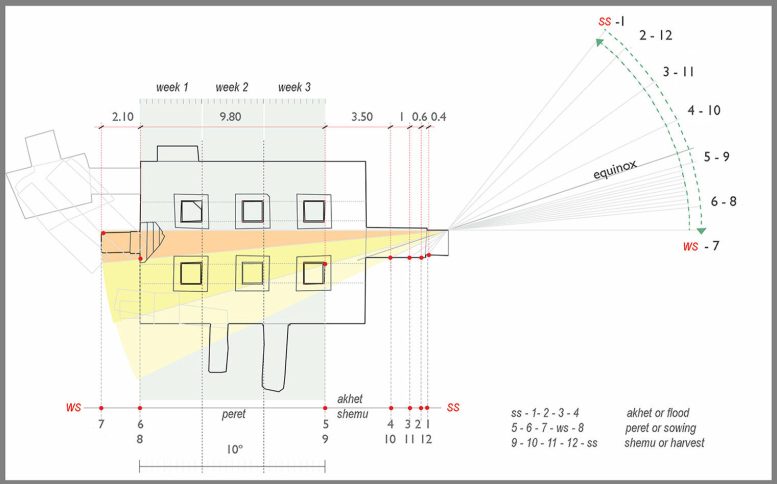
This alignment with the solstice allowed the tomb to perfectly track the solar cycle, linking it with the concept of rebirth. The winter solstice represented the start of the triumph of light over darkness, while the summer solstice coincided with the beginning of the annual flooding of the Nile, both events held great symbolic meaning in relation to the resurrection of the deceased governor.
Perfection in the Orientation
In this paper, recently published in the prestigious scientific journal Mediterranean Archaeology and Archaeometry, the researchers explain that, in order to achieve perfection in the orientation, the Egyptian architect simply used a two-cubit pole, around one meter long, a square, and some robes, with which he was able to perfectly calculate the orientation of the funerary chapel and the location of the statue of the governor.
Moreover, they explain that the Egyptian architect not only achieved the perfect orientation but also designed its volume with great precision, as determined in a previous paper published by the UJA in 2020 and signed by, among others, Professor Antonio Mozas –an author of the current study–, which revealed that the volume of the tomb was perfectly calculated to avoid being coincident with any previous tomb.
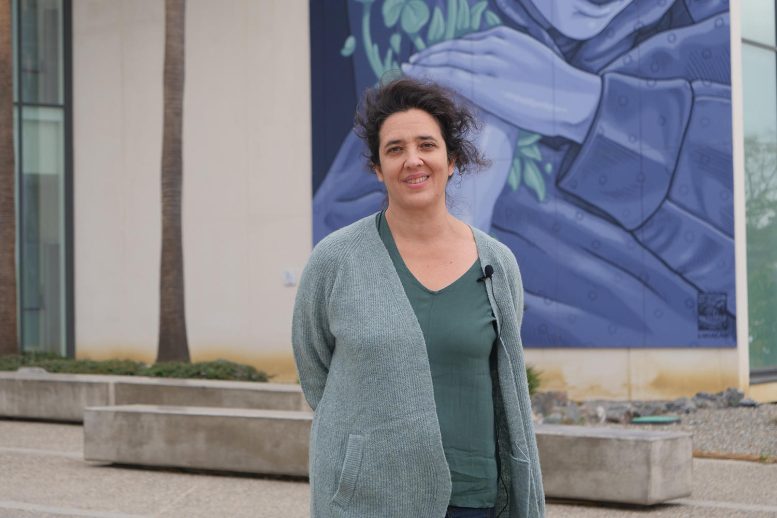
The tomb of this governor, cataloged with No. 33, and possibly built by Governor Heqaib-ankh, was excavated by the UJA between 2008 and 2018. From that time on, it has been architecturally studied by different specialists, among them, the Professor of Architecture at UMA Lola Joyanes, who has been participating in this project since 2015, working on her own line of research since 2019.
The work this researcher of the UMA has performed in the necropolis involves everything related to architecture and landscape, particularly, their study through drawing and photogrammetry.
A Specific Software To Reproduce the Position of the Sun
The Andalusian scientists reached these conclusions thanks to the identification of the period where the tomb was built, which allowed them to use a specific software (Dialux Evo) that reproduces the position of the sun with respect to the horizon in ancient times.
“This study demonstrates that Egyptians were capable of calculating the position of the sun and the orientation of its rays to design their monuments. Although the tomb No. 33 of Qubbet el-Hawa is the oldest example ever found, certainly it is not the only one”, say the scientists.
Reference: “Solar Geometry and the Organization of the Annual Cycle Through Architecture and the Funerary Landscape in Qubbet El Hawa” by María Joyanes-Díaz, Juan Martínez-De Dios, Antonio Mozas-Calvache, Jonathan Ruíz-Jaramillo, Carmen Muñoz-González and Alejandro Jiménez-Serrano, 22 July 2022, Mediterranean Archaeology and Archaeometry.
DOI: 10.5281/zenodo.681546
This research has been financed by the Government of Andalusia.
Never miss a breakthrough: Join the SciTechDaily newsletter.
Follow us on Google and Google News.
1 Comment
So what, they figured this out after Graham Hancock told them in a Netflix documentary? What a joke so called main stream archeologists are.funny he talks about it in his book from 30 years ago.