
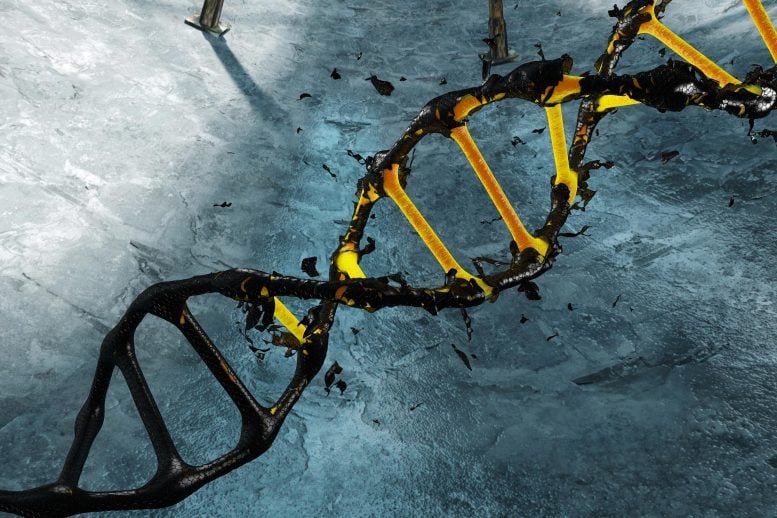
Studying the genomes of modern humans from 26 worldwide populations, researchers discovered the genetic “footprint” of an ancient coronavirus outbreak. Studies like this one could help identify viruses that have caused epidemics in the distant past and may do so in the future.
A new study co-authored by a University of Arizona researcher has discovered a coronavirus epidemic broke out in the East Asia region more than 20,000 years ago, with traces of the outbreak evident in the genetic makeup of people from that area.
In a paper published in Current Biology, researchers analyzed the genomes of more than 2,500 modern humans from 26 worldwide populations, to better understand how humans have adapted to historical coronavirus outbreaks. The team, co-led by researchers at the University of Arizona and the University of Adelaide, used computational methods to uncover genetic traces of adaptation to coronaviruses, the family of viruses responsible for three major outbreaks in the last 20 years, including the ongoing COVID-19 pandemic.
Past Epidemics Leave Genetic Signatures
In the past 20 years, there have been three outbreaks of epidemic severe coronaviruses: SARS-CoV leading to Severe Acute Respiratory Syndrome, which originated in China in 2002 and killed more than 800 people; MERS-CoV leading to Middle East Respiratory Syndrome, which killed more than 850 people; and SARS-CoV-2 leading to COVID-19, which has killed 3.8 million people.
But this study of the evolution of the human genome has revealed another large coronavirus epidemic broke out thousands of years earlier.
“It is like finding fossilized dinosaur footprints instead of finding fossilized bones directly,” said David Enard, a professor in the UArizona Department of Ecology and Evolutionary Biology and one of the study’s lead authors. “We did not find the ancient virus directly – instead we found signatures of the natural selection that it imposed on human genomes at the time of an ancient epidemic.”

The team synthesized both human and SARS-CoV-2 proteins, without using living cells, and showed that these interacted directly and specifically pointed to the conserved nature of the mechanism coronaviruses use to invade cells. Modern human genomes contain evolutionary information tracing back hundreds of thousands of years, including physiological and immunological adaptions that have enabled humans to survive new threats, including viruses.
Ancient Coronavirus Epidemic in East Asia
The results revealed that the ancestors of East Asian people experienced an epidemic of a coronavirus-induced disease similar to COVID-19. East Asian people come from the area that is now China, Japan, Mongolia, North Korea, South Korea, and Taiwan.
To invade cells, a virus must attach and interact with specific proteins produced by the host cell known as viral interacting proteins, or VIPs. The researchers found signs of adaptation in 42 different human genes encoding VIPs, suggesting the ancestors of modern East Asians were first exposed to coronaviruses over 20,000 years ago.
“We found the 42 VIPs are primarily active in the lungs – the tissue most affected by coronaviruses – and confirmed that they interact directly with the virus underlying the current pandemic,” said the paper’s first author Yassine Souilmi of the University of Adelaide’s School of Biological Sciences.
In addition to the VIPs, which are located on the surface of a host cell and used by coronaviruses to enter the cell, the viruses interact with many other cellular proteins once inside.
Genetic Adaptations Helped Ancestors Survive
“We found that those human genes that code for proteins that either prevent or help the virus to multiply have experienced a lot more natural selection about 25,000 years ago than you would typically expect,” Enard said.
The work shows that over the course of the epidemic, selection favored certain variants of human genes involved in the virus-cell interactions that could have led to a less severe disease. Studying the “tracks” left by ancient viruses can help researchers better understand how the genomes of different human populations adapted to viruses that have emerged as important drivers of human evolution.
Other independent studies have shown that mutations in VIP genes may mediate coronavirus susceptibility and also the severity of COVID-19 symptoms. And several VIPs are either currently being used in drug treatments for COVID-19 or are part of clinical trials for further drug development.
Evolutionary Clues for Future Pandemic Preparedness
“Our past interactions with viruses have left telltale genetic signals that we can leverage to identify genes influencing infection and disease in modern populations, and can inform drug repurposing efforts and the development of new treatments,” said study co-author Ray Tobler from the University of Adelaide’s School of Biological Sciences.
“By uncovering the genes previously impacted by historical viral outbreaks, our study points to the promise of evolutionary genetic analyses as a new tool in fighting the outbreaks of the future,” Souilmi said.
The study’s authors say their research could help identify viruses that have caused epidemics in the distant past and may do so in the future. Studies like theirs help researchers compile a list of potentially dangerous viruses and then develop diagnostics, vaccines, and drugs for the event of their return.
Reference: “An ancient viral epidemic involving host coronavirus interacting genes more than 20,000 years ago in East Asia” by Yassine Souilmi, M. Elise Lauterbur, Ray Tobler, Christian D. Huber, Angad S. Johar, Shayli Varasteh Moradi, Wayne A. Johnston, Nevan J. Krogan, Kirill Alexandrov and David Enard, 24 June 2021, Current Biology.
DOI: 10.1016/j.cub.2021.05.067
Never miss a breakthrough: Join the SciTechDaily newsletter.
Follow us on Google and Google News.
2 Comments
Well done Detectives.
Looks like finaly the power of the Computing and Satistical Correlation is helpful.
Some suggestions for Consideration.
1.
Can we figure out how we can speed up the Pandemic to make it endemic rapidly (in much shorter time frames) after figuring out how it enters the human ecosystem and preventing infection, except the harmless endemic variety, which may provide the natural immunity from the harmful variety?
2.
Can we figure out how we can enhance the Immunity of the Human Ecosystem, to ensure that it is able to fight of the Harmful Viruses, Bacteria and Pathogens using the “Set a thief to catch a thief” strategy? For e.g. , from ancient times we know that Curd after a meal has a salutory effect on the digestive system, as it introduces friendly bacteria which enhances the ability of the digestive system to work more efficienty and effectively in the digestion of food. I remember reading that some very Long lived people in the Mountatins of Afghanistan ( Centurions all) , eat a lot of Curd.
I suspect that the source of most diseaes , originates in the stomach and can be traced back to the unfriendly stuff we introduce into the microbiome.
The second brain needs to be kept in Balance for good health.
Views expressed are personal and not binding on anyone.
I recommend you a wonderful site reports that will help you write any written work https://www.jcpenneykiosk.run/