
Close Menu
    Facebook X (Twitter) Instagram
    SciTechDaily
    • Biology
    • Chemistry
    • Earth
    • Health
    • Physics
    • Science
    • Space
    • Technology
    Facebook X (Twitter) Pinterest YouTube RSS
    SciTechDaily
    Home»Health»Researchers Discover New Way To Wake Up Cancer-Killing T Cells
    Health

    Researchers Discover New Way To Wake Up Cancer-Killing T Cells

    By University of SouthamptonJanuary 11, 20269 Comments4 Mins Read
    Facebook Twitter Pinterest Telegram LinkedIn WhatsApp Email Reddit
    Share
    Facebook Twitter LinkedIn Pinterest Telegram Email Reddit
    White Blood Cells Attacking Cancer Cell Close
    Researchers have developed a new way to amplify immune signaling that could help T cells respond more effectively to cancer. By redesigning antibodies to better mimic natural immune activation, the approach reveals a promising strategy for strengthening immunotherapy without directly targeting tumors themselves. Credit: Shutterstock

    A new multi-pronged antibody design could help immune cells receive stronger activation signals against cancer.

    Researchers at the University of Southampton have identified a new strategy that could strengthen how the immune system responds to cancer.

    Reporting their findings in Nature Communications, the scientists describe the use of specially engineered antibodies designed to more effectively switch on T cells that are capable of destroying cancer cells.

    These antibodies act by ‘grabbing’ and ‘clustering’ several immune cell receptors at once, increasing the strength of the signal that instructs T cells to attack tumors.

    The work was led by a team at the University of Southampton’s Centre for Cancer Immunology and focused on an immune receptor known as CD27. To activate T cells, CD27 requires a specific matching key (ligand). This ligand is naturally produced during infections, but it is largely absent in cancer. Without this signal, T cells are only weakly activated and struggle to mount an effective response against cancer cells.

    Limits of Conventional Antibodies

    Antibodies can function like a master key by binding to immune receptors, but most antibodies used in current treatments have a Y-shaped structure with only two binding points. This limits them to engaging just two receptors at the same time.

    Although antibody therapies have transformed cancer care, they are not effective for all patients. In many cases, T cells fail to receive the full set of activation signals needed to become fully functional.
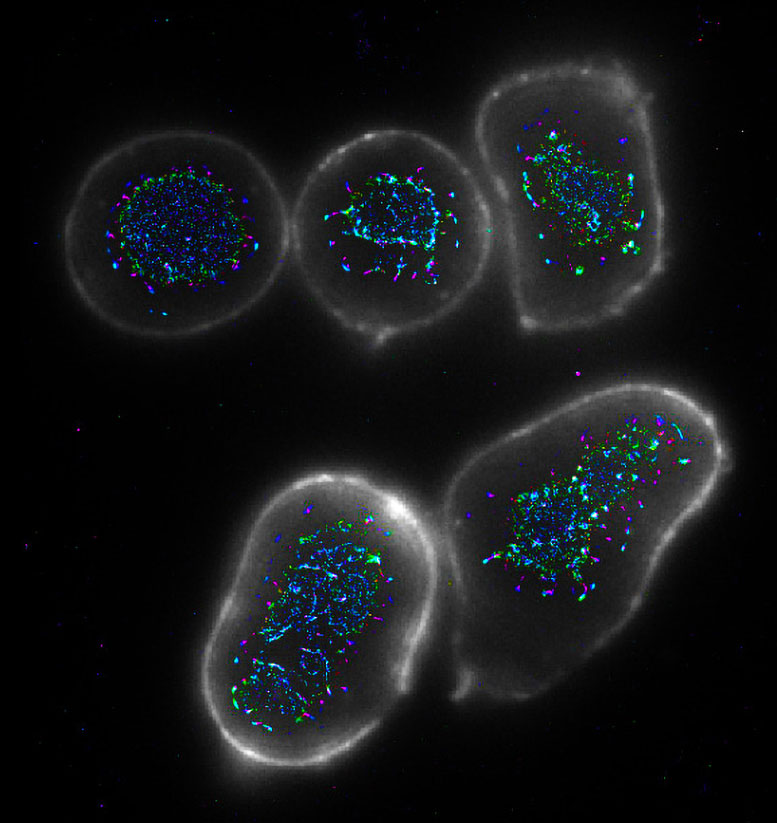
    Microscopy Image Depicting Immune Receptor Distribution Analysis in Human T Cells
    The same-colored spots represent receptors that are clumped together in a single cluster. This image is made by superimposing two different images from two different techniques. One that ‘slices’ through the cell to show clusters on the periphery and a super-resolution technique that gives higher resolution of the clusters (the colored spots). Credit: University of Southampton

    To address this, the researchers created antibodies with four binding points, enabling them to attach to a greater number of receptors. These antibodies also recruit a second cell, which forces the bound CD27 receptors to cluster together. This process strengthens the activation signal and closely replicates how CD27 is triggered naturally within the body.

    Professor Aymen Al‑Shamkhani at the University of Southampton, who led the study, explains: “We already understood how the body’s natural CD27 signal switches on T cells, but turning that knowledge into a medicine was the real challenge. Antibodies are reliable molecules that make excellent drugs. However, the natural antibody format was not powerful enough, so we had to create a more effective version.”

    Stronger Anti-Tumor Responses

    In lab studies using mice as well as human immune cells, the new antibodies were more effective in switching on CD8⁺ T cells – the ‘special forces’ of the immune system, than standard Y-shaped antibodies, delivering a more robust antitumor response.

    By making CD27 more responsive to therapeutic targeting, the findings provide a blueprint for developing next‑generation immunotherapies that harness the immune system to fight cancer more effectively.

    Professor Al‑Shamkhani said: “This approach could help improve future cancer treatments by allowing the immune system to work closer to its full potential.”

    Reference: “Harnessing multivalency and FcγRIIB engagement to augment anti-CD27 immunotherapy” by Marcus A. Widdess, Anastasia Pakidi, Hannah J. Metcalfe, H. T. Claude Chan, Tatyana Inzhelevskaya, Chris A. Penfold, C. Ian Mockridge, Steven G. Booth, Sonya James, Sean H. Lim, Stephen A. Beers, Mark S. Cragg and Aymen Al-Shamkhani, 20 December 2025, Nature Communications.
    DOI: 10.1038/s41467-025-67882-3

    The research was funded by Cancer Research UK and highlights the Centre for Cancer Immunology’s role in advancing innovative cancer immunotherapies.

    Never miss a breakthrough: Join the SciTechDaily newsletter.
    Follow us on Google and Google News.

    Antibodies Cancer Immunology Popular University of Southampton
    Share. Facebook Twitter Pinterest LinkedIn Email Reddit

    Related Articles

    Harnessing the Power of Nature To Improve Anti-Cancer Therapy

    COVID Antibodies Remain Stable – or Even Increase – 7 Months After Infection

    Highly Potent COVID Treatment: New Nanobodies Stop SARS-CoV-2 and Its Dangerous Variants

    New Treatment Breakthrough: Helping the Immune System Search Out and Destroy Cancer Cells

    Common Antidepressant Medication Helps Fight Cancer in Mice – May Activate Immune System to Shrink Tumors

    Groundbreaking Research Optimizes Body’s Own Immune System to Fight Cancer

    Antibody Binding-Site Conserved Across COVID-19 Virus Variants – Big Implications for Future Vaccines

    Researchers Discover New Disease That Prevents Formation of Antibodies

    Scientists Discover a Way to Control the Immune System’s “Natural Killer” Cells With “Invisible” Stem Cells

    9 Comments

    1. Denis March on January 11, 2026 11:14 pm

      Very interesting keep up the good work and the future is looking a bit better for the future. Well done to all concerned. 👌

      Reply
    2. Pamela on January 12, 2026 3:24 am

      Can you get in à clinical trail around Cleveland oh

      Reply
    3. Judy on January 12, 2026 1:18 pm

      Carob powder wards off cancer, breast Cancer Watermelon and book title The cause for cancer Revealed Author Dr Cass Ingram AMAZON cancer can’t live in a Alkaline body.

      Reply
      • Franklin on January 14, 2026 2:00 pm

        Has main stream medical been made aware of these findings. )ike the V.A.

        Reply
    4. Lugisani mufamadi on January 13, 2026 3:51 am

      When will the treatment be rolled out? I’m in South Africa and living with cancer

      Reply
    5. Patti on January 13, 2026 3:59 am

      This is very encouraging news. I would be interested in joining a clinical trial. I was diagnosed with multiple myeloma in May 2025 and I am still going thru chemo and immunotherapy.

      Reply
      • William Henry on January 13, 2026 5:27 am

        Can I please sign up for trials?

        Reply
      • Jennifer mckeon on January 15, 2026 11:05 am

        How do I sign up for trials currently going through breast cancer

        Reply
    6. Bal on January 15, 2026 4:04 pm

      Well done indeed!!!
      Immeasurable hope to the suffering!
      Details of planned trials will no doubt bring in more donations & funding!

      Reply
    Leave A Reply Cancel Reply

    • Facebook
    • Twitter
    • Pinterest
    • YouTube

    Don't Miss a Discovery

    Subscribe for the Latest in Science & Tech!

    Trending News

    Your Blood Pressure Reading Could Be Wrong Because of One Simple Mistake

    Astronomers Stunned by Ancient Galaxy With No Spin

    Physicists May Be on the Verge of Discovering “New Physics” at CERN

    Scientists Solve 320-Million-Year Mystery of Reptile Skin Armor

    Scientists Say This Daily Walking Habit May Be the Secret to Keeping Weight Off After Dieting

    New Therapy Rewires the Brain To Restore Joy in Depression Patients

    Giant Squid Detected off Western Australia in Stunning Deep-Sea Discovery

    Popular Sugar-Free Sweetener Linked to Liver Disease, Study Warns

    Follow SciTechDaily
    • Facebook
    • Twitter
    • YouTube
    • Pinterest
    • Newsletter
    • RSS
    SciTech News
    • Biology News
    • Chemistry News
    • Earth News
    • Health News
    • Physics News
    • Science News
    • Space News
    • Technology News
    Recent Posts
    • Scientists Discover “Hidden” Materials That Could Transform Clean Energy and Batteries
    • Scientists Just Measured an Energy Pulse Smaller Than a Trillionth of a Billionth of a Joule
    • 540-Million-Year-Old Fossils Reveal a Huge Surprise About Early Life on Earth
    • Scientists Create “Living” Materials That Crawl, Walk, and Dig on Their Own
    • Dante’s Inferno May Secretly Be About a Planet-Destroying Asteroid Strike
    Copyright © 1998 - 2026 SciTechDaily. All Rights Reserved.
    • Science News
    • About
    • Contact
    • Editorial Board
    • Privacy Policy
    • Terms of Use

    Type above and press Enter to search. Press Esc to cancel.