
A research team has managed to “bottle” a highly reactive carbene in water, overturning a major assumption in chemistry.
Chemists have pulled off a feat long considered impossible: they created a normally ultra-reactive molecule called a carbene and kept it stable in water for months, a result that finally delivers direct evidence for a vitamin B1 theory proposed nearly 70 years ago.
Carbenes are unusual carbon species with an electron configuration that makes them extremely reactive. In 1958, Columbia University chemist Ronald Breslow proposed that vitamin B1 (thiamine) carries out key metabolic chemistry by briefly forming a carbene-like intermediate.
The problem is that carbenes are unusually reactive carbon species that are typically destroyed almost instantly in water, so they seemed fundamentally incompatible with the body’s water-rich environment, making Breslow’s idea difficult to prove.
A team led by UC Riverside chemist Vincent Lavallo has now designed a carbene that is not just water-tolerant, but water-stable, and they confirmed it using nuclear magnetic resonance (NMR) spectroscopy and single-crystal X-ray crystallography.
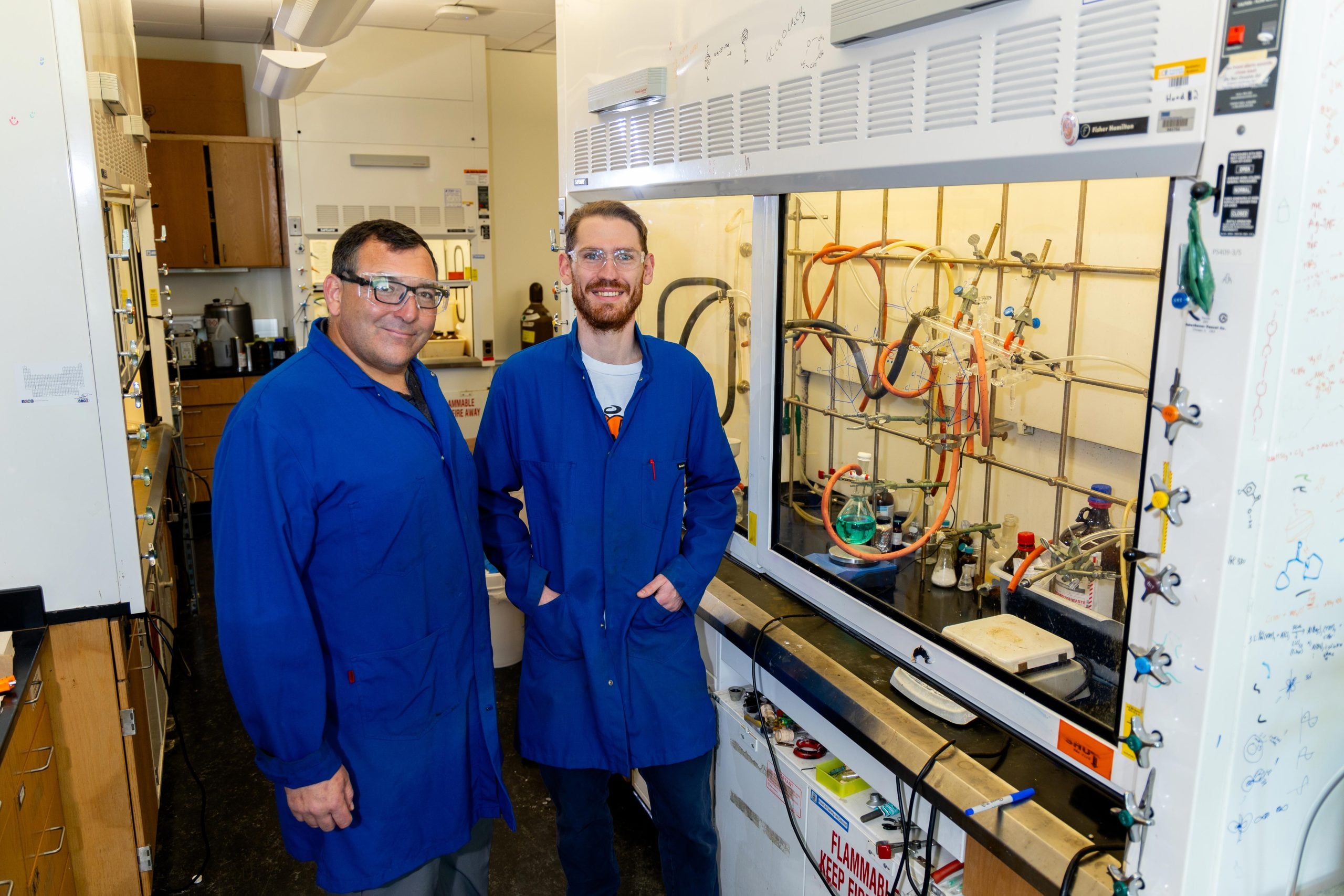
“This is the first time anyone has been able to observe a stable carbene in water,” said Vincent Lavallo, a professor of chemistry at UC Riverside and corresponding author of the paper. “People thought this was a crazy idea. But it turns out, Breslow was right.”
How they made a carbene that water can’t destroy
The breakthrough came from engineering both steric shielding and electronic tuning—essentially building a protective “pocket” around the reactive carbon. Lavallo’s group wrapped the carbene center in a bulky, highly chlorinated carborane-based framework, which acts like a molecular “suit of armor.” The crowded 3D structure physically blocks water from attacking the carbene’s reactive orbitals, while the electron-withdrawing substituents help shift the acid–base balance so the carbene form is less easily shut down by water.
The team tracked formation of the carbene by characteristic NMR signatures, especially in carbon-13 NMR, where the carbene carbon appears at a distinctly downfield chemical shift. X-ray crystallography then provided a direct structural snapshot, confirming the molecule’s geometry and showing the carbene carbon sits buried within a sterically protected environment.
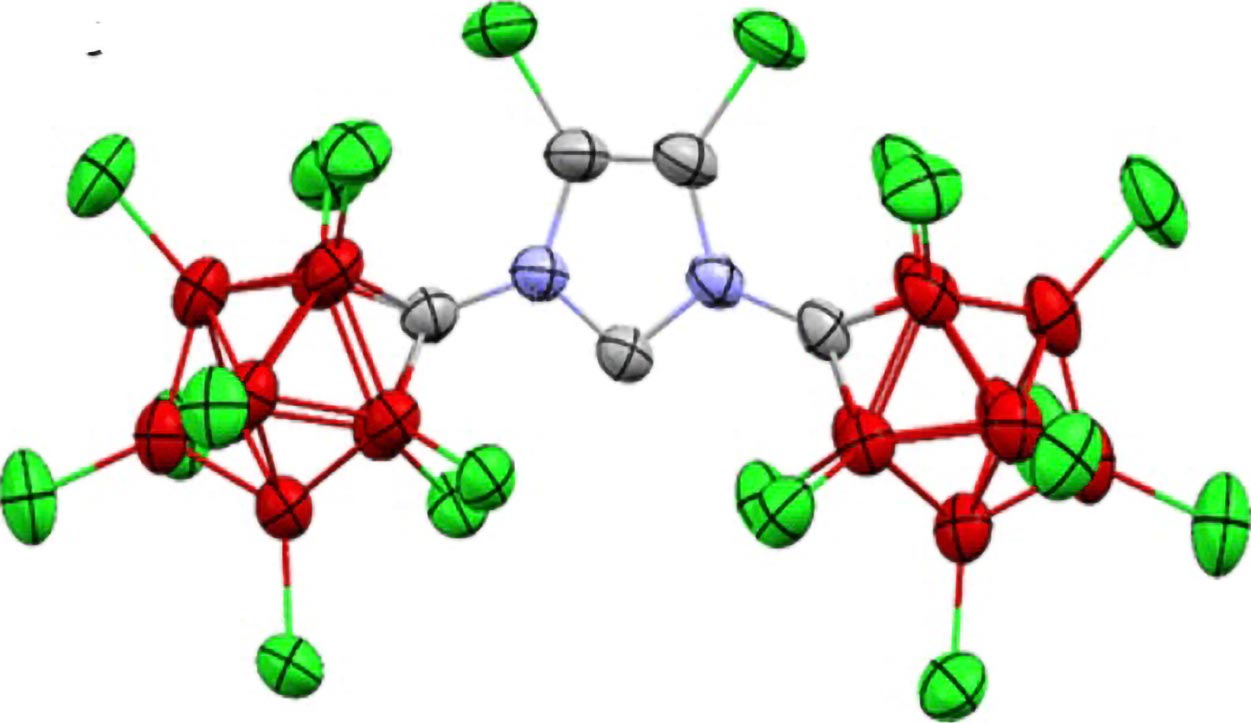
The carbene showed no detectable decomposition over months of monitoring—an extraordinary result for a species that normally can’t last seconds in water.
“We were making these reactive molecules to explore their chemistry, not chasing a historical theory,” said first author Varun Raviprolu, who completed the research as a graduate student at UCR and is now a postdoctoral researcher at UCLA. “But it turns out our work ended up confirming exactly what Breslow proposed all those years ago.”
What it says about vitamin B1 chemistry
This doesn’t mean the body makes this exact armored carbene. Enzymes don’t use chlorinated carborane cages. But the work demonstrates a key principle: a carbene can exist in water if it is sufficiently protected and the equilibrium conditions favor its formation, a concept that helps reconcile how thiamine-dependent enzymes can plausibly access carbene-like intermediates despite operating in aqueous environments.
It also aligns with how many enzymes work in general: they often create microenvironments that control reactivity-positioning groups, excluding bulk water in specific ways, and stabilizing high-energy intermediates long enough for chemistry to proceed.

Why industry cares: catalysts and greener solvents
Carbenes aren’t just biochemical curiosities. They’re widely used as ligands in metal catalysts that drive important industrial reactions, including steps in pharmaceutical and materials synthesis. Today, many of those processes rely on toxic or flammable organic solvents partly because water can destroy key intermediates.
If chemists can translate the stabilization concept into catalysts that are both water-stable and still reactive, it could open the door to cleaner manufacturing that uses water as the main solvent.
“Water is the ideal solvent — it’s abundant, non-toxic, and environmentally friendly,” Raviprolu said. “If we can get these powerful catalysts to work in water, that’s a big step toward greener chemistry.”
A window into “invisible” intermediates
Perhaps the biggest scientific promise is methodological: protecting fragile intermediates so they can be directly observed. Many reaction mechanisms invoke short-lived species that are inferred but not captured.
“There are other reactive intermediates we’ve never been able to isolate, just like this one,” Lavallo said. “Using protective strategies like ours, we may finally be able to see them and learn from them.”
And for Lavallo, the result marks a shift in what chemists consider possible: “Just 30 years ago, people thought these molecules couldn’t even be made,” he said. “Now we can bottle them in water. What Breslow said all those years ago — he was right.”
Reference: “Confirmation of Breslow’s hypothesis: A carbene stable in liquid water” by Varun Tej Raviprolu, Aaron Gregory, Isaac Banda, Scott G. McArthur, Sarah E. McArthur, William A. Goddard III, Charles B. Musgrave III and Vincent Lavallo, 11 April 2025, Science Advances.
DOI: 10.1126/sciadv.adr9681
The study was funded by the National Science Foundation.
A version of this article was originally published in May 2025.
Never miss a breakthrough: Join the SciTechDaily newsletter.
Follow us on Google and Google News.
10 Comments
Nice great Job!
First they laugh and call you crazy, and then… 😁 (not to imply all laughed at craziness will turn out to be true, but true new ideas are treated the same as any truly crazy idea) I applaud the discovery and also the curiosity and determination to make this proof happen when even many peers in science were probably still laughing about even trying. Well done🥹
(My personal “please dear God someone formally study this, I’m unable to” is… essential oils. (Pause for eye rolls😂) But not for aromatherapy. For use as an oral antibiotic, maybe broader antimicrobial. One study does show at least that particularly oregano essential oil is an effective antibiotics. I took the next step – tested it on myself (with maximum precautions ofc) …and successfully got rid of a kidney infection that all pharma antibiotics couldn’t remove (kidney cysts involvement, shelters some infecting bacteria from bloodstream presence of typical oral antibiotics); it worked. Leaving me seeming crazy and also frustrated as heck that this isn’t yet being used, or even studied more, to help, maybe save, others with antibiotic resistant infections. Why post this here? I guess mostly expanding on that I understand how hard it is & what it must have taken to be listened to enough to even make the study happen; Proud of and happy for you for that (and then a second time for proving the theory)! 🙂
So I’m curious to ask how was your oregano oil used to cure kidney infection was an ingested orally or was it applied to the area? Thank you.
Yes, oregano oil capsules work as an antibiotic and also tooth pain. It is amazing!
GOD BLESS YOUR 🙌 🙏 ♥️ 😊 ❤️ WORK.
The image doesn’t match the caption below it.
X-ray diffractometers cannot produce orbital phase images
No carbene center exists in the structure
The electronic structure shown contradicts carbene chemistry
Correct caption would be:
“DFT-calculated molecular orbital of a bimetallic coordination complex.”
Nothing in this image is “seen by X-ray diffraction,” and nothing in it is a carbene.
The image doesn’t match the caption below it. Water stable carbene as seen by the x-ray diffractometer.
X-ray diffractometers cannot produce orbital phase images
No carbene center exists in the structure
The electronic structure shown contradicts carbene chemistry
Correct caption would be:
“DFT-calculated molecular orbital of a bimetallic coordination complex.” Nothing in this image is “seen by X-ray diffraction,” and nothing in it is a carbene.
Cool 😎 info 😎 👌 .
The image doesn’t match the caption below it. Water stable carbene as seen by the x-ray diffractometer.
There is a Chinese website plagiarism your article
https://www.google.com/amp/s/health.ltn.com.tw/amp/article/breakingnews/5292713