
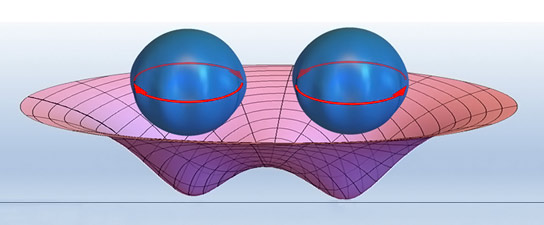
A new grant from the W.M. Keck Foundation will help fund experiments at Yale University that may provide new insights into quantum gravity.
Yale University has received a grant from the W. M. Keck Foundation to fund experiments that researchers hope will provide new insights into quantum gravity. Jack Harris, associate professor of physics, will lead a Yale team that aims to address a long-standing question in physics — how the classical behavior of macroscopic objects emerges from microscopic constituents that obey the laws of quantum mechanics.
Very small objects like photons and electrons are known for their odd behavior. Thanks to the laws of quantum mechanics, they can act as particles or waves, appear in multiple places at once, and mysteriously interact over great distances. The question is why these behaviors are not observed in larger objects.
Scientists know that friction plays an important part in producing classical behavior in macroscopic objects, but many suspect that gravity also suppresses quantum effects. Unfortunately, there has been no practical way to test this possibility, and in the absence of a full quantum theory of gravity, it is difficult even to make any quantitative predictions.
To address this problem, Harris will create a novel instrument that will enable a drop of liquid helium to exhibit quantum mechanical effects. “A millimeter across,” Harris said, “our droplet will be five orders of magnitude more massive than any other object in which quantum effects have been observed. It will enable us to explore quantum behavior on unprecedentedly macroscopic scales and to provide the first experimental tests of leading models of gravity at the quantum level.”
Game-changing research
The W.M. Keck Foundation grant will fund five years of activity at the Harris lab, which is part of Yale’s Department of Physics. In the first year, Harris and his team will construct their apparatus, and in subsequent years they will use it to perform increasingly sophisticated experiments.
“We are extremely grateful to the W.M. Keck Foundation for this generous support,” said Steven Girvin, the Eugene Higgins Professor of Physics and deputy provost for research. “This is a forward-looking grant that will advance truly ground-breaking research.”
Girvin, whose own research interests include quantum computing, described the Harris project as a possible game-changer. “Truly quantum mechanical behaviors have been observed in the flight of molecules through a vacuum and in the flow of electrons through superconductive circuits, but nothing has been accomplished on this scale. If Jack succeeds, this would be the first time that an object visible to the naked eye has bulk motion that exhibits genuine quantum mechanical effects.”
Into the whispering gallery
To explain his project, Harris invokes an architectural quirk of St. Paul’s Cathedral, a London landmark with a famous “whispering gallery.” High up in its main dome, a whisper uttered against one wall is easily audible at great distances, as the sound waves skim along the dome’s interior. Harris plans to create his own whispering gallery, albeit on a smaller scale, using a droplet of liquid helium suspended in a powerful magnetic field. Rather than sound waves, Harris’ gallery will bounce a single photon.
This approach is closely related to an idea proposed by Albert Einstein in the 1920s, but until now, it has remained beyond the technical capabilities of experimentalists. To complete the experiment, Harris will need to combine recent advances in three different areas of physics: the study of optical cavities (objects that can capture photons), magnetic levitation, and the strange, frictionless world of superfluid helium.
“Superfluid liquid helium has particular properties, like absence of viscosity and near-absence of optical absorption,” Harris explained. “In our device, a drop of liquid helium will be made to capture a single photon, which will bounce around inside. We expect to see the drop respond to the photon.
“A photon always behaves quantum mechanically,” he added. “If you have a macroscopic object — our helium drop — that responds appreciably to a photon, the quantum mechanical behavior can be transferred to the large object. Our device will be ideally suited to studying quantum effects in the drop’s motion.”
Potential applications for Harris’ research include new approaches to computing, cryptography, and communications. But Harris is most excited about the implications for fundamental physics: “Finding a theory of quantum gravity has been an outstanding challenge in physics for several decades, and it has proceeded largely without input from experiments. We hope that our research can provide some empirical data in this arena.”
Never miss a breakthrough: Join the SciTechDaily newsletter.
Follow us on Google and Google News.
1 Comment
Looking at the relative theory that Energy=Mass times a Constant, E=MC2 from a whole absolute infinite view, we find that Infinite Energy=Infinite Mass without a constant. E…=M… The infinite view does not explain the interaction of individual electrons, and light, but reveals a total absolute relation of all matter and all energy and an understanding that gravity is a motion of all space surrounding each particle and not just a property of matter.