
Renewable resource has potential to revolutionize our energy system.
In an indication of growing interest in the holy grail of geothermal energy—tapping into the superhot rock miles below our feet—18 papers on the topic were presented over multiple sessions at a recent major conference on the overall geothermal industry.
“By driving down costs and making large-scale geothermal power available nearly anywhere, Superhot Rock energy has the potential to disrupt and revolutionize the energy system.” That’s according to a description of the sessions on Technological, Engineering, and Geological Advances in Superhot Geothermal presented at the 2023 Geothermal Rising Conference held over four days in October.
“For me, a pretty big highlight of Geothermal Rising 2023 was the increased focus on superhot rock geothermal through multiple presentations from around the world,” says Matt Houde, co-founder and project manager at Quaise Energy.
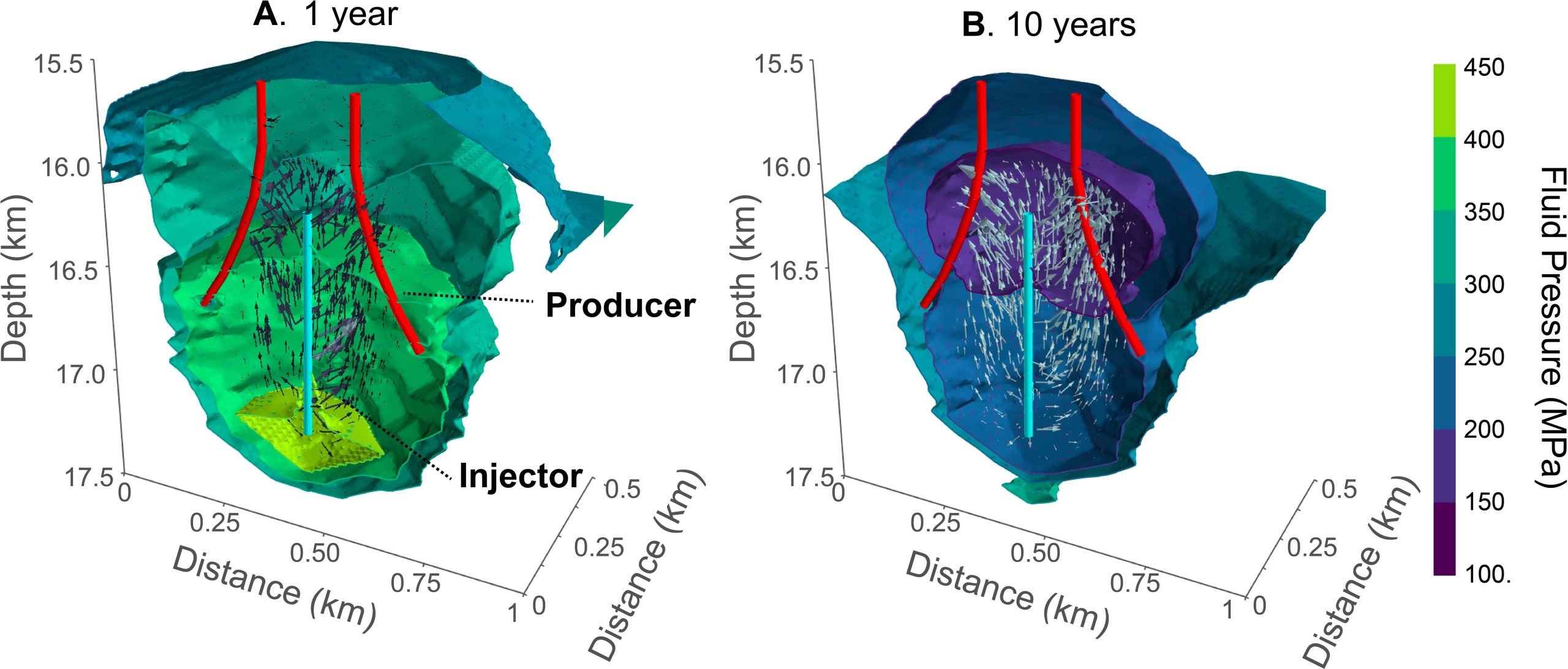
Houde is a co-author of two papers presented at the conference. Both report on research showing that superhot geothermal “can be viable,” he says. One of the papers describes work led by researchers from Europe on the first computer simulations of a Superhot Enhanced Geothermal System (EGS) reservoir capable of plumbing the energy from more than six miles (10-20 km) down where rocks can reach temperatures of more than 752 degrees Fahrenheit (400oC).
The other paper describes work led by researchers at TEVERRA, LLC, on the stability of a geothermal well extending miles into the Earth, where superhot temperatures are abundant. It addresses some of the challenges associated with drilling and producing geothermal energy at such depths.
Houde emphasized that although both papers “validate some of our assumptions on the potential of a superhot reservoir,” additional research is necessary. “We need more experimental data to fully determine the viability of the resource.”
The Energy Down Deep
The mother lode of geothermal energy is some 2 to 12 miles beneath the Earth’s surface where the rock is so hot that if water could be pumped to the area it would become supercritical, a steam-like phase that most people aren’t familiar with. (Familiar phases are liquid water, ice, and the vapor that makes clouds.) Supercritical water, in turn, can carry some 5-10 times more energy than regular hot water, making it an extremely efficient energy source if it could be pumped above ground to turbines that could convert it into electricity.
Today we can’t access those resources. The number one problem: we can’t drill down far enough. The drills used by the oil and gas industries can’t withstand the formidable temperatures and pressures that are found miles down without becoming exponentially more expensive with depth.
Quaise is working to replace the conventional drill bits that mechanically break up the rock with millimeter wave energy (cousins to the microwaves many of us cook with). Those millimeter waves literally melt then vaporize the rock to create ever deeper holes.
As the company develops the technology, it is also funding basic research to give a better understanding of the dynamics and conditions associated with tapping the heat deep below our feet. Says Carlos Araque, CEO of Quaise, “We don’t want to just blindly drill a hole and hope for the best. We want to make sure that we’re using the best human knowledge and understanding to know what to expect.”
First Simulations
The paper on the first simulations of heat mining at 10-25 km depths was presented by its first author, Samuel Scott of the Institute of Earth Sciences at the University of Iceland. Additional authors, in addition to Houde, were Alina Yapparova of the Institute of Geochemistry and Petrology at ETH Zurich, and Philipp Weis of the GFZ Potsdam German Research Center for Geosciences.
While Scott’s presentation was limited in scope because the paper is currently under review by a scientific journal, he described the basic functionality of the models behind the simulations and a few results.
For example, he said, “our models show that superhot rock enhanced geothermal systems can achieve high power output with a small spatial footprint,” or amount of land needed atop the hole. More specifically, he said, “we found that hypothetical systems involving a well doublet or triplet can deliver a thermal power output of >100-120 MW per well for timescales of decades.” That’s 5-10 times more power than typically produced today from a conventional, shallower geothermal system, Houde says, and this improvement in power density could make geothermal competitive with oil and gas.
Scott notes that these results depend on the model assumptions, particularly the effectiveness of hydraulic stimulation at such depths. As a result, he and colleagues are continuing research to refine the models with more data and constraints on rock behavior. They are focusing on three key parameters: water flow within the holes, or wellbores; the chemical reactions expected to occur in the reservoir; and rock mechanics and fractures at these depths and temperatures.
Wellbore Stability
The paper on wellbore stability was presented by Jerjes Porlles of TEVERRA, LLC. His coauthors, in addition to Houde, are Andrew Madyarov, Joseph Batir, and Hamed Soroush, all of TEVERRA.
Specifically, Porlles and colleagues explored the stability of a wellbore at the depths that Quaise is targeting for superhot rock geothermal energy production. Says Porlles, “in this paper, we explored some of the dynamics behind fluid flow and cool water – rock interactions in a hypothetical borehole, and none of the models show borehole stability issues.” That said, he emphasized the need for additional data on, for example, rock type and associated material properties, and further testing on the material properties developed during the millimeter wave drilling process” being developed by Quaise.
The work on both of these papers was supported by Quaise Energy.
Never miss a breakthrough: Join the SciTechDaily newsletter.
Follow us on Google and Google News.
1 Comment
Very interesting. Good idea to explore all areas and outlets for other types of energy besides oil and gas, wind, etc. Great article.