
Close Menu
    Facebook X (Twitter) Instagram
    SciTechDaily
    • Biology
    • Chemistry
    • Earth
    • Health
    • Physics
    • Science
    • Space
    • Technology
    Facebook X (Twitter) Pinterest YouTube RSS
    SciTechDaily
    Home»Science»Researchers Investigate Turbulence in Planetary Cores
    Science

    Researchers Investigate Turbulence in Planetary Cores

    By CNRSJuly 26, 2017No Comments3 Mins Read
    Facebook Twitter Pinterest Telegram LinkedIn WhatsApp Email Reddit
    Share
    Facebook Twitter LinkedIn Pinterest Telegram Email Reddit
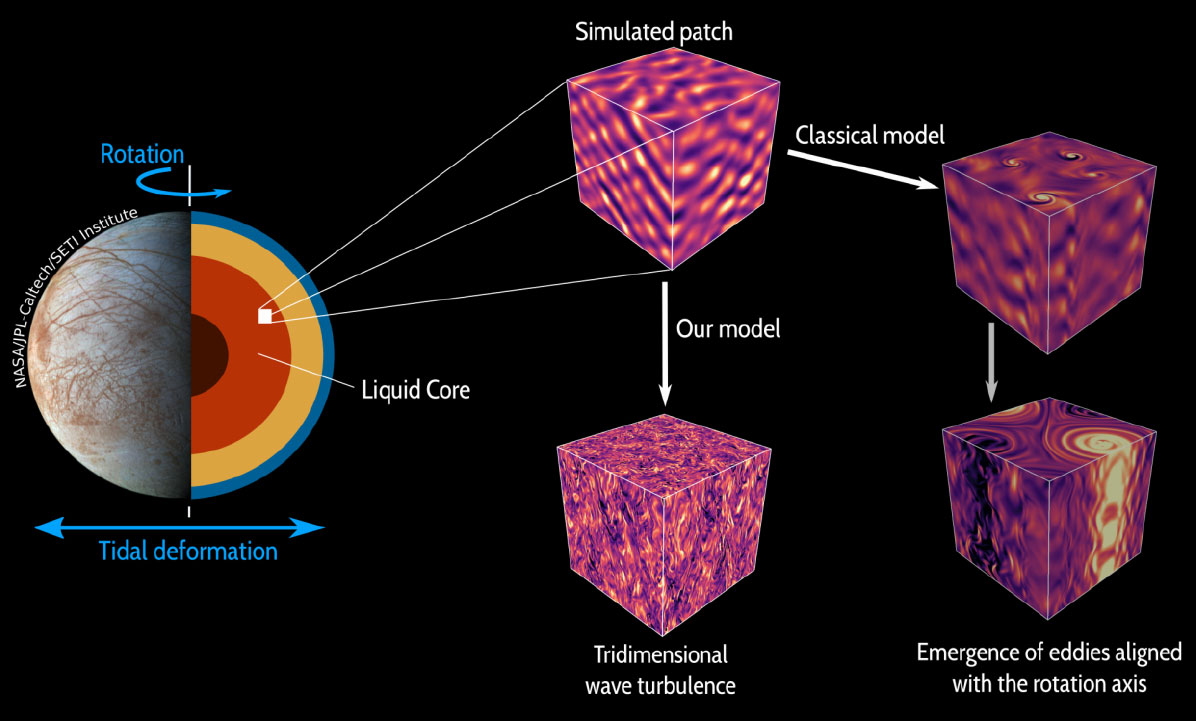
    Turbulence in Planetary Cores Excited by Tides
    Left: simulation of a cubic parcel located in the liquid core of a planet disturbed by tidal effects. By focusing their electronic analysis on this reduced domain, researchers have accessed regimes similar to planetary regimes. The flow takes the shape of superimposed waves that interact non-linearly until forming three-dimensional wave inertia turbulence (see vertical vorticity field in the center), by contrast with models where flow becomes larger-scale turbulence structures aligned with the axis of rotation (see vertical vorticity field on the right).

    New research investigates the combination of elliptical deformation of streamlines and vorticity that can lead to the destabilization of any rotating flow via the elliptical instability. Such a mechanism has been invoked as a possible source of turbulence in planetary cores subject to tidal deformations.

    Veritable shields against high-energy particles, planets’ magnetic fields are produced by iron moving in their liquid core. Yet the dominant model for explaining this system does not fit the smallest celestial bodies. Researchers at the Institut de Recherche sur les Phénomènes Hors Equilibre (IRPHE, CNRS/Aix Marseille Université/Centrale Marseille) and the University of Leeds have proposed a new model suggesting that turbulence in the liquid cores is due to tides produced by gravitational interactions between celestial bodies. The model infers that instead of being due to large, turbulent molten iron vortices far from the surface, movements in the core are due to the superposition of many wave-type motions. This work was published in Physical Review Letters on July 21, 2017.

    Scientists agree that magnetic fields form and remain due to iron flowing in the liquid core. Discussions become more complicated when they attempt to determine what allows these colossal masses to move. The dominant model is based on the slow cooling of celestial bodies, which causes convection, which in turn creates large vortices of molten iron parallel to the axis of rotation of the celestial body. But small planets and moons cool too quickly for a magnetic field to be maintained there by convection several billions of years after they form. Researchers at IRPHE (CNRS/Aix Marseille Université/Centrale Marseille) and the University of Leeds have now presented an alternative model where it is gravitational interactions between celestial bodies that disturb the core.

    Tides, produced by these gravitational interactions, do indeed disturb the core periodically and amplify wave movements naturally present in the rotating liquid iron. This phenomenon ends up producing a completely turbulent flow, whose nature is not yet well understood. To study this, researchers used a numerical model of a small parcel of a planetary core, rather than simulating the core as a whole, which would require too much calculation power. This approach allows fine characterization of the movements created in extreme geophysical regimes, while retaining the essential physical features. The researchers have shown that turbulence is the result of the superimposition of a very high number of wave movements that permanently exchange energy. This specific state, called wave turbulence, can be seen as analogous in three dimensions to the movement of the ocean’s surface, far from the shores.

    This work opens the path to new models that allow a better understanding and prediction of the properties of the magnetic field of celestial bodies. This tidal model would apply to all orbiting bodies that are sufficiently disturbed by neighboring stars, planets or moons.

    Reference: “Inertial Wave Turbulence Driven by Elliptical Instability” by Thomas Le Reun, Benjamin Favier, Adrian J. Barker and Michael Le Bars, 21 July 2017, Physical Review Letters.
    DOI: 10.1103/PhysRevLett.119.034502

    Never miss a breakthrough: Join the SciTechDaily newsletter.
    Follow us on Google and Google News.

    CNRS Geophysics Planetary Science Turbulence
    Share. Facebook Twitter Pinterest LinkedIn Email Reddit

    Related Articles

    Martian Rock Reveals a Record of the Planet’s Climate

    Yale Study Reveals Parts of Ancient Antarctica Were as Warm as Today’s California Coast

    Interplanetary Dust Particles Can Deliver Water and Organics to Terrestrial Planets

    Cloud-Chamber Experiments Show How Martian Clouds Form

    Xenon Gas Has Almost Vanished From the Atmosphere

    Coniophis Precedens, The Most Primitive Known Snake

    Experimental Evidence Verifies High-Pressure Structure for Cold-Compressed Graphite

    Friction on Raindrops Dissipates Almost as Much Atmospheric Energy as Turbulence

    MIT Researchers Use Mathematical Model to Predict Speed of Spreading Valleys

    Leave A Reply Cancel Reply

    • Facebook
    • Twitter
    • Pinterest
    • YouTube

    Don't Miss a Discovery

    Subscribe for the Latest in Science & Tech!

    Trending News

    First-of-Its-Kind Discovery: Homer’s Iliad Found Embedded in a 1,600-Year-Old Egyptian Mummy

    Beyond Inflammation: Scientists Uncover New Cause of Persistent Rheumatoid Arthritis

    A Simple Molecule Could Unlock Safer, Easier Weight Loss

    Scientists Just Built a Quantum Battery That Charges Almost Instantly

    Researchers Unveil Groundbreaking Sustainable Solution to Vitamin B12 Deficiency

    Millions of People Have Osteopenia Without Realizing It – Here’s What You Need To Know

    Researchers Discover Boosting a Single Protein Helps the Brain Fight Alzheimer’s

    World-First Study Reveals Human Hearts Can Regenerate After a Heart Attack

    Follow SciTechDaily
    • Facebook
    • Twitter
    • YouTube
    • Pinterest
    • Newsletter
    • RSS
    SciTech News
    • Biology News
    • Chemistry News
    • Earth News
    • Health News
    • Physics News
    • Science News
    • Space News
    • Technology News
    Recent Posts
    • New Research Challenges Long-Held Beliefs About How the Brain Makes Decisions
    • Breakthrough Technology Reveals New Treatment Targets for Cancer
    • Scientists Discover New Way To Make Drug-Resistant Cancer Treatable Again
    • This Simple Exercise Trick Builds Muscle With Less Effort, Study Finds
    • Middle Age Is Becoming a Breaking Point in America, Study Reveals
    Copyright © 1998 - 2026 SciTechDaily. All Rights Reserved.
    • Science News
    • About
    • Contact
    • Editorial Board
    • Privacy Policy
    • Terms of Use

    Type above and press Enter to search. Press Esc to cancel.