
A study in Ontario found that schizophrenia cases linked to cannabis use disorder have more than doubled since cannabis legalization.
Hospital visits for cannabis-related issues spiked by 270%, with young men being the most vulnerable.
Cannabis Legalization and Rising Schizophrenia Cases
The number of new schizophrenia cases linked to cannabis use disorder (CUD) has more than doubled in Ontario, rising from 4% before legalization to 10% after, according to new research.
A study published today (February 4) in JAMA Network Open by researchers from ICES, The Ottawa Hospital, the University of Ottawa’s Department of Family Medicine, and the Bruyère Health Research Institute analyzed healthcare data from all Ontario residents. The researchers examined whether the liberalization of medical cannabis in 2015 and the legalization of non-medical cannabis in 2018 influenced the association between cannabis use disorder (CUD) and new schizophrenia diagnoses.
Uncertainty and Risks of Cannabis Use
“Regular cannabis use is strongly associated with an increased risk of schizophrenia, and one of the main areas of uncertainty surrounding cannabis legalization is whether there would be changes in the number of new cases of schizophrenia,” says Dr. Daniel Myran, a Canada Research Chair in Social Accountability at the University of Ottawa, ICES Adjunct Scientist, Investigator at the Bruyère Health Research Institute, and Associate Scientist at The Ottawa Hospital.
“We found that there have been concerning increases over time in the percentage of people with a new schizophrenia diagnosis who had received care for a cannabis use disorder before their diagnosis.”
The study included all Ontario residents aged 14 to 65 years and eligible for universal health care (over 13.5 million individuals) and considered three policy time periods between 2006 and 2022: before legalization, after liberalization of medical cannabis, and after legalization of non-medical cannabis.
A total of 118,650 individuals (0.9% of the population of Ontario) had an emergency department visit or hospitalization for a CUD. Over the study period, 10,583 (9%) of individuals with CUD developed schizophrenia compared to 80,523 (0.6%) of individuals without CUD.
Key Findings
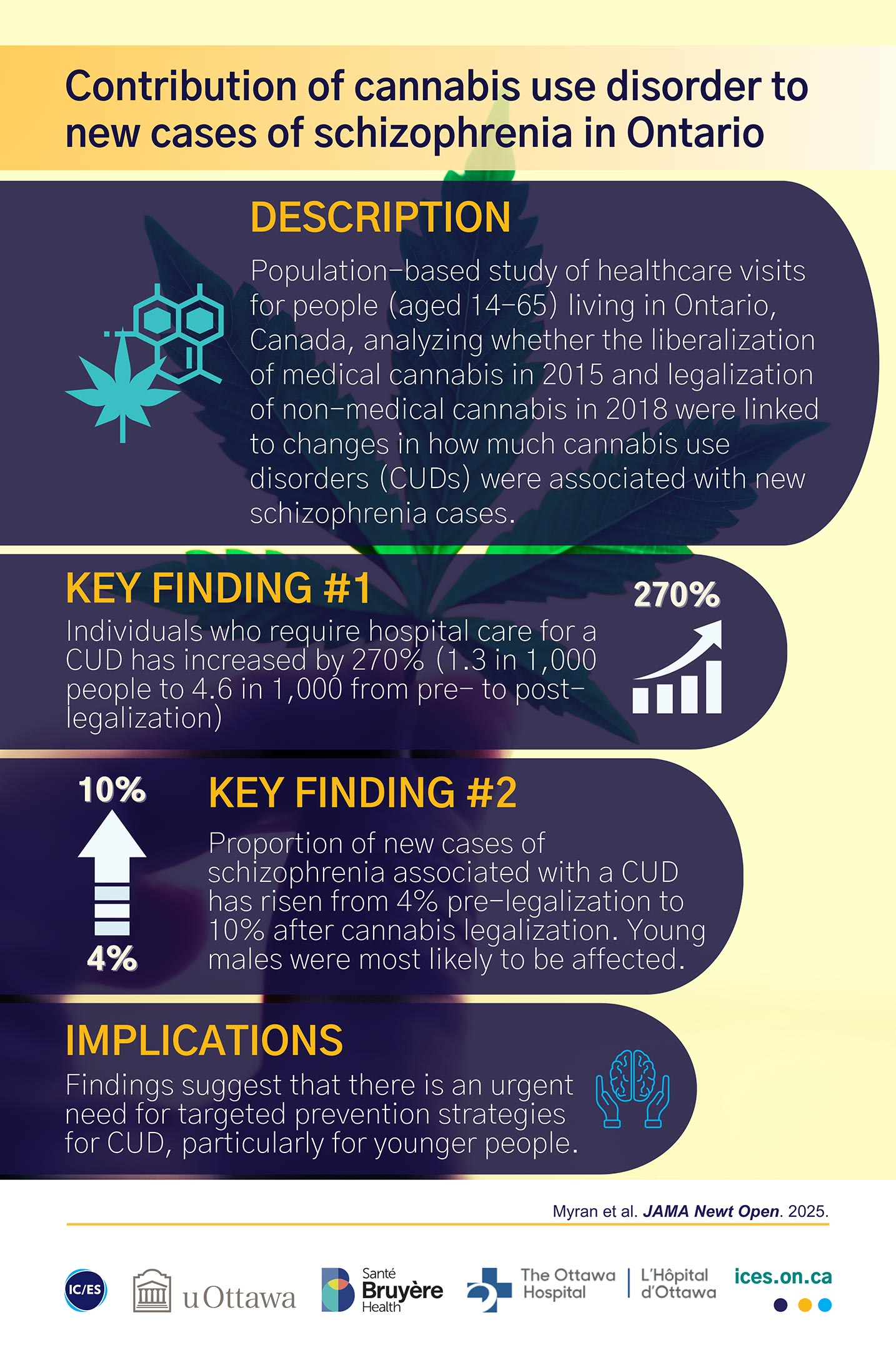
- The number of individuals in Ontario who require hospital care for a CUD has increased by 270% (1.3 in 1,000 people to 4.6 in 1,000 people) since before legalization to after the legalization of non-medical cannabis.
- Over the same period, the percentage of all new cases of schizophrenia in Ontario who had received hospital care for a CUD before their schizophrenia diagnosis increased from 7% to 16%.
- After adjusting for differences between individuals with and without hospital care for a CUD the authors estimated that during the legalization period, 10% of new cases of schizophrenia could have been prevented if people with cannabis use severe enough to require care in the emergency department or hospital had not stopped using cannabis. In men aged 14 to 24 that percentage rose to 18%.
High-Potency Cannabis and Public Health Challenges
“Our study highlights the growing public health challenge posed by the combination of increasingly high-potency cannabis and rising regular cannabis use,” says Dr. Myran.
The authors highlight that the study does not settle ongoing debates about whether or not heavy cannabis use can cause schizophrenia. Nevertheless, the authors note that heavy cannabis use does worsen symptoms and the prognosis for those living with schizophrenia and caution about the trends observed in the study.
A Call for Prevention Strategies
“The tripling of schizophrenia cases associated with a cannabis use disorder over the past 17 years and rising cases of psychosis underscores the urgent need for targeted prevention strategies, particularly for younger populations who appear to be at the greatest risk,” says Dr. Myran.
Reference: “Changes in Incident Schizophrenia Diagnoses Associated With Cannabis Use Disorder After Cannabis Legalization” by Daniel T. Myran, Michael Pugliese, Lyndsay D. Harrison, Marco Solmi, Kelly K. Anderson, Jess G. Fiedorowicz, Yaron Finkelstein, Doug Manuel, Monica Taljaard, Colleen Webber and Peter Tanuseputro, 4 February 2025, JAMA Network Open.
DOI: 10.1001/jamanetworkopen.2024.57868
Never miss a breakthrough: Join the SciTechDaily newsletter.
Follow us on Google and Google News.
10 Comments
More BS. All of the sudden? 17 years ago? People have been smoking weed far longer. This is all scare tactic to get funding and initiate new programs and jobs and MORE BULL 💩
Definitely a giant load of garbage. Misdiagnosis is so prevalent these days and they keep going after pot. They just can’t stop, my roommate says it’s because of the paper industry. The news usually entertains me, but also saddens me because to younger generations this is a solid “fact” they will be live by after reading this nonsense.
I have a family member who began smoking at a young age and went on to be diagnosed with schizophrenia. I’ve always wondered about the connection, as both his illness and cannabis use seemed to increase/worsen. In herbal medicine, they talk about a substance being on a continuum, where on one end, in lower quantities, it can be medicinal. On the other end, at high quantities, it can be classified as poisonous. Any substance that is medicinal is obviously having a significant effect on the body, and given that different people respond to other medications differently, it follows that there will be doses that are so high as to become harmful, and also that different genetics respond differently to this substance.
Men with underlying gene for it can have their psychotic break before 25 ish. And it cam be cause by any trauma so too much marijuana could be a cause but it is likely abuseof other substances and a mixture like alcohol/weed/high doses psychadelics like LSD and Shrooms.
Unlikey to be from moderate cannabis use. Imo. 32 y/o non schizophrenic, smoking since I was a teenager.
It is hereditary in nature not anyone just becomes schiz from doing drugs.
I’m not believing this anti propaganda
If ya gonna warn people and of course ya know they have a hard head, why not post the dosage ya talking about.
Legal in many states is 3 mg by weight.
I ran across amny sites saying 10 mg is high dosage and so I guess I’ll go with that baseline.
I hope your nephews don’t end up unrecognizable like mine did.
Yeah, it might. Or people might just have it and never know. Psychosis vs Schizophrenia vs people smoking and realizing the world is falling apart and its likely just depression. And not any other illness they have made up.
Society is crushing us little people down here. Yall think we are stupid and not victims. We arent all blind. Or willfully ignorant.
Suffered from extreme insomnia, bouts of depression and anxiety and shaky hands, arms and legs since puberty set in. Am now 65 years old, and smoking weed and consuming weed butter (for longer sleep) are the only things that alleviate these symptoms. I spent decades going to G.P.’s, psychologists, and psychiatrists. Took all the drugs and advice they gave me. Suffered mild to severe immediate side effects with all of them. None of them worked, not even a little bit. Smoking and consuming weed has been my only salvation. Thank God for weed. EF the government and big pharma and all their propaganda fake research.
A long time schizophrenic friend has used cannabis for decades to help him cope with his malfunctioning brain. Yes, he is also on some pretty strong pharmaceuticals. The cause and effect in his case is that he started adding cannabis to his drug regimen, and found it helpful, after the schizophrenia showed up, and so schizophrenia led to his cannabis use. I suggest that we outlaw schizophrenia, not cannabis.