
Close Menu
    Facebook X (Twitter) Instagram
    SciTechDaily
    • Biology
    • Chemistry
    • Earth
    • Health
    • Physics
    • Science
    • Space
    • Technology
    Facebook X (Twitter) Pinterest YouTube RSS
    SciTechDaily
    Home»Biology»Revealed: How Sea Creatures Glide Through Water Without Wasting Energy
    Biology

    Revealed: How Sea Creatures Glide Through Water Without Wasting Energy

    By Swansea UniversityDecember 16, 2024No Comments3 Mins Read
    Facebook Twitter Pinterest Telegram LinkedIn WhatsApp Email Reddit
    Share
    Facebook Twitter LinkedIn Pinterest Telegram Email Reddit
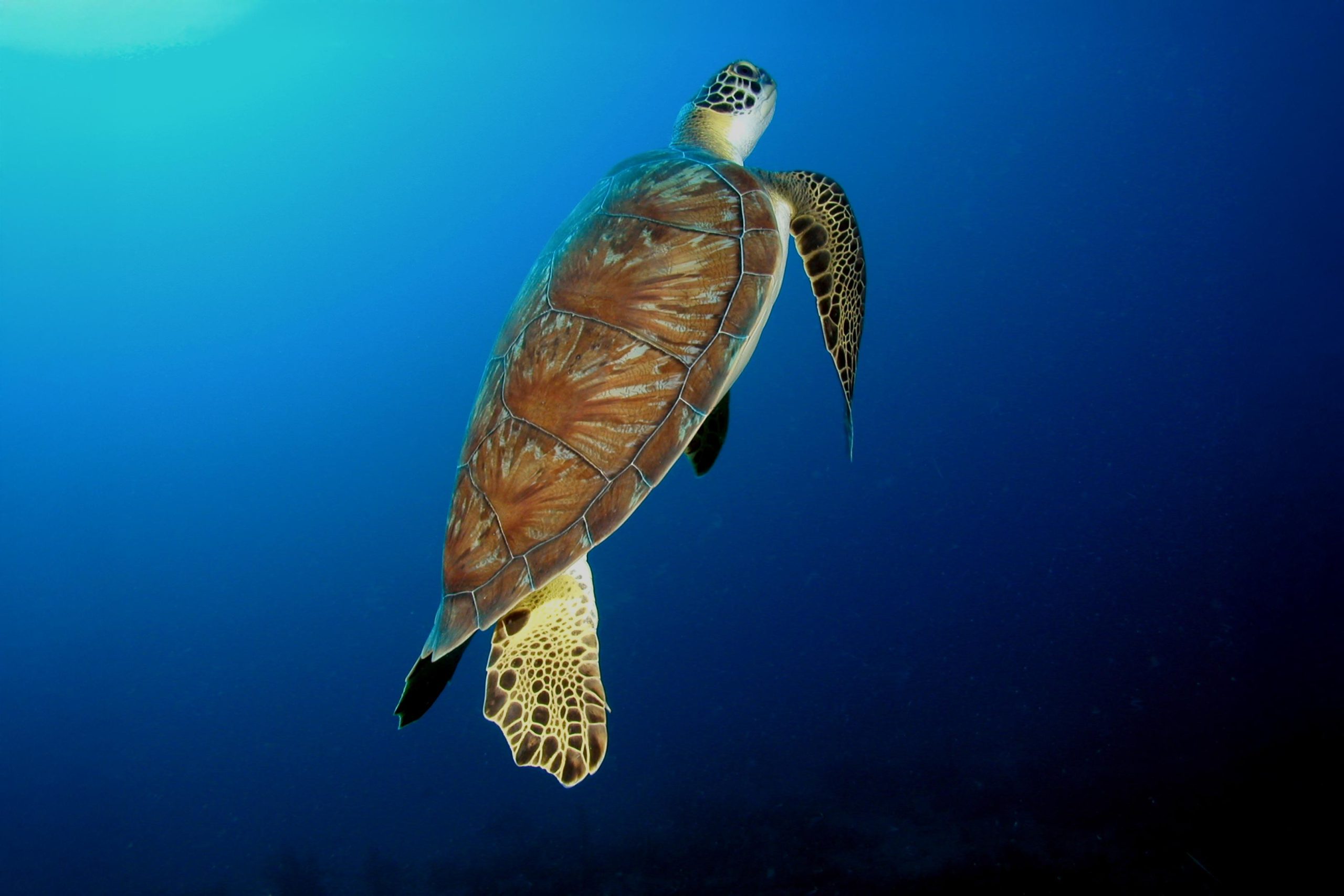
    Green Turtle Comes Up for Air
    Like many air-breathing marine megafauna, green turtles optimize their swim depth during migration to minimize the cost of transport, traveling at around three body depths beneath the surface in order to avoid creating waves whilst maximizing horizontal distance traveled. Credit: R. D. and B. S. Kirkby

    Researchers have established that marine animals travel at optimal depths roughly three times their body size to conserve energy, minimizing wave drag.

    This pattern, confirmed through advanced tracking technologies, holds true across species from penguins to whales.

    Marine Animal Swim Depths

    Researchers from Swansea and Deakin Universities have discovered that marine animals, including mammals, birds, and reptiles, swim at similar relative depths when traveling without feeding. This behavior helps them conserve energy by reducing water resistance.

    The research, led by Dr. Kimberley Stokes, Professor Graeme Hays, and Dr. Nicole Esteban, involved six institutions across five countries. They studied the swimming depths of various sea turtles, penguins, and whales. The team found that these animals typically travel at depths about three times their body length from the surface. This depth represents a ‘sweet spot’ that minimizes both wave formation at the surface and the vertical distance the animals must move through the water.
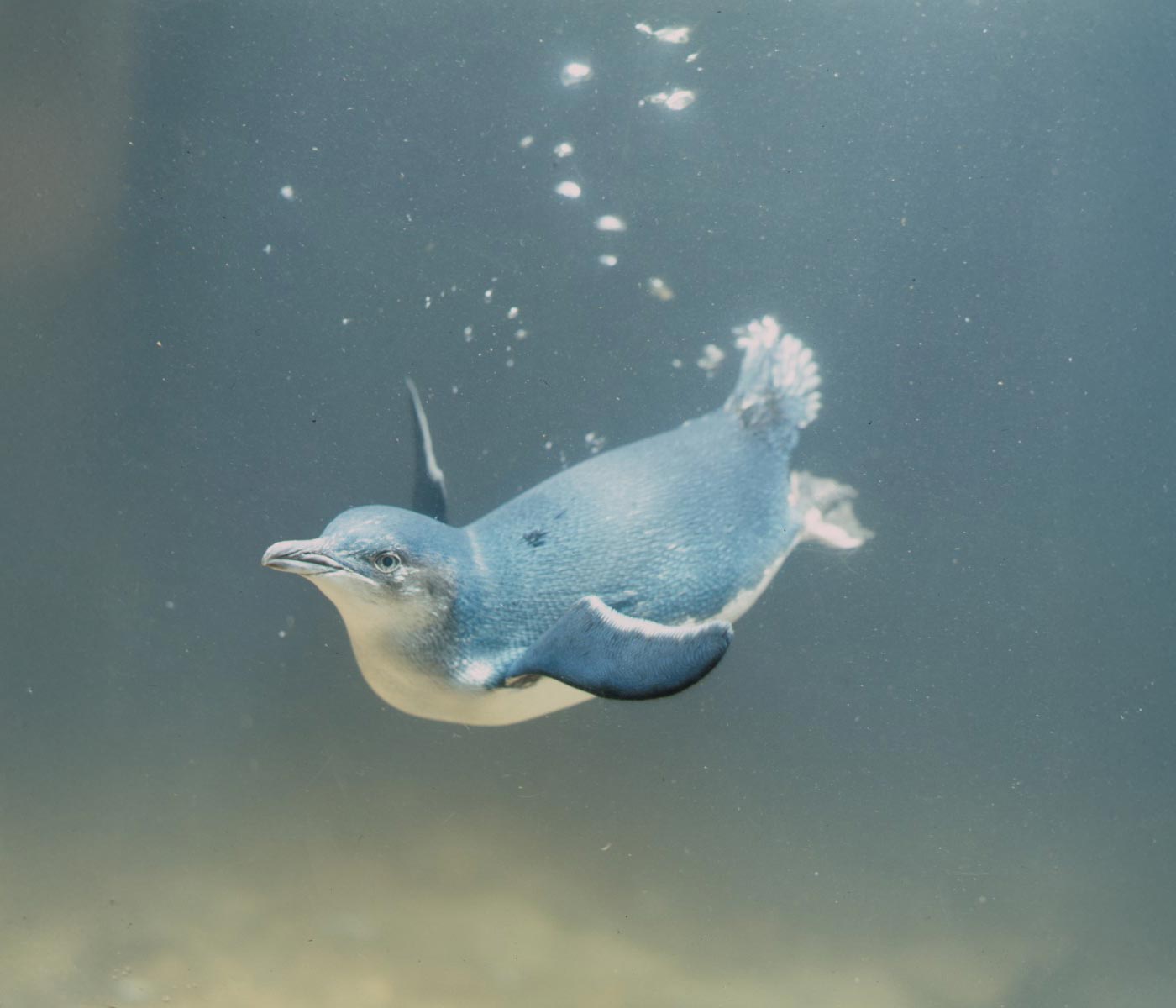
    Little Penguin Underwater
    Little penguins travel beneath the zone of highest wave drag close to the surface. Many air-breathing marine vertebrates optimize their swim depth when transiting and not feeding, traveling just deep enough to avoid wave creation on the surface. Credit: Phillip Island Nature Parks

    Energy Efficiency in Aquatic Travel

    In contrast, some semi-aquatic animals like mink swim at the surface, where creating waves wastes significant energy. For marine birds, mammals, and reptiles that undertake long-distance migrations, evolving to swim at energy-efficient depths is crucial for reducing the cost of travel over their lifetimes.

    It has long been known that additional drag from wave creation minimizes once a traveling object is at depths greater than three times its diameter, but it was hard to compare with travel depths of wild animals due to tracking limitations.

    Technological Advancements in Animal Tracking

    In this new study published today (December 16) in Proceedings of the National Academy of Sciences (PNAS) near surface swim depths were recorded to within 1.5 centimeters in little penguin and loggerhead turtles, along with motion data and video footage from animal-borne cameras. This was compared with satellite tracking data for long-distance migrations in green turtles and data from other studies on penguins and whales. It was found that these animal swim at optimal depths predicted from physics when either ‘commuting’ to a foraging patch in the wild or migrating over longer distances while not feeding.

    Swansea University’s Dr. Kimberley Stokes, lead author of the study said:

    “There are of course examples where animal swim depth is driven by other factors, such as searching for prey, but it was exciting to find that all published examples of non-foraging air-breathing marine animals followed the predicted pattern. This has rarely been recorded because of the difficulty in retrieving depth data from animals that migrate over large distances, so it was great to find enough examples to show a common relationship between swim depth and body size from animals across the size spectrum from 30 cm to about 20 m in length.”

    Reference: “Optimization of swim depth across diverse taxa during horizontal travel” by Kimberley L. Stokes, Nicole Esteban, Paolo Casale, André Chiaradia, Yakup Kaska, Akiko Kato, Paolo Luschi, Yan Ropert-Coudert, Holly J. Stokes and Graeme C. Hays, 16 December 2024, Proceedings of the National Academy of Sciences.
    DOI: 10.1073/pnas.2413768121

    Never miss a breakthrough: Join the SciTechDaily newsletter.
    Follow us on Google and Google News.

    Marine Biology Penguin Swansea University Turtle
    Share. Facebook Twitter Pinterest LinkedIn Email Reddit

    Related Articles

    Scientists Uncover Secret Foraging Havens of the World’s Largest Turtles

    Snuggling Sea Turtles Filmed for the First Time

    New Turtle Discovered From the Late Cretaceous of Madagascar

    Illuminating the Mystery of Sea Turtles’ Epic Migrations

    InvestEggator: Tracking Sea Turtle Egg Traffickers With GPS-Enabled Decoy Eggs

    Sea Turtles Complete Impressive Feats of Navigation Despite Surprisingly Crude “Map”

    Researchers Shocked to Find Antarctic Penguins Much Happier With Less Sea Ice

    Extinction of Threatened Marine Megafauna Would Lead to Devastating Loss in Functional Diversity

    Crabs Can Solve a Complex Maze and Remember Their Route Weeks Later [Video]

    Leave A Reply Cancel Reply

    • Facebook
    • Twitter
    • Pinterest
    • YouTube

    Don't Miss a Discovery

    Subscribe for the Latest in Science & Tech!

    Trending News

    One of the Universe’s Largest Stars May Be Getting Ready To Explode

    Scientists Discover Enzyme That Could Supercharge Ozempic-Like Weight Loss Drugs

    Popular Sweetener Linked to DNA Damage – “It’s Something You Should Not Be Eating”

    Ancient “Rock” Microbes May Reveal How Complex Life Began

    Researchers Capture Quantum Interference in One of Nature’s Rarest Atoms

    “A Plague Is Upon Us”: The Mass Death That Changed an Ancient City Forever

    Scientists Discover Game-Changing New Way To Treat High Cholesterol

    This Small Change to Your Exercise Routine Could Be the Secret to Living Longer

    Follow SciTechDaily
    • Facebook
    • Twitter
    • YouTube
    • Pinterest
    • Newsletter
    • RSS
    SciTech News
    • Biology News
    • Chemistry News
    • Earth News
    • Health News
    • Physics News
    • Science News
    • Space News
    • Technology News
    Recent Posts
    • Revolutionary Imaging Technique Unlocks Secrets of Matter at Extreme Speeds
    • Where Does Mass Come From? Scientists Find Evidence of a New Exotic Nuclear State
    • Quantum Breakthrough: Unhackable Keys Sent Over 120 km Using Quantum Dots
    • Researchers Discover Unknown Beetle Species Just Steps From Their Lab
    • Jellyfish Caught Feasting on Exploding Sea Worms for the First Time
    Copyright © 1998 - 2026 SciTechDaily. All Rights Reserved.
    • Science News
    • About
    • Contact
    • Editorial Board
    • Privacy Policy
    • Terms of Use

    Type above and press Enter to search. Press Esc to cancel.