
Close Menu
    Facebook X (Twitter) Instagram
    SciTechDaily
    • Biology
    • Chemistry
    • Earth
    • Health
    • Physics
    • Science
    • Space
    • Technology
    Facebook X (Twitter) Pinterest YouTube RSS
    SciTechDaily
    Home»Space»Revealing the Milky Way’s Warp: How Cepheid Stars Map Our Dark Matter Halo
    Space

    Revealing the Milky Way’s Warp: How Cepheid Stars Map Our Dark Matter Halo

    By Chinese Academy of SciencesJuly 20, 20241 Comment4 Mins Read
    Facebook Twitter Pinterest Telegram LinkedIn WhatsApp Email Reddit
    Share
    Facebook Twitter LinkedIn Pinterest Telegram Email Reddit
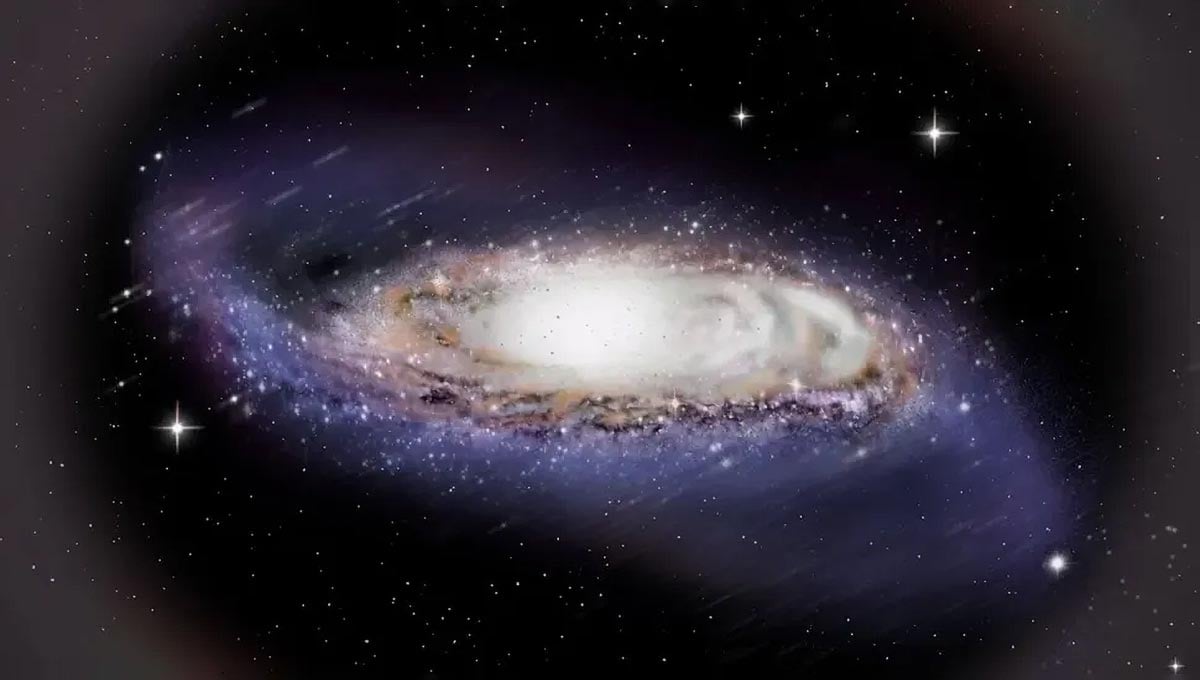
    Milky Way Galactic Disk Warp
    Researchers have measured the Milky Way’s warp precession with Cepheid stars, uncovering an oblate dark matter halo influencing the galaxy’s structural dynamics. Credit: Kaiyuan Hou and Zhanxun Dong from the Shanghai Jiao Tong University

    A research team developed a novel “motion picture” method to measure the precession rate of the Milky Way’s warp using Cepheid variable stars. Their findings suggest the Milky Way’s dark matter halo is slightly oblate, shaping our understanding of galactic dynamics and the structure of the universe.

    Astrophysicists pioneered a “motion picture” method for measuring the precession rate of the Milky Way’s disk warp. This method allows the clear observation of the precession direction and rate of the Milky Way’s warp using a sample of Cepheid variable stars of different ages. Based on these measurements, the team revealed that the current dark matter halo of the Milky Way is slightly oblate. Led by Dr. Yang Huang from the National Astronomical Observatories of the Chinese Academy of Sciences (NAOC), the research team published their study in Nature Astronomy.

    In the nearby universe, nearly one-third of disk galaxies are not perfect disks but exhibit a warped shape resembling a potato chip. Astronomers refer to this phenomenon as a disk warp. The Milky Way, as a typical disk galaxy, also has this warp feature. It is generally believed that the warp originates from the rotational plane of the outer disk stars deviating from the symmetry plane of the surrounding dark matter halo. This tilted, rotating Galactic disk, much like a spinning top, inevitably undergoes precession due to the torque exerted by the surrounding dark matter halo.

    Challenges in Measuring Galactic Precession

    However, the measurement of this important dynamic parameter, both in direction and rate, has been widely debated. This is because previous measurements relied on indirect kinematic methods, where the tracers used are subject to dynamical perturbations or heating effects, greatly limiting their accuracy and precision.

    This study used 2,600 young classical Cepheid variable stars discovered by Gaia as tracers, along with precise distance and age data from both Gaia and LAMOST. The researchers, using the “motion picture” method, constructed the three-dimensional structure of the Milky Way’s disk across populations of various ages but all younger than 250 Myr.
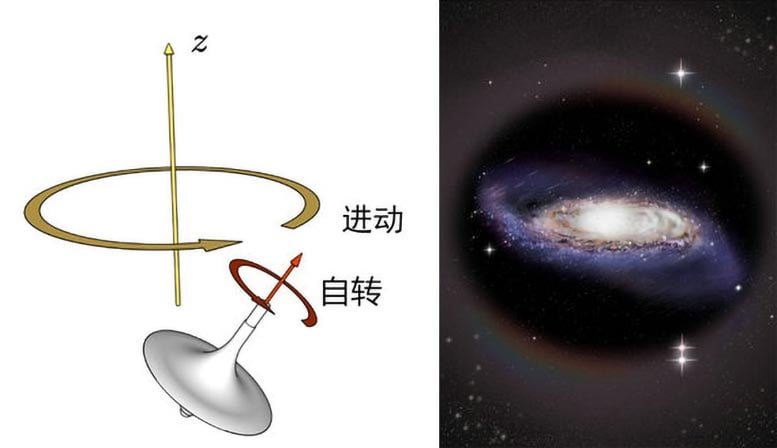
    Spinning Top Galactic Disk Warp
    Left panel: the spinning top precesses under the torque from gravity; Right panel: similar to the spinning top, the Galactic disk warp “dances gracefully” under the torque of the dark matter halo. Credit: Kaiyuan Hou and Zhanxun Dong from the Shanghai Jiao Tong University

    Findings on Warp Precession and Galactic Dynamics

    By “seeing” how the disk warp evolves with age, the researchers found that the warp precesses in a retrograde direction at a rate of 2 km/s/kpc (or 0.12 degrees per million years).

    Further measurements showed that the warp’s precession rate gradually decreases with radius. Regardless of the origin of the warp, its precession rate and direction were jointly determined by the Galactic inner disk and the dark matter halo.

    Implications for the Milky Way’s Dark Matter Halo

    After subtracting the contribution of the Galactic inner disk, the researchers found that the current dark matter halo enveloping the warp exhibits a slightly oblate ellipsoidal shape with a flattening ratio q between 0.84 and 0.96 for the equipotential surfaces. Currently, only this shape can explain the remaining precession rate of the warp.

    This study provides a crucial anchor point for studying the evolution of the Milky Way’s dark matter halo.

    Reference: “A slightly oblate dark matter halo revealed by a retrograde precessing Galactic disk warp” by Yang Huang, Qikang Feng, Tigran Khachaturyants, Huawei Zhang, Jifeng Liu, Juntai Shen, Timothy C. Beers, Youjun Lu, Song Wang and Haibo Yuan, 27 June 2024, Nature Astronomy.
    DOI: 10.1038/s41550-024-02309-5

    Never miss a breakthrough: Join the SciTechDaily newsletter.
    Follow us on Google and Google News.

    Astronomy Astrophysics Chinese Academy of Sciences Dark Matter Milky Way Popular
    Share. Facebook Twitter Pinterest LinkedIn Email Reddit

    Related Articles

    The Center of Our Galaxy May Not Be a Black Hole

    A Strange Glow in the Milky Way May Be Our First Glimpse of Dark Matter

    The Milky Way May Be Surrounded by 100 Hidden Galaxies

    Strangely Massive Black Hole Discovered in Milky Way Satellite Galaxy

    Dark Matter “Counterweight” Is Slowing the Spin of the Milky Way’s Galactic Bar

    New All-Sky Map of Milky Way’s Outer Reaches Released – Could Offer a New Test of Dark Matter Theories

    Milky Way’s Dark Side Revealed by Measurements of Pulsar Acceleration

    Milky Way Is Being Twisted and Deformed With Extreme Violence by the Gravitational Force of the LMC’s Dark Matter Halo

    Link Between Dark Matter Halos and Galaxy Formation Revealed With Help From the Milky Way’s Satellites

    1 Comment

    1. Fixed gravity for you. on July 21, 2024 3:09 am

      Seems MOND may have difficulty anticipating DM effects tilted off the galactic plane, while a gravity that supports focus in binding energies along spin planes of individual galactic component masses could lack that problem.

      Reply
    Leave A Reply Cancel Reply

    • Facebook
    • Twitter
    • Pinterest
    • YouTube

    Don't Miss a Discovery

    Subscribe for the Latest in Science & Tech!

    Trending News

    New Pill Lowers Stubborn Blood Pressure and Protects the Kidneys

    Humans May Have Hidden Regenerative Powers, New Study Suggests

    Scientists Just Solved the Mystery of Why Crabs Walk Sideways

    Doctors Are Surprised by What This Vaccine Is Doing to the Heart

    This Popular Supplement May Boost Your Brain, Not Just Your Muscles

    Scientists Say This Simple Supplement May Actually Reverse Heart Disease

    Warming Oceans Could Trigger a Dangerous Methane Surge

    This Simple Movement Could Be Secretly Cleaning Your Brain

    Follow SciTechDaily
    • Facebook
    • Twitter
    • YouTube
    • Pinterest
    • Newsletter
    • RSS
    SciTech News
    • Biology News
    • Chemistry News
    • Earth News
    • Health News
    • Physics News
    • Science News
    • Space News
    • Technology News
    Recent Posts
    • Scientists Solve 320-Million-Year Mystery of Reptile Skin Armor
    • Hidden Heart Risk Found in 1 in 5 People, Study Warns
    • Scientists Say This Daily Walking Habit May Be the Secret to Keeping Weight Off After Dieting
    • New Therapy Rewires the Brain To Restore Joy in Depression Patients
    • Researchers Discover Efficient New Way To Split Hydrogen From Water for Energy
    Copyright © 1998 - 2026 SciTechDaily. All Rights Reserved.
    • Science News
    • About
    • Contact
    • Editorial Board
    • Privacy Policy
    • Terms of Use

    Type above and press Enter to search. Press Esc to cancel.