
From Moonwalkers to Farmers: Turning Lunar Soil into Fertilizer for Hydroponic Farming
Sooner or later, settlers on the Moon will have to become farmers. A new European Space Agency (ESA) Discovery project led by Norway’s Solsys Mining is looking into the treatment of lunar soil to create fertilizer for growing plants.
The good news is that analysis of lunar samples returned to Earth in the past by Moonwalkers and robots shows sufficient essential minerals are available for plant growth, apart from nitrogen compounds. The bad news is that lunar soil (or ‘regolith’) compacts in the presence of water, creating problems for plant germination and root growth.
Hydroponic farming therefore offers a practical alternative; this type of agriculture involves feeding plant roots directly with nutrient-rich water, without the need for soil. The potential is still there however to put lunar regolith to work, on the basis of ‘in-situ resource utilization’ – or living off the land.
The ‘Enabling Lunar In-Situ Agriculture by Producing Fertilizer from Beneficiated Regolith’ project, led by Solsys Mining with Norway’s Geotechnical Institute (NGI) and Centre for Interdisciplinary Research in Space (CIRiS), involves studying a combination of mechanical, chemical and biological processes to extract mineral nutrients from the regolith. Valuable elements might need concentrating before use, while undesirable ones would be removed.
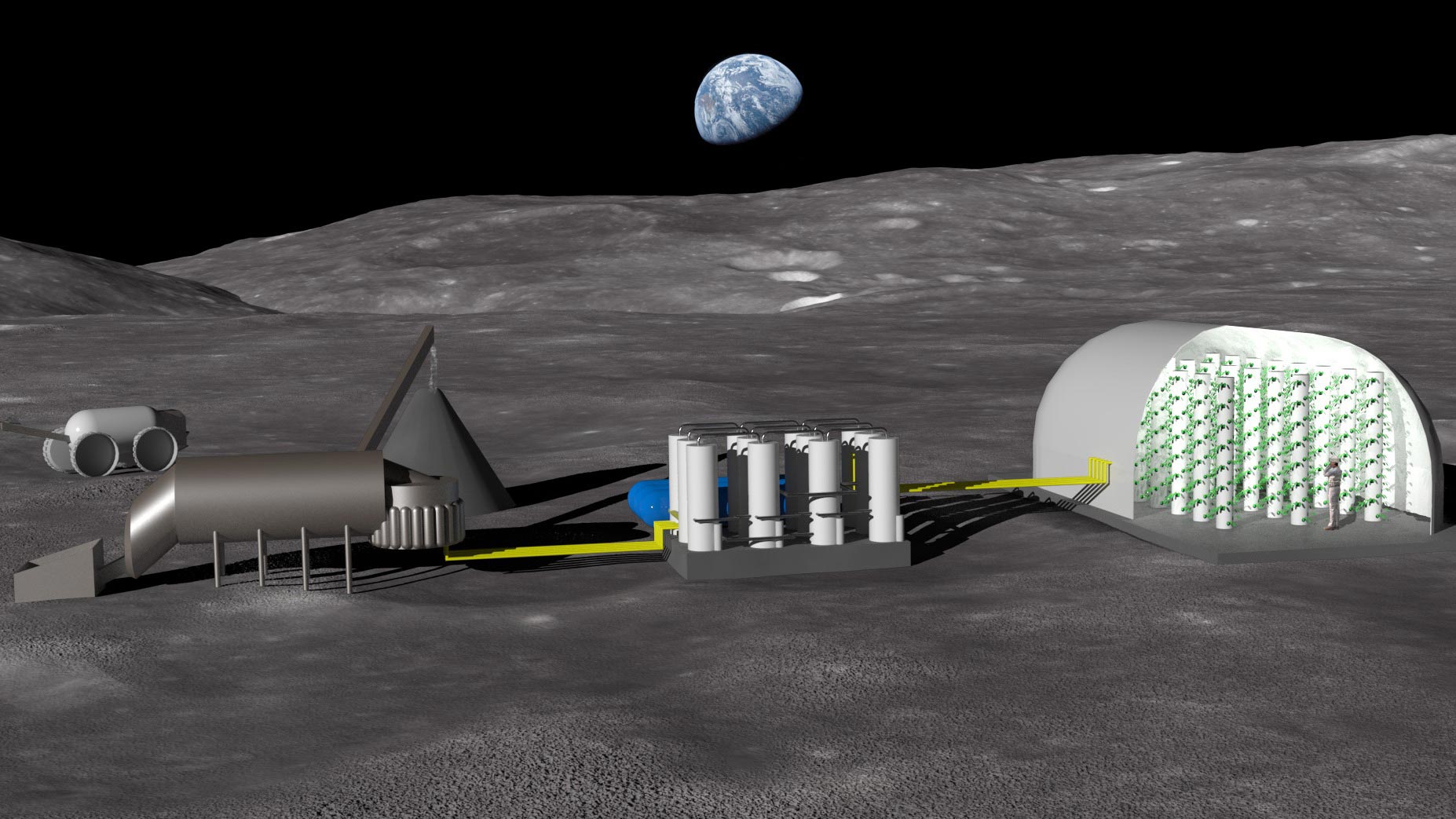
The left of this artist’s impression (image at top of article) shows a mechanical sorting area for the regolith, passing through to the central module for more advanced processing, such as chemical leaching. Finally extracted nutrients would be dissolved in water to be pumped to the hydroponic garden, right.
Future Prospects for Sustainable Lunar Farming
“This work is essential for future long-term lunar exploration,” comments ESA materials and processes engineer Malgorzata Holynska. “Achieving a sustainable presence on the Moon will involve using local resources and gaining access to nutrients present in lunar regolith with the potential to help cultivate plants. The current study represents a proof of principle using available lunar regolith simulants, opening the way to more detailed research in the future.”
The Solsys Mining team is optimistic, having already cultivated beans using simulated lunar highland regolith as a nutrient source.
The project came about as an idea submitted through ESA’s Open Space Innovation Platform, seeking out promising new ideas for space research. It is now being funded by the Discovery element of ESA’s Basic Activities.
Never miss a breakthrough: Join the SciTechDaily newsletter.
Follow us on Google and Google News.
4 Comments
Who on earth would wish to travel 250,000 miles into Space tp live on a lump of rock with no atmosphere, a black sky and a surface that boils and freezes by turns and is useless for growing anything?
Maybe “Farmer Bill” Gates would like to blaze the trail and take along some of the other useless eaters we earthlings would be better off without, starting with Klaus Schwab and the rest of the WEF’s Great Reset advocates.
SNX30 fertilizer supplement reduces nitrogen, could save farmers billions. No more fear about high fertilizer prices when farmers use the “SNX30 fertilizer supplement” that makes fertilizer affordable.
In the Moon’s Atmosphere, what is the concentration of the now poisonous compound Carbon Dioixde, the basis of photosynthesis, along with water?
Where is that Carbon Dioxide going to come from?
Now all they have to do is figure out how to keep plants growing during the 336 hour night.