
Close Menu
    Facebook X (Twitter) Instagram
    SciTechDaily
    • Biology
    • Chemistry
    • Earth
    • Health
    • Physics
    • Science
    • Space
    • Technology
    Facebook X (Twitter) Pinterest YouTube RSS
    SciTechDaily
    Home»Space»New Mosiac of the Moon’s South Pole
    Space

    New Mosiac of the Moon’s South Pole

    By European Space AgencyMay 27, 2014No Comments3 Mins Read
    Facebook Twitter Pinterest Telegram LinkedIn WhatsApp Email Reddit
    Share
    Facebook Twitter LinkedIn Pinterest Telegram Email Reddit
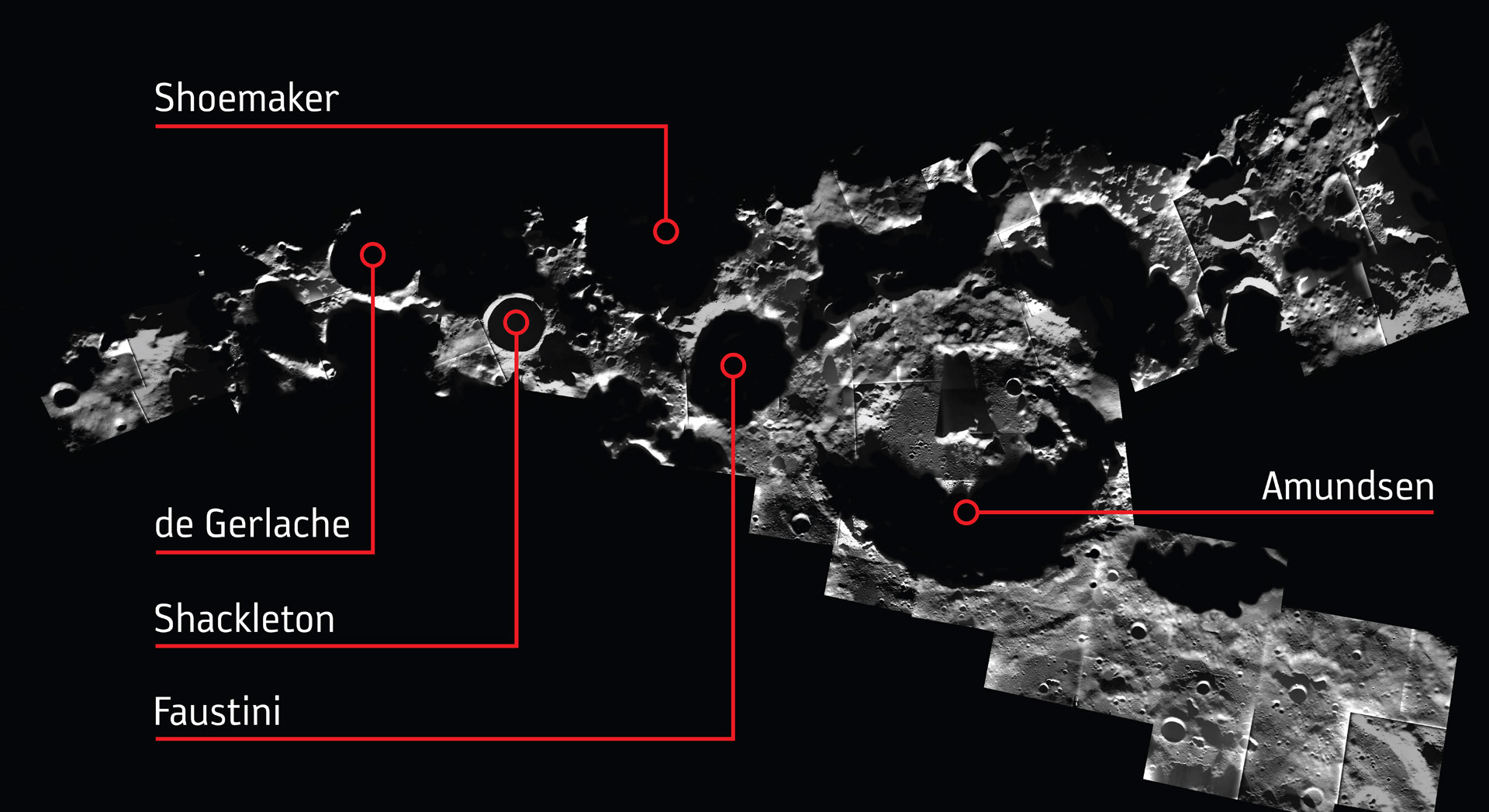
    New Mosiac Image of Craters at the Moons South Pole
    (Click on the image for a larger annotated map) This mosaic depicts a crater-covered area extending across the lunar south pole. Composed of roughly 40 individual images captured between December 2005 and March 2006, it spans an area of about 500 x 150 km (310 x 93 mi). Credit: ESA/SMART-1/AMIE camera team; image mosaic: M. Ellouzi/B. Foing

    This newly released mosaic shows a crater-riddled region at the lunar south pole of our Moon.

    The dark and shadowed regions of the Moon fascinate astronomers and Pink Floyd fans alike. Our Moon’s rotation axis has a tilt of 1.5º, meaning that some parts of its polar regions never see sunlight – the bottoms of certain craters, for example, are always in shadow.

    Imaged during summertime in the Moon’s southern hemisphere by the Advanced Moon Imaging Experiment on ESA’s SMART-1 spacecraft, this mosaic shows a crater-riddled region spanning the lunar south pole. It is made up of around 40 individual images taken between December 2005 and March 2006, and covers an area of about 500 x 150 km (310 x 93 mi).

    The craters visible here include (from right to left, starting with the largest round shape visible in the frame) the Amundsen, Faustini, Shoemaker, Shackleton, and de Gerlache craters.

    Amundsen is the largest of the bunch at 105 km (65 mi) across, followed by Shoemaker (50 km or 31 mi), Faustini (39 km or 24 mi), de Gerlache (32 km or 20 mi), and Shackleton (19 km or 12 mi). This group of craters all look different, see varying levels of sunlight, and display a range of interesting properties.

    Shackleton crater, the small circle visible to the left of the center, contains the south pole within its rim. By using SMART-1 images to explore the number of small impact craters scattered on the smooth, dark surface surrounding Shackleton, scientists have found this crater to be older than the Apollo 15 landing site (3.3 billion years), but younger than the Apollo 14 site (3.85 billion years).

    Shoemaker crater, visible to the upper left of the center, is notable because of the 1999 Lunar Prospector mission, which deliberately crashed into the crater in an attempt to create a detectable plume of water vapor by heating any water ice that may have been present. No vapor was spotted. However, all is not lost; some permanently shadowed regions have been in the dark for millions of years, and it is still possible that they may contain water ice deposited by comets and water-rich asteroids.

    Studying the dark depths of these craters could tell us not just about the history of the Moon, but also about Earth, helping us to understand better how, and how much, water and organic material may have been transferred from the Moon to Earth over its history.


    Never miss a breakthrough: Join the SciTechDaily newsletter.
    Follow us on Google and Google News.

    Astronomy European Space Agency Moon
    Share. Facebook Twitter Pinterest LinkedIn Email Reddit

    Related Articles

    Extraordinary Convergence: Chasing Chandrayaan and the Super Blue Moon

    Peek-a-Boo Moon: Astronaut on Space Station Captures Spectacular Photos of the Lunar Eclipse

    Connecting Earth With the Moon: Lunar Satellites

    Hubble Uses Moon As “Mirror” to Study Earth’s Atmosphere – Proxy in Search of Potentially Habitable Planets Around Other Stars

    NELIOTA Project Views Flashes of Light Across the Surface of the Moon

    Moon Bricks Will Pave the Way for Human Space Exploration

    Can Lunar Dust Jeopardise Human Health?

    Moon Village – How to Build a Permanent Base Station on the Moon

    Weather Satellite Captures Image of “Blue” Moon

    Leave A Reply Cancel Reply

    • Facebook
    • Twitter
    • Pinterest
    • YouTube

    Don't Miss a Discovery

    Subscribe for the Latest in Science & Tech!

    Trending News

    Monster Storms on Jupiter Unleash Lightning Beyond Anything on Earth

    Scientists Create “Liquid Gears” That Spin Without Touching

    The Simple Habit That Could Help Prevent Cancer

    Millions Take These IBS Drugs, But a New Study Finds Serious Risks

    Scientists Unlock Hidden Secrets of 2,300-Year-Old Mummies Using Cutting-Edge CT Scanner

    Bread Might Be Making You Gain Weight Even Without Eating More Calories

    Scientists Discover Massive Magma Reservoir Beneath Tuscany

    Europe’s Most Active Volcano Just Got Stranger – Here’s Why Scientists Are Rethinking It

    Follow SciTechDaily
    • Facebook
    • Twitter
    • YouTube
    • Pinterest
    • Newsletter
    • RSS
    SciTech News
    • Biology News
    • Chemistry News
    • Earth News
    • Health News
    • Physics News
    • Science News
    • Space News
    • Technology News
    Recent Posts
    • Scientists Were Wrong About This Strange “Rule-Breaking” Particle
    • Webb Space Telescope Uncovers Unexpected Ice Clouds on a Jupiter-Like World
    • 289-Million-Year-Old Reptile Mummy Reveals Origin of Human Breathing System
    • New Brain Discovery Challenges Long-Held Theory of Teenage Brain Development
    • Sharks Are Overheating as Warming Oceans Push Them to the Edge
    Copyright © 1998 - 2026 SciTechDaily. All Rights Reserved.
    • Science News
    • About
    • Contact
    • Editorial Board
    • Privacy Policy
    • Terms of Use

    Type above and press Enter to search. Press Esc to cancel.