
Close Menu
    Facebook X (Twitter) Instagram
    SciTechDaily
    • Biology
    • Chemistry
    • Earth
    • Health
    • Physics
    • Science
    • Space
    • Technology
    Facebook X (Twitter) Pinterest YouTube RSS
    SciTechDaily
    Home»Space»Dark Stars – Astronomers Investigate if Dark Matter Influenced the Development of Stars
    Space

    Dark Stars – Astronomers Investigate if Dark Matter Influenced the Development of Stars

    By Harvard-Smithsonian Center for AstrophysicsMay 27, 2014No Comments3 Mins Read
    Facebook Twitter Pinterest Telegram LinkedIn WhatsApp Email Reddit
    Share
    Facebook Twitter LinkedIn Pinterest Telegram Email Reddit
    Simulations Investigate the Effect of Dark Matter Annihilation on the Collapse of Primordial Gas
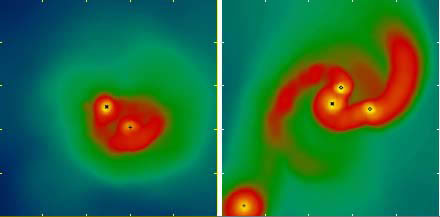
    Dark stars, entirely speculative entities for now, are hypothesized to form in the early cosmos when dark matter condenses and associated particle annihilation reactions heat up the matter, perhaps disrupting the formation of normal stars. The image shows one result from a new simulation of the birth of the first stars: the left panel shows normal stars forming when no annihilating dark matter is present and the right panel shows one instance of what happens when dark stars form and disrupt the process. Credit: A. Stacey

    Astronomers from the Harvard-Smithsonian Center for Astrophysics used computer simulations of dark matter in the early universe to investigate if and how dark matter might influence the development of normal stars.

    The vast majority of matter is the universe, about eighty-five percent of it, is so-called “dark matter.” It consists not of ordinary atoms, but of some still unknown kind of particle. Understanding this ubiquitous yet mysterious substance is a prime goal of modern astrophysics. Dark matter is detected via its gravitational influence on stars and other normal matter, and some astronomers speculate that it might have another property besides gravity in common with ordinary matter: It might come in two forms, matter, and anti-matter, that annihilate on contact emitting high energy radiation.

    Several hundred million years after the Big Bang, the first stars began to form as gravity gradually condensed the primordial material and heated it to temperatures able to trigger nuclear burning. Scientists have speculated that something roughly similar might also have occurred to dark matter: Gravity condensed it into cores that ultimately ignite, not with nuclear burning – dark matter is not atomic and has no (normal) nuclei – but rather via annihilation radiation. These so-called “dark stars” might have shone for some time as more and more dark matter accreted onto them, powering ongoing annihilation. They may even have heated up their environment in a way that inhibited the growth of the first generation of normal stars.

    CfA astronomer Avi Loeb and three of his colleagues used computer simulations of dark matter in the early universe to investigate if and how dark matter might influence the development of normal stars. The details are complex, in part because the growing clumps of matter tend to fragment into clusters within which they then scatter off one another. The scientists tested their simulations under a variety of assumptions, and found in one of the more sophisticated versions that the annihilating dark matter was considerably less effective in forming a dark star (or disrupting normal stars) than had been thought because of the disruption from scattering. They conclude that dark stars may never have existed, and hence that the formation of normal stars may not have been retarded. They caution, however, that further research is needed to refine these conclusions, not least to determine the nature of the mysterious dark matter itself. Astronomers are optimistic that some of the first stars in the universe will actually be detected in this decade; some proposed space missions (like the Japanese WISH mission) set this as their primary goal. These new simulations provide a basis for interpreting those detections.

    Reference: “The mutual interaction between Population III stars and self-annihilating dark matter” by Athena Stacy, Andreas H. Pawlik, Volker Bromm and Abraham Loeb, 2 May 2014, MNRAS.
    DOI: 10.1093/mnras/stu621
    arXiv: 1312.3117


    Never miss a breakthrough: Join the SciTechDaily newsletter.
    Follow us on Google and Google News.

    Astronomy Astrophysics Harvard-Smithsonian Center for Astrophysics Star Formation Stellar Evolution
    Share. Facebook Twitter Pinterest LinkedIn Email Reddit

    Related Articles

    Harvard Astrophysicists Examine the Properties of Pre-Stellar Cores

    SMA Reveals New Insights Into How Cosmic Seeds Grow Into Massive Stars

    Astronomers Discover “Old Young” Stars in the Eagle Nebula

    A Link Between Black Hole Accretion Rate and Star Formation Rate

    TW Hydrae Provides Insight About the Birth of Our Sun

    Herschel Discovers the Earliest Known Starburst Galaxy

    Signs of Star Formation Near Supermassive Black Hole at the Galactic Center

    Herschel Data Reveals Clues About High-Mass Star Formation

    Masers as Evolutionary Indicators for Star Formation

    Leave A Reply Cancel Reply

    • Facebook
    • Twitter
    • Pinterest
    • YouTube

    Don't Miss a Discovery

    Subscribe for the Latest in Science & Tech!

    Trending News

    One of the Universe’s Largest Stars May Be Getting Ready To Explode

    Scientists Discover Enzyme That Could Supercharge Ozempic-Like Weight Loss Drugs

    Popular Sweetener Linked to DNA Damage – “It’s Something You Should Not Be Eating”

    Ancient “Rock” Microbes May Reveal How Complex Life Began

    Researchers Capture Quantum Interference in One of Nature’s Rarest Atoms

    “A Plague Is Upon Us”: The Mass Death That Changed an Ancient City Forever

    Scientists Discover Game-Changing New Way To Treat High Cholesterol

    This Small Change to Your Exercise Routine Could Be the Secret to Living Longer

    Follow SciTechDaily
    • Facebook
    • Twitter
    • YouTube
    • Pinterest
    • Newsletter
    • RSS
    SciTech News
    • Biology News
    • Chemistry News
    • Earth News
    • Health News
    • Physics News
    • Science News
    • Space News
    • Technology News
    Recent Posts
    • Revolutionary Imaging Technique Unlocks Secrets of Matter at Extreme Speeds
    • Where Does Mass Come From? Scientists Find Evidence of a New Exotic Nuclear State
    • Quantum Breakthrough: Unhackable Keys Sent Over 120 km Using Quantum Dots
    • Researchers Discover Unknown Beetle Species Just Steps From Their Lab
    • Jellyfish Caught Feasting on Exploding Sea Worms for the First Time
    Copyright © 1998 - 2026 SciTechDaily. All Rights Reserved.
    • Science News
    • About
    • Contact
    • Editorial Board
    • Privacy Policy
    • Terms of Use

    Type above and press Enter to search. Press Esc to cancel.