
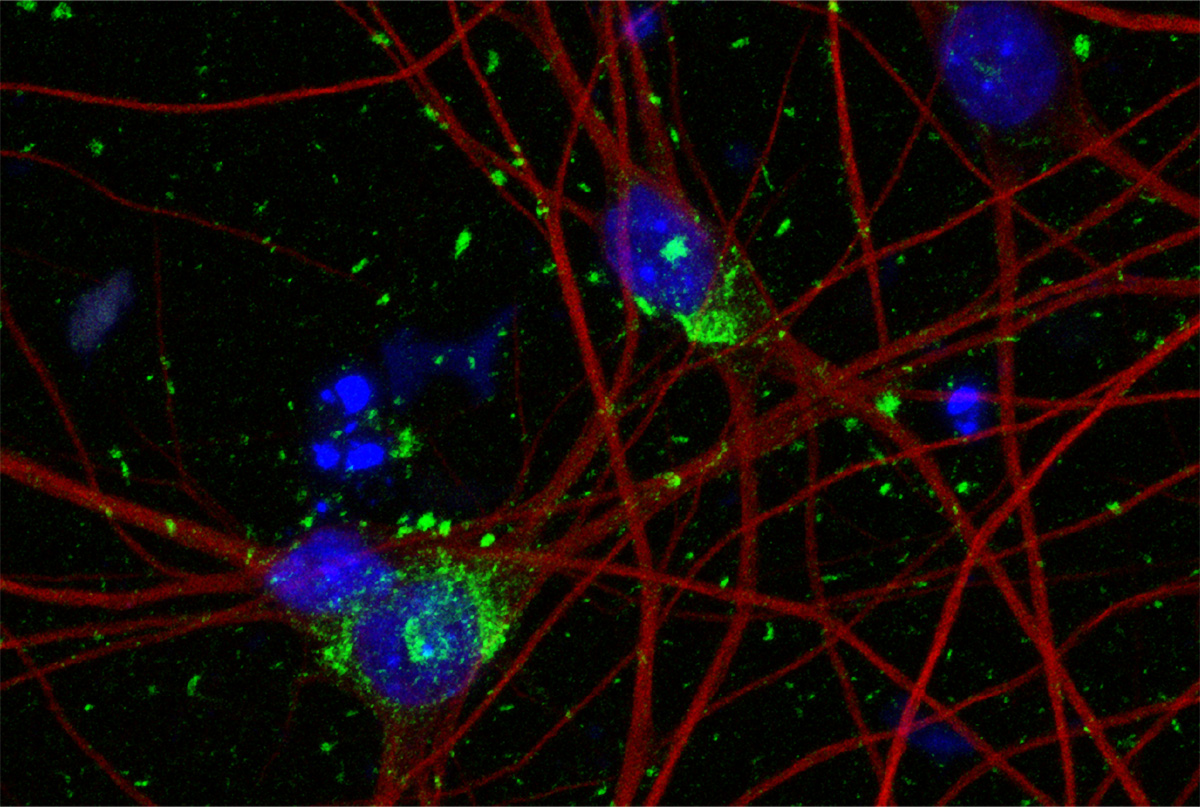
Scientists at Weill Cornell Medicine have developed an innovative human neuron model that robustly simulates the spread of tau protein aggregates in the brain—a process that drives cognitive decline in Alzheimer’s disease and frontotemporal dementia. This new model has led to the identification of novel therapeutic targets that could potentially block tau spread.
The preclinical study, published April 5 in Cell, is a significant advancement in Alzheimer’s disease research.
“Currently no therapies can stop the spread of tau aggregates in the brains of patients with Alzheimer’s disease,” said lead study author, Dr. Li Gan, director of the Helen and Robert Appel Alzheimer’s Disease Research Institute and the Burton P. and Judith B. Resnick Distinguished Professor in Neurodegenerative Diseases in the Feil Family Brain and Mind Research Institute at Weill Cornell Medicine. “Our human neuron model of tau spread overcomes the limitations of previous models and has unveiled potential targets for drug development that were previously unknown.”
Human pluripotent stem cells can develop into any cell of the body and can be coaxed to become neurons to model brain diseases in a lab dish. However, it had been nearly impossible to model tau propagation in these young neurons, as tau propagation requires decades in aging brains.
Advancements in Modeling Tau Spread
Dr. Gan’s team used CRISPR technology to modify the genomes of human stem cells, prompting them to express forms of tau associated with diseased aging brains. “This model has been a game-changer, simulating tau spread in neurons within weeks—a process that would typically take decades in the human brain,” Dr. Gan said.
In their quest to halt tau propagation, Dr. Gan’s team employed CRISPRi screening to disable one thousand genes to ascertain their roles in tau spread. They discovered 500 genes that have a significant impact on tau abundance.
“CRISPRi technology allowed us to use unbiased approaches to look for drug targets, not confined to what was previously reported by other scientists,” said one of the lead study authors Celeste Parra Bravo, a neuroscience doctoral candidate in the Weill Cornell Graduate School of Medical Sciences working in the Gan lab.
Discoveries and Implications for Treatment
One discovery includes the UFMylation cascade, a cellular process involving the attachment of a small protein named UFM1 to other proteins. This process’s connection to tau spread was previously unknown. Post-mortem studies of brains from patients with Alzheimer’s disease found that UFMylation is altered, and the team also found in preclinical models that inhibition of the enzyme required for UFMylation blocks tau propagation in neurons.
“We are particularly encouraged by the confirmation that inhibiting UFMylation blocked tau spread in both human neurons and mouse models,” said paper co-author Dr. Shiaoching Gong, associate professor of research in neuroscience in the Appel Institute at Weill Cornell Medicine.
Many Alzheimer’s disease treatments initially show promise in mouse models but do not succeed in clinical trials, Dr. Gan said. With the new human cell model, she is optimistic about the path ahead. “Our discoveries in human neurons open the door to developing new treatments that could truly make a difference for those suffering from this devastating disease.”
Reference: “Human iPSC 4R tauopathy model uncovers modifiers of tau propagation” by Celeste Parra Bravo, Alice Maria Giani, Jesus Madero Perez, Zeping Zhao, Yuansong Wan, Avi J. Samelson, Man Ying Wong, Alessandro Evangelisti, Ethan Cordes, Li Fan, Pearly Ye, Daphne Zhu, Tatyana Pozner, Maria Mercedes, Tark Patel, Allan Yarahmady, Gillian K. Carling, Fredrik H. Sterky, Virginia M.Y. Lee, Edward B. Lee, Michael DeTure, Dennis W. Dickson, Manu Sharma, Sue-Ann Mok, Wenjie Luo, Mingrui Zhao, Martin Kampmann, Shiaoching Gong and Li Gan, 5 April 2024, Cell.
DOI: 10.1016/j.cell.2024.03.015
Never miss a breakthrough: Join the SciTechDaily newsletter.
Follow us on Google and Google News.