
Close Menu
    Facebook X (Twitter) Instagram
    SciTechDaily
    • Biology
    • Chemistry
    • Earth
    • Health
    • Physics
    • Science
    • Space
    • Technology
    Facebook X (Twitter) Pinterest YouTube RSS
    SciTechDaily
    Home»Technology»Revolutionizing Battery Tech: Helical Polymers Unlock Next-Gen Solid-State Electrolytes
    Technology

    Revolutionizing Battery Tech: Helical Polymers Unlock Next-Gen Solid-State Electrolytes

    By University of Illinois Grainger College of EngineeringAugust 14, 2024No Comments3 Mins Read
    Facebook Twitter Pinterest Telegram LinkedIn WhatsApp Email Reddit
    Share
    Facebook Twitter LinkedIn Pinterest Telegram Email Reddit
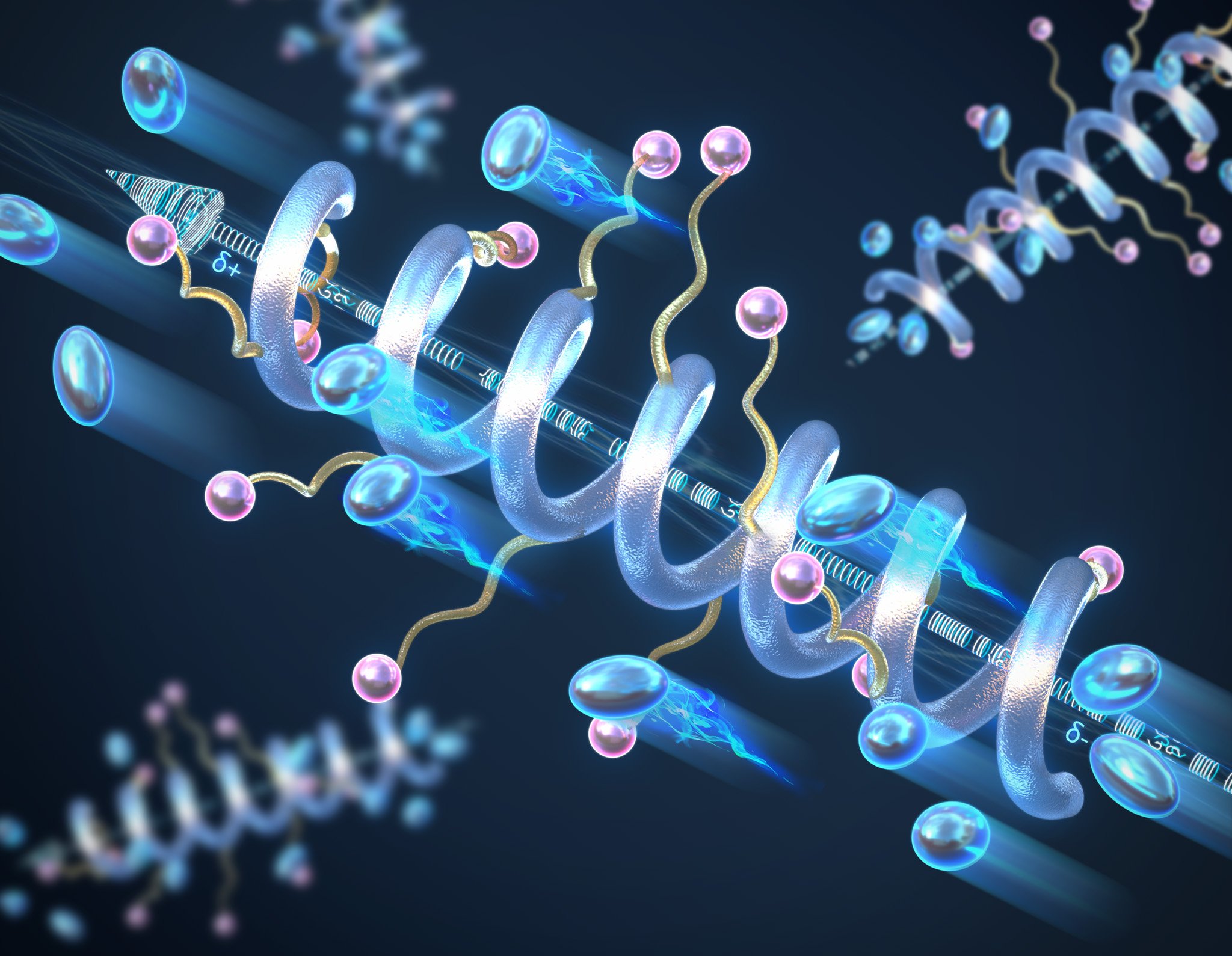
    Helical Peptide Polymer Electrolyte
    Artistic representation of a helical peptide polymer electrolyte with the macrodipole indicated by an arrow with positive and negative charges. Credit: The Grainger College of Engineering at the University of Illinois Urbana-Champaign

    Researchers at the University of Illinois Urbana-Champaign have developed helical structured peptide polymer electrolytes that exhibit superior conductivity and stability compared to traditional “random coil” structures. These helical polymers enhance the performance of solid-state batteries and are environmentally friendly as they can be decomposed and recycled after their useful life.

    Researchers have explored solid-state electrolytes for decades as potential components in energy storage systems, particularly for developing solid-state batteries. These materials are safer alternatives to the traditional liquid electrolyte—a solution that allows ions to move within the cell—used in batteries today. However, new concepts are needed to push the performance of current solid polymer electrolytes to be viable for next-generation materials.

    Materials science and engineering researchers at the University of Illinois Urbana-Champaign have explored the role of helical secondary structure on the conductivity of solid-state peptide polymer electrolytes and found that the helical structure shows greatly enhanced conductivity compared to the “random coil” counterparts. They also found that longer helices lead to higher conductivity and that the helical structure increases the overall stability of the material to temperature and voltage.

    “We introduced the concept of using secondary structure—the helix—to design and improve upon the basic material property of ionic conductivity in solid materials,” says Professor Chris Evans, who led this work. “It’s the same helix that you would find in peptides in biology, we’re just using it for non-biological reasons.”

    Enhancements Due to Helical Structures

    Polymers tend to adopt random configurations, but the backbone of the polymer can be controlled and designed to form a helical structure, like DNA. As a consequence, the polymer will have a macrodipole moment—a large-scale separation of positive and negative charges. Along the length of the helix, the small dipole moments of each individual peptide unit will add up to form the macrodipole, which increases both the conductivity and dielectric constant—a measure of a materials’ ability to store electrical energy—of the entire structure and improves charge transport. The longer the peptide, the higher the conductivity of the helix.

    Evans adds, “These polymers are much more stable than typical polymers—the helix is a very robust structure. You can go to high temperatures or voltages compared to random coil polymers, and it doesn’t degrade or lose the helix. We don’t see any evidence that the polymer breaks down before we want it to.”

    Further, since the material is made from peptides, it can be degraded back into individual monomer units using enzymes or acid when the battery has failed or reached the end of its useful life. The starting materials can be recovered and reused after a separation process, reducing its environmental impact.

    Reference: “Helical peptide structure improves conductivity and stability of solid electrolytes” by Yingying Chen, Tianrui Xue, Chen Chen, Seongon Jang, Paul V. Braun, Jianjun Cheng and Christopher M. Evans, 6 August 2024, Nature Materials.
    DOI: 10.1038/s41563-024-01966-1

    This research was funded by the U.S. National Science Foundation and by the U.S. Department of Energy, Office of Basic Science, Division of Materials Science and Engineering.

    Never miss a breakthrough: Join the SciTechDaily newsletter.
    Follow us on Google and Google News.

    Battery Technology Electrolyte Engineering University of Illinois at Urbana-Champaign
    Share. Facebook Twitter Pinterest LinkedIn Email Reddit

    Related Articles

    Surpassing All Existing Designs – Researchers Develop High-Voltage Microbattery With Exceptional Energy and Power Density

    MIT Engineers Look Toward All-Solid Lithium Batteries

    Engineers Reveal a ‘New Universe’ of Organic Molecules That Can Store Energy in Flow Batteries

    Engineers Design Calcium-Based Multi-Element for Liquid Batteries

    Solid Electrolyte Paves the Way for Rechargeable Batteries with Almost Indefinite Lifetimes

    Power Conserving Chip May Increase Smartphone Battery Life

    Scientists Develop First Water-Based Nuclear Battery

    Stanford Scientists Generate Electricity from Sewage

    MIT Researchers Design Inexpensive Liquid Batteries With Distinct Layers

    Leave A Reply Cancel Reply

    • Facebook
    • Twitter
    • Pinterest
    • YouTube

    Don't Miss a Discovery

    Subscribe for the Latest in Science & Tech!

    Trending News

    Monster Storms on Jupiter Unleash Lightning Beyond Anything on Earth

    Scientists Create “Liquid Gears” That Spin Without Touching

    The Simple Habit That Could Help Prevent Cancer

    Millions Take These IBS Drugs, But a New Study Finds Serious Risks

    Scientists Unlock Hidden Secrets of 2,300-Year-Old Mummies Using Cutting-Edge CT Scanner

    Bread Might Be Making You Gain Weight Even Without Eating More Calories

    Scientists Discover Massive Magma Reservoir Beneath Tuscany

    Europe’s Most Active Volcano Just Got Stranger – Here’s Why Scientists Are Rethinking It

    Follow SciTechDaily
    • Facebook
    • Twitter
    • YouTube
    • Pinterest
    • Newsletter
    • RSS
    SciTech News
    • Biology News
    • Chemistry News
    • Earth News
    • Health News
    • Physics News
    • Science News
    • Space News
    • Technology News
    Recent Posts
    • New Brain Discovery Challenges Long-Held Theory of Teenage Brain Development
    • Sharks Are Overheating as Warming Oceans Push Them to the Edge
    • Scientists Discover Plants “Scream” – We Just Couldn’t Hear Them Until Now
    • 25-Year Study Uncovers Hidden Paths and Early Warning Signs of Blood Cancer
    • Not Just Snoring – New Research Reveals Sleep Apnea May Be Damaging Your Muscles
    Copyright © 1998 - 2026 SciTechDaily. All Rights Reserved.
    • Science News
    • About
    • Contact
    • Editorial Board
    • Privacy Policy
    • Terms of Use

    Type above and press Enter to search. Press Esc to cancel.