
Close Menu
    Facebook X (Twitter) Instagram
    SciTechDaily
    • Biology
    • Chemistry
    • Earth
    • Health
    • Physics
    • Science
    • Space
    • Technology
    Facebook X (Twitter) Pinterest YouTube RSS
    SciTechDaily
    Home»Physics»Revolutionizing Medicine: How Electric Currents Guide Microswimmers Through Microscopic Mazes
    Physics

    Revolutionizing Medicine: How Electric Currents Guide Microswimmers Through Microscopic Mazes

    By Max Planck Institute for Dynamics and Self-OrganizationNovember 1, 20241 Comment3 Mins Read
    Facebook Twitter Pinterest Telegram LinkedIn WhatsApp Email Reddit
    Share
    Facebook Twitter LinkedIn Pinterest Telegram Email Reddit
    Microswimmers Channel Oscillation
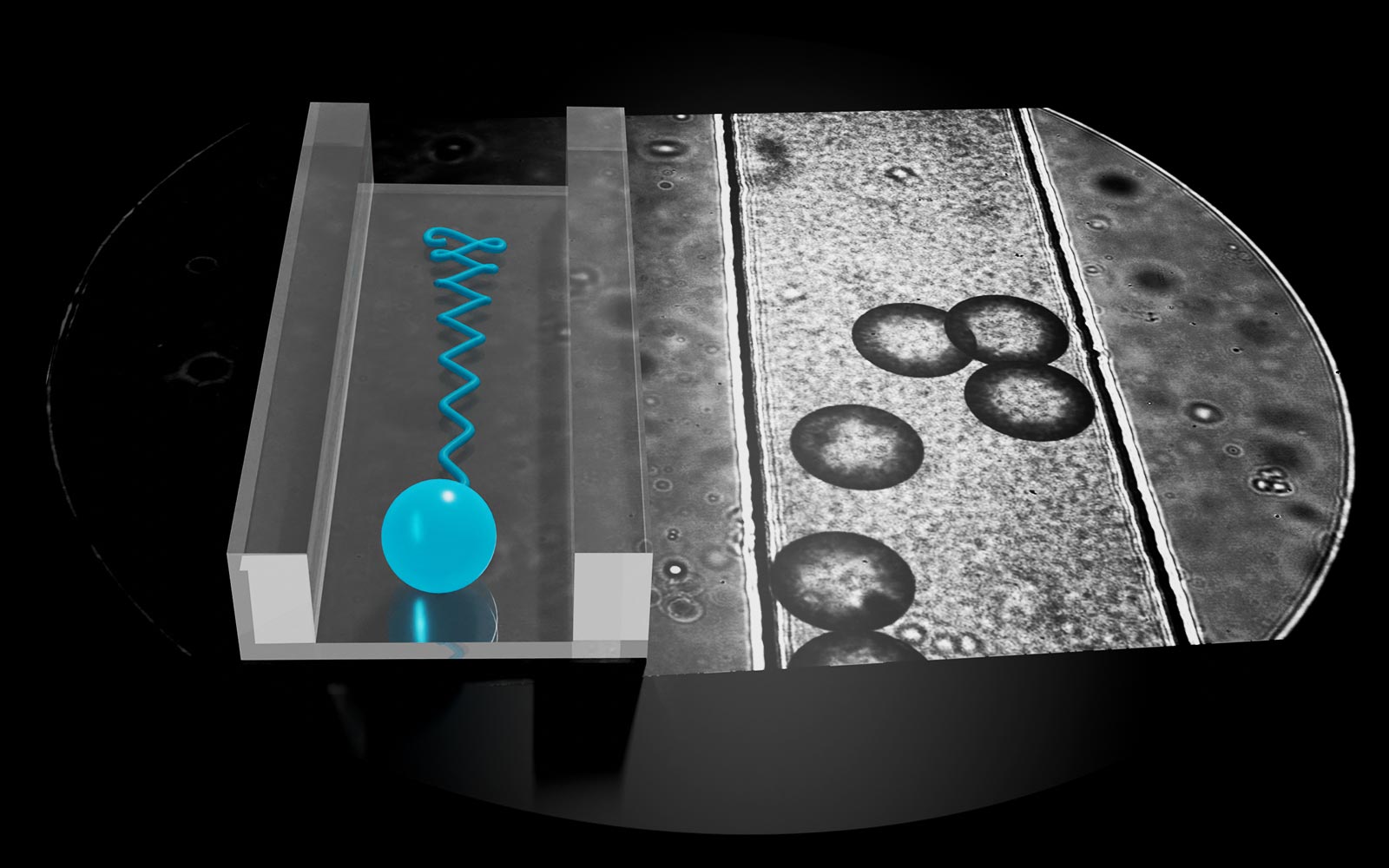
    Using an electrical field and pressure-driven flow, microswimmers can be directed to follow a defined path within a channel. Credit: Maass. MPI-DS

    Researchers at Max Planck Institute for Dynamics and Self-Organization (MPI-DS), the Indian Institute of Technology (IIT) Hyderabad, and the University of Twente, Netherlands have explored the use of electric fields combined with flow techniques to manipulate the movement of artificial microswimmers in channels.

    These swimmers, which can be biological like bacteria or custom-designed, are crucial for tasks such as drug delivery in narrow environments. The study revealed various movement patterns, such as wall adherence, centerline navigation, and even U-turns, offering a new way to control these microdevices precisely.

    Microswimmer Navigation

    Microswimmers, such as algae, bacteria, or custom-designed structures, often need to navigate narrow spaces like microchannels, porous materials, or even blood vessels. When custom-designed swimmers are used for tasks like transporting chemicals or delivering drugs, it’s crucial to control their movement near walls and boundaries. While they may need to exchange fuel or information with their surroundings, they also must avoid sticking to surfaces where they could get trapped.

    Electric Field Guidance in Microswimmer Control

    Because many of these microswimmers are electrically charged, electric fields offer a flexible way to guide them through complex environments. Scientists from MPI-DS explored this in experiments with self-propelling artificial microswimmers.

    “We investigated the influence of a combination of electric fields and pressure-driven flow on the states of motion of artificial microswimmers in a channel,” explains Corinna Maass, group leader at MPI-DS and Associate Professor at the University of Twente. “We identified distinct modes of motion and the system parameters that control them.”

    In previous research, the scientists showed that these artificial swimmers tend to move upstream, oscillating between the channel walls. Now, with this new discovery, they can control the swimmers’ movement precisely by applying electric fields and flow through the channel.

    Enhancing Microswimmer Maneuverability

    This way, the researchers generated a broad range of possible motility patterns: The swimmers can be directed to adhere to the channel walls or follow its centerline, either in an oscillating or in a straight motion. They are also able to execute U-turns if they set off in the wrong direction. The scientists analyzed these different states using a general hydrodynamic model that is applicable to any swimmer with a surface charge.

    Ranabir Dey, Assistant Professor at IIT Hyderabad explains: “We show that the motility of charged swimmers can be further controlled using external electric fields. Our model can help to understand and customize artificial microswimmers, and provide inspiration for autonomous micro-robotic and other biotechnological applications.”

    Reference: “Electrotaxis of Self-Propelling Artificial Swimmers in Microchannels” by Carola M. Buness, Avi Rana, Corinna C. Maass and Ranabir Dey, 7 October 2024, Physical Review Letters.
    DOI: 10.1103/PhysRevLett.133.158301

    Never miss a breakthrough: Join the SciTechDaily newsletter.
    Follow us on Google and Google News.

    Max Planck Institute
    Share. Facebook Twitter Pinterest LinkedIn Email Reddit

    Related Articles

    Inner Structure of Heavy Atomic Nuclei Is Becoming Clearer

    New Insights Into How Superconducting Materials Interact With Magnetic Ones

    Quantum Information is Preserved for Longer Than a Second at Room Temperature

    High-Energy Radiation is Refracted Setting the Stage for Gamma Optics

    Simulating Quantum Walks in Two Dimensions

    Ultracold Atoms as Quantum Simulators

    Molecules as Antennas Transmit Signals of Single Photons

    Dynamics of a System of Ultracold Potassium Atoms

    Researchers Discover Electrical Switch for Magnetic Current

    1 Comment

    1. Eric M. Jones on November 2, 2024 7:39 am

      This was known to separate male and female spermatozoa…50 years ago.

      Reply
    Leave A Reply Cancel Reply

    • Facebook
    • Twitter
    • Pinterest
    • YouTube

    Don't Miss a Discovery

    Subscribe for the Latest in Science & Tech!

    Trending News

    Popular Weight-Loss Drugs Like Ozempic Linked to Lower Breast Cancer Risk

    AI Learned the Rules of the Universe and That Became a Problem

    Scientists Found a Hidden Brain Signal That Predicts Social Behavior

    Even GPT-5 Failed This Human Attention Test

    Scientists Discover a Biological Clock Unlike Anything Seen Before

    The Brain May Not Need Full Sleep To Recover, New Research Finds

    Your Gut Microbes May Decide How Many Calories You Really Absorb

    Millions Take This Joint Supplement but Scientists Found a Concerning Alzheimer’s Link

    Follow SciTechDaily
    • Facebook
    • Twitter
    • YouTube
    • Pinterest
    • Newsletter
    • RSS
    SciTech News
    • Biology News
    • Chemistry News
    • Earth News
    • Health News
    • Physics News
    • Science News
    • Space News
    • Technology News
    Recent Posts
    • Scientists Discover Brain-Protecting Peptide That Could Change Parkinson’s Treatment
    • This Copper Drug Clears Alzheimer’s Brain Toxins and Boosts Memory
    • Adults Over 65 Lost Massive Amounts of Weight With Ozempic
    • This AI Learned the Laws of Physics and Could Accelerate Quantum Computing Breakthroughs
    • How Flocking Birds “Defy” One of Physics’ Most Fundamental Laws
    Copyright © 1998 - 2026 SciTechDaily. All Rights Reserved.
    • Science News
    • About
    • Contact
    • Editorial Board
    • Privacy Policy
    • Terms of Use

    Type above and press Enter to search. Press Esc to cancel.