

Close Menu
    Facebook X (Twitter) Instagram
    SciTechDaily
    • Biology
    • Chemistry
    • Earth
    • Health
    • Physics
    • Science
    • Space
    • Technology
    Facebook X (Twitter) Pinterest YouTube RSS
    SciTechDaily
    Home»Space»Revolutionizing Space: FASHI’s Record-Breaking Extragalactic HI Catalog via FAST
    Space

    Revolutionizing Space: FASHI’s Record-Breaking Extragalactic HI Catalog via FAST

    By Science China PressDecember 30, 20231 Comment3 Mins Read
    Facebook Twitter Pinterest Telegram LinkedIn WhatsApp Email Reddit
    Share
    Facebook Twitter LinkedIn Pinterest Telegram Email Reddit
    FAST All Sky HI Survey (FASHI)
    The promotional image shows the project about the Five-hundred-meter Aperture Spherical radio Telescope (FAST) All Sky HI survey (FASHI). As the image illustrates, the powerful FAST telescope is observing distant galaxies, recording their HI emission, and revealing the detailed physical properties of the galaxies. Credit: ©Science China Press

    The FASHI survey has mapped 35% of its target sky area with the FAST telescope, discovering over 41,000 extragalactic HI sources, and gaining acclaim in the astronomical community.

    The FAST All Sky HI survey (FASHI) was designed to cover the entire sky observable by the Five-hundred-meter Aperture Spherical radio Telescope (FAST), spanning approximately 22000 square degrees of declination between -14 deg and +66 deg, and in the frequency range of 1050-1450 MHz, with the expectation of eventually detecting more than 100000 HI sources.

    Between August 2020 and June 2023, FASHI covered more than 7600 square degrees, which is approximately 35% of the total sky observable by FAST. FASHI team has detected a total of 41741 extragalactic HI sources in the frequency range 1305.5-1419.5 MHz. When completed, FASHI team will provide the largest extragalactic HI catalog and an objective view of HI content and large-scale structure in the local universe.

    Lister Staveley-Smith, a professor at the University of Western Australia and a peer reviewer of the paper, called their work: “That’s an impressive milestone. That is an extremely important contribution to astronomical research, particularly in the field of galaxy evolution.”
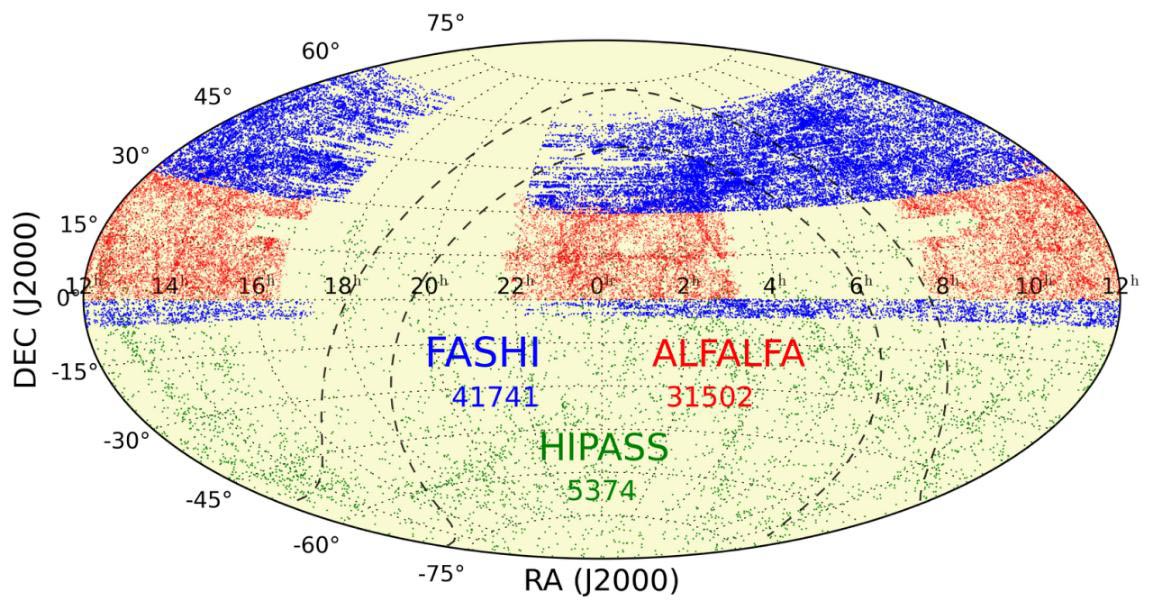
    FASHI Sky Distribution of Currently Released 41741 H I Sources
    FASHI sky distribution of the currently released 41741 H I sources (in blue dots) in the galactic hemispheres, showing the coarseness of the limits imposed by practical and scheduling constraints. For comparison, ALFALFA α100 (Haynes et al., 2018) and HIPASS galaxies (Koribalski et al., 2004; Meyer et al., 2004; Wong et al., 2006) are also shown with red and green points, respectively. The two black dashed lines indicate the position of the of the galactic plane at galactic latitude b = ±10deg. Credit: ©Science China Press

    Hélène Courtois, a professor at the University of Lyon 1, called their work: “The paper is fantastic news for projects like Cosmic Flows!! I didn’t know that the FASHI survey was already going so strongly for 3 years!!

    “The quality of the spectra that are shown is exquisite, the completeness of the sample is amazing, and showing the excellent sensitivity of the instrument. The area surveyed in just 3 years gives high hopes that the full sky that can be accessed by the FAST will be covered in record time!

    “The paper was a total surprise to me, and reading page after page of the article was just like being a child unwrapping slowly and with delight a Christmas gift.”

    The work was recently published in the journal SCIENCE CHINA Physics, Mechanics and Astronomy. Researchers from Guizhou University, the National Astronomical Observatories under the Chinese Academy of Sciences, and Peking University in China contributed to the study.

    Reference: “The FAST all sky H i survey (FASHI): The first release of catalog” by Chuan-Peng Zhang, Ming Zhu, Peng Jiang, Cheng Cheng, Jing Wang, Jie Wang, Jin-Long Xu, Xiao-Lan Liu, Nai-Ping Yu, Lei Qian, Haiyang Yu, Mei Ai, Yingjie Jing, Chen Xu, Ziming Liu, Xin Guan, Chun Sun, Qingliang Yang, Menglin Huang, Qiaoli Hao and FAST Collaboration, 8 December 2023, Science China Physics, Mechanics & Astronomy.
    DOI: 10.1007/s11433-023-2219-7

    Never miss a breakthrough: Join the SciTechDaily newsletter.
    Follow us on Google and Google News.

    Astronomy Astrophysics Science China Press
    Share. Facebook Twitter Pinterest LinkedIn Email Reddit

    Related Articles

    Mystery Deepens: Astrophysicists Say Dark Matter May Not Be One Thing

    Researchers Unveil Galactic Treasure Map, Opening a New Window to the Extreme Universe

    This Star Got Kicked Out at a Million MPH – And Exposed a Hidden Black Hole

    Meet TEGO: The Tetrahedral Observatory That Could Change Our Understanding of Gravity

    The Universe’s Brightest Explosion: Scientists Discover Unprecedented Energy Lines in Record-Breaking Gamma-Ray Burst

    HAWC+ Reveals Magnetic Chaos Hidden Within the Whirlpool Galaxy

    A Tale of Planetary Resurrection in a Triple-Star System With a Skewed Configuration

    A Star Dying Soon After the Beginning of the Universe Could Be Disrupting Mobile Phone Reception Today

    Most Distant Quasar Discovered Sheds Light on How Supermassive Black Holes Grow

    1 Comment

    1. Paul on January 2, 2024 2:13 am

      What is “HI” in “HI sources”?

      Reply
    Leave A Reply Cancel Reply

    • Facebook
    • Twitter
    • Pinterest
    • YouTube

    Don't Miss a Discovery

    Subscribe for the Latest in Science & Tech!

    Trending News

    Massive Study Warns Marijuana Use in Teens Is Linked to Serious Mental Illness

    Scientists Discover a Completely Unexpected Way T Cells Kill Cancer

    Scientists Just Found the Solar System’s Original “Planet Factory”

    Study Warns Widely Used Food Preservatives Linked to High Blood Pressure and Heart Disease

    New Treatment Could Reverse Osteoarthritis Within Weeks

    Physicists Have Measured “Negative Time” in Bizarre Quantum Experiment

    The Deadly Tapeworm Spreading Across America Has Reached the Pacific Northwest

    Could Low Vitamin D Be Making Your Pain Worse?

    Follow SciTechDaily
    • Facebook
    • Twitter
    • YouTube
    • Pinterest
    • Newsletter
    • RSS
    SciTech News
    • Biology News
    • Chemistry News
    • Earth News
    • Health News
    • Physics News
    • Science News
    • Space News
    • Technology News
    Recent Posts
    • The Future of Work Belongs to People Who Master AI
    • Scientists Challenge a 70-Year-Old Theory of Language With a Surprising Discovery
    • Scientists Discover Mysterious Creature Living in the Great Salt Lake – and It Exists Nowhere Else on Earth
    • It’s Alive? Surprising Discovery Changes What We Know About Fog
    • Simple Family Routines May Be the Secret to a Smoother Start at School
    Copyright © 1998 - 2026 SciTechDaily. All Rights Reserved.
    • Science News
    • About
    • Contact
    • Editorial Board
    • Privacy Policy
    • Terms of Use

    Type above and press Enter to search. Press Esc to cancel.