

Study challenges long-standing beliefs about the Mediterranean Phoenician-Punic civilization, a culture recognized as one of the most influential maritime powers in history.
The Phoenician culture originated in the Bronze Age city-states of the Levant and introduced major innovations, including the first alphabet, an ancestor to many modern writing systems. By the early first millennium BCE, Phoenician cities had created an extensive maritime network of trading posts reaching as far as Iberia. Through these networks, they spread their culture, religion, and language throughout the central and western Mediterranean.
By the 6th century BCE, Carthage, a Phoenician colony on the coast of present-day Tunisia, had become the dominant power in the region. Culturally, Phoenician communities associated with or governed by Carthage became known as “Punic” by the Romans. Carthage is remembered in history for the Punic Wars against the Roman Republic, including the famed military campaign in which General Hannibal crossed the Alps.
In a study conducted under the Max Planck-Harvard Research Center for the Archaeoscience of the Ancient Mediterranean, co-directed by Johannes Krause of the Max Planck Institute for Evolutionary Anthropology and Michael McCormick of Harvard University, an international research team has now revealed new genetic evidence that reshapes our understanding of these ancient civilizations.
New perspective on the spread of Phoenician culture
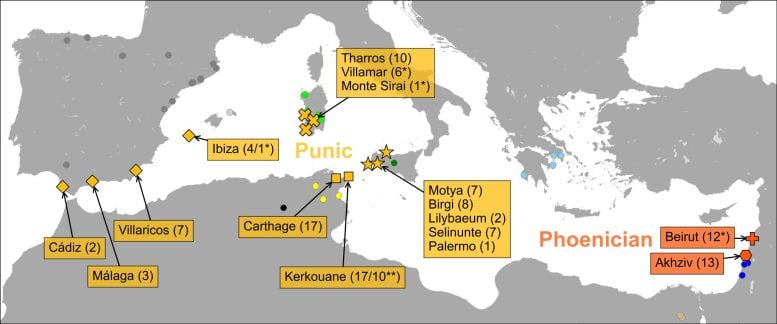
The new study aimed to use ancient DNA to characterize Punic people’s ancestry and look for genetic links between them and Levantine Phoenicians, with whom they share a common culture and language. This was made possible by sequencing and analyzing a large sample of genomes from human remains buried in 14 Phoenician and Punic archaeological sites spanning the Levant, North Africa, Iberia, and the Mediterranean islands of Sicily, Sardinia, and Ibiza.
The researchers revealed an unexpected result.
“We find surprisingly little direct genetic contribution from Levantine Phoenicians to western and central Mediterranean Punic populations,” says lead author Harald Ringbauer, who was a post-doctoral scientist at Harvard University when he began this research, and is now a group leader at the Max Planck Institute for Evolutionary Anthropology in Leipzig, Germany. “This provides a new perspective on how Phoenician culture spread—not through large-scale mass migration, but through a dynamic process of cultural transmission and assimilation.”
The study highlights that Punic sites were home to people with vastly different ancestry profiles. “We observe a genetic profile in the Punic world that was extraordinarily heterogeneous,” says David Reich, a professor of Genetics and Human Evolutionary Biology at Harvard University who co-led the work. “At each site, people were highly variable in their ancestry, with the largest genetic source being people similar to contemporary people of Sicily and the Aegean, and many people with significant North African-associated ancestry as well.”
Ancient DNA reveals cosmopolitan nature of Punic world
The results underscore the Punic world’s cosmopolitan nature. Individuals with North African ancestry lived next to and intermingled with a majority of people of mainly Sicilian-Aegean ancestry in all sampled Punic sites, including Carthage.
Moreover, genetic networks across the Mediterranean suggest that shared demographic processes—such as trade, intermarriage, and population mixing—played a critical role in shaping these communities. The researchers even found a pair of close relatives (ca. second cousins) bridging the Mediterranean, one buried in a North African Punic site and one in Sicily.
“These findings reinforce the idea that ancient Mediterranean societies were deeply interconnected, with people moving and mixing across often large geographic distances,” says Ilan Gronau, a professor of Computer Science at Reichman University in Herzliya, Israel, who co-led the work. He adds: “Such studies highlight the power of ancient DNA in its ability to shed light on the ancestry and mobility of historical populations for which we have relatively sparse direct historical records.”
Reference: “Punic people were genetically diverse with almost no Levantine ancestors” by Harald Ringbauer, Ayelet Salman-Minkov, Dalit Regev, Iñigo Olalde, Tomer Peled, Luca Sineo, Gioacchino Falsone, Peter van Dommelen, Alissa Mittnik, Iosif Lazaridis, Davide Pettener, Maria Bofill, Ana Mezquida, Benjamí Costa, Helena Jiménez, Patricia Smith, Stefania Vai, Alessandra Modi, Arie Shaus, Kim Callan, Elizabeth Curtis, Aisling Kearns, Ann Marie Lawson, Matthew Mah, Adam Micco, Jonas Oppenheimer, Lijun Qiu, Kristin Stewardson, J. Noah Workman, Nicholas Márquez-Grant, Antonio M. Sáez Romero, María Luisa Lavado Florido, Juan Manuel Jiménez-Arenas, Isidro Jorge Toro Moyano, Enrique Viguera, José Suárez Padilla, Sonia López Chamizo, Tomas Marques-Bonet, Esther Lizano, Alicia Rodero Riaza, Francesca Olivieri, Pamela Toti, Valentina Giuliana, Alon Barash, Liran Carmel, Elisabetta Boaretto, Marina Faerman, Michaela Lucci, Francesco La Pastina, Alessia Nava, Francesco Genchi, Carla Del Vais, Gabriele Lauria, Francesca Meli, Paola Sconzo, Giulio Catalano, Elisabetta Cilli, Anna Chiara Fariselli, Francesco Fontani, Donata Luiselli, Brendan J. Culleton, Swapan Mallick, Nadin Rohland, Lorenzo Nigro, Alfredo Coppa, David Caramelli, Ron Pinhasi, Carles Lalueza-Fox, Ilan Gronau and David Reich, 23 April 2025, Nature.
DOI: 10.1038/s41586-025-08913-3
Funding: NIH/National Institutes of Health, John Templeton Foundation
Never miss a breakthrough: Join the SciTechDaily newsletter.
Follow us on Google and Google News.
27 Comments
it’s so hard for you all to clearly say the Phoenicians mainly come from Lebanon and you do circus worthy backflips to hide that fact.
Possibly because most people familiar with the Phoenicians already know that, not necessary to repeat it.
And “Lebanon” is nothing but a part of Israel originally. Phoenicians were the ancient Hebrew people
More like the other way around, as the Hebrews descended from a much larger Levante Phoenician people, spoke one of their dialects, wrote using their alphabet and took their top god, El, to become the ‘only god’ Elohim.
Stop the cap . Phoenicians are Hebrew 😂
Are you stupid your Israel and Hebrew was not yet existe you stupid
They just said no Levant ancestry.
Phoenician population originally came from Crete after the destruction from Thera volcano.
HAHAHA🤣
WW DON’T SHARE THW SAME DNA woth You 😜
Depends. Are u a Phoenician or Invader from Hijaz?
There is no such ugly liberal term like BCE.
BC and AD, period!!!
Sure pal. Language never changes.
But hey, why are you so insecure about your religious beliefs.
If you like them , go with it.
But don’t expect the rest of the world to.
😊
No. From ancient Hebrew Israelites
The culture of the Phoenicians originated in, what is nowadays, Lebanon. Infact the Phoenicians had colonies all the way south down to today’s Caesarea in Israel.
The Phoenicians probably spoke a similar language to Hebrew – a Canaanite language.
The modern alphabet probably did not originate from them but from early Hebrew known as proto sinaic. The Phoenicians did settle in the area of Crete and created the Minoan culture. The alphabet was a pictogram, like that on the Phaistos disc’s.
This kind of alphabet was not practical enough for trade and, as soon as they could, adopted the Hebrew alphabet. Being traders, the Phoenicians sailed throughout the Mediterranean region and passed on their new adopted alphabet.
Knowing Hebrew one can understand the meaning of the name of the letters and why they look as they are.
Some of the names of the Phoenician colonies have meaning, even in Hebrew.
Kartago/Carthage (Cartagena) means New Town. Marseilles – Mesilia/Masilia means route/way. In Hebrew: Mesilot.
Thank you.
Leave it to people to turn an insightful article demonstrating a diverse culture into a modern day tribalist juvenile political commentary
Pike Stance, Agreed.
I think the article was designed to spark this type of comments. I wonder it didn’t drew in the woke and anti-woke readers.
This is real hestory
Well said.
This is real hestory
This is a fake history article that basically aims to wipe out any mention of Lebanon ,the actual origin of the Phoenician and DNA speaking ,, studies at the American University of Beirut linked the DNA of modern day Lebanese citizens to residents of the north African and Tunisian coasts and the all the way across to Malta !
Yet this shady Israeli led article doesn’t mention any of the above genetic facts and deludes itself and the readers into wiping out any mention of lebanon as the very homeland and progenitor of the carthaginian and Maltese DNA carriers that previous study proved in detail.
A sick mind never heals on its own . And the timing is sooo suspicious !
It continues to amaze me that people dig up a few things and they think they have an ancient set of cultures figured out. If they just told us what they found and kept from ruminating or trying to disprove the Bible or trying to invent a history they prefer it would make more sense. All the guessing and trying to sound factual is not science, it’s theatre. What is even worse is when they convince people living on the land that they are somehow descendants and they can be proud and demand rights and even reparation if they were oppressed. Just tell us what you found and what the context of the find is and keep your notions in check.
Peace. Well if they’d just show the evolutionary chart with DNA attached to it they taught in schools till April 1st 1979 when they removed from existance we could put and end to all this useless information but THEY WILL NOT. Those who signed the antartic Treaty in 1950 not 1961 are all in total control of the eartH and 100% Atheist and don’t want you to KNIW IT. Dumbest evil people ever walked this Heart. They’ll learn unfortunately the hard way just like your all gonna get reminded here real quick like… YET…AGAIN. 🙃❤️✌️
😊is that part of the Gallian dialectic?
26 letter alphabet makes a good codex,vs.latin alphabet.
Tinn in Cornwall mixed with Copper in Lebanon, makes BRASS.
2×PILLARS
2×BALLS.
Is that part of the Gallian dialectic?
26 letter alphabet makes a good codex,vs.latin alphabet.
Tinn in Cornwall mixed with Copper in Lebanon, makes BRASS.
2×PILLARS
2×BALLS.