
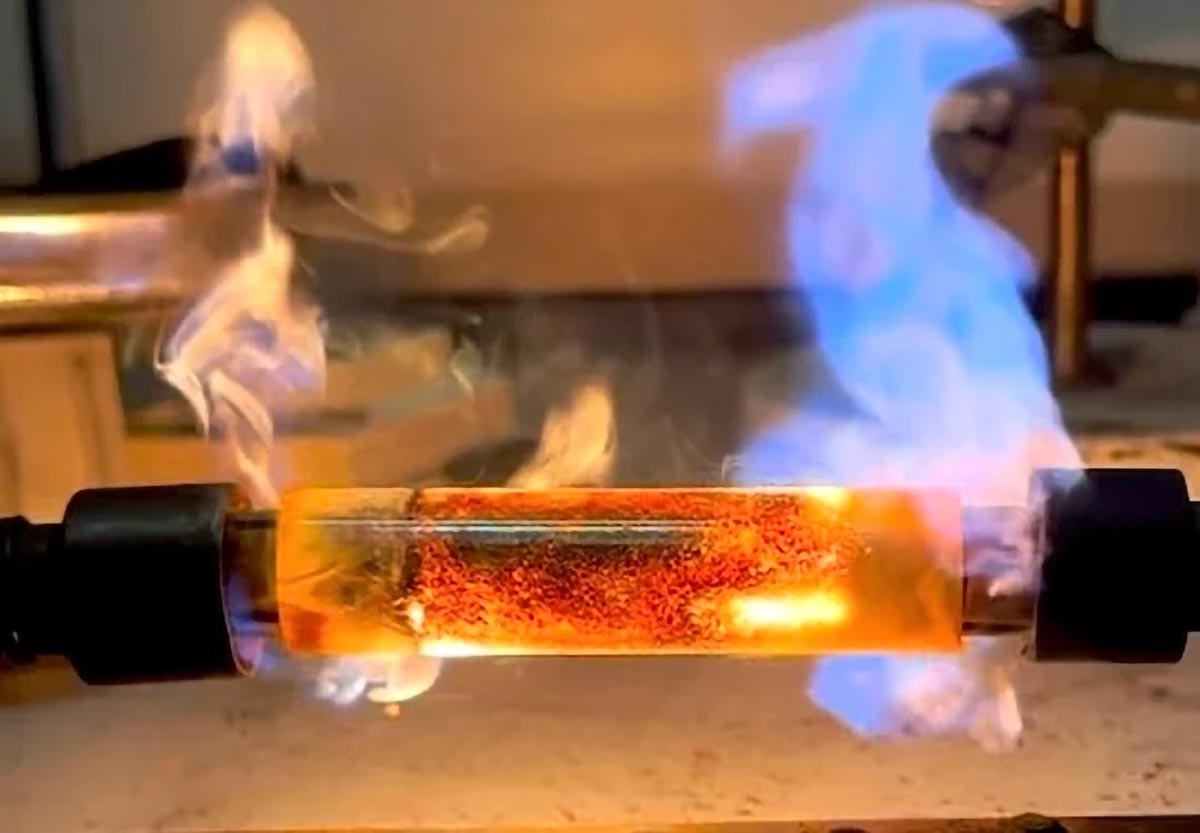
Researchers at Rice University have unveiled a groundbreaking method called flash-within-flash Joule heating (FWF), capable of producing high-quality solid-state materials rapidly and sustainably.
This innovative technique not only minimizes energy use, water consumption, and greenhouse gas emissions by over 50%, but also allows the creation of advanced materials like semiconductor and aerospace components, setting a new standard in manufacturing efficiency and environmental responsibility.
Flash-Within-Flash Joule Heating
James Tour’s lab at Rice University has developed a new method known as flash-within-flash Joule heating (FWF) that could transform the synthesis of high-quality solid-state materials, offering a cleaner, faster, and more sustainable manufacturing process. The findings were published on August 8 in Nature Chemistry.
Traditionally, synthesizing solid-state materials has been a time-consuming and energy-intensive process, often accompanied by the production of harmful byproducts. But FWF enables gram-scale production of diverse compounds in seconds while reducing energy, water consumption, and greenhouse gas emissions by more than 50%, setting a new standard for sustainable manufacturing.
The Science Behind FWF
The innovative research builds on Tour’s 2020 development of waste disposal and upcycling applications using flash Joule heating, a technique that passes a current through a moderately resistive material to quickly heat it to over 3,000 degrees Celsius (over 5,000 degrees Fahrenheit) and transform it into other substances.
“The key is that formerly we were flashing carbon and a few other compounds that could be conductive,” said Tour, the T.T. and W.F. Chao Professor of Chemistry and professor of materials science and nanoengineering. “Now we can flash synthesize the rest of the periodic table. It is a big advance.”

Breakthrough in Material Production
FWF’s success lies in its ability to overcome the conductivity limitations of conventional flash Joule heating methods. The team — including Ph.D. student Chi Hun “Will” Choi and corresponding author Yimo Han, assistant professor of chemistry, materials science and nanoengineering — incorporated an outer flash heating vessel filled with metallurgical coke and a semiclosed inner reactor containing the target reagents. FWF generates intense heat of about 2,000 degrees Celsius, which rapidly converts the reagents into high-quality materials through heat conduction.
This novel approach allows for the synthesis of more than 20 unique, phase-selective materials with high purity and consistency, according to the study. FWF’s versatility and scalability is ideal for the production of next-generation semiconductor materials such as molybdenum diselenide (MoSe2), tungsten diselenide, and alpha phase indium selenide, which are notoriously difficult to synthesize using conventional techniques.
Implications for Industry and Research
“Unlike traditional methods, FWF does not require the addition of conductive agents, reducing the formation of impurities and byproducts,” Choi said.
This advancement creates new opportunities in electronics, catalysis, energy and fundamental research. It also offers a sustainable solution for manufacturing a wide range of materials. Moreover, FWF has the potential to revolutionize industries such as aerospace, where materials like FWF-made MoSe2 demonstrate superior performance as solid-state lubricants.
“FWF represents a transformative shift in material synthesis,” Han said. “By providing a scalable and sustainable method for producing high-quality solid-state materials, it addresses barriers in manufacturing while paving the way for a cleaner and more efficient future.”
Reference: “Flash-within-flash synthesis of gram-scale solid-state materials” by Chi Hun ‘William’ Choi, Jaeho Shin, Lucas Eddy, Victoria Granja, Kevin M. Wyss, Bárbara Damasceno, Hua Guo, Guanhui Gao, Yufeng Zhao, C. Fred Higgs III, Yimo Han and James M. Tour, 8 August 2024, Nature Chemistry.
DOI: 10.1038/s41557-024-01598-7
This study was supported by the Air Force Office of Scientific Research, U.S. Army Corp of Engineers, and Welch Foundation.
Never miss a breakthrough: Join the SciTechDaily newsletter.
Follow us on Google and Google News.