
Close Menu
    Facebook X (Twitter) Instagram
    SciTechDaily
    • Biology
    • Chemistry
    • Earth
    • Health
    • Physics
    • Science
    • Space
    • Technology
    Facebook X (Twitter) Pinterest YouTube RSS
    SciTechDaily
    Home»Space»Rock “Appears” in Front of Opportunity Rover
    Space

    Rock “Appears” in Front of Opportunity Rover

    By Jet Propulsion LaboratoryJanuary 22, 20143 Comments2 Mins Read
    Facebook Twitter Pinterest Telegram LinkedIn WhatsApp Email Reddit
    Share
    Facebook Twitter LinkedIn Pinterest Telegram Email Reddit


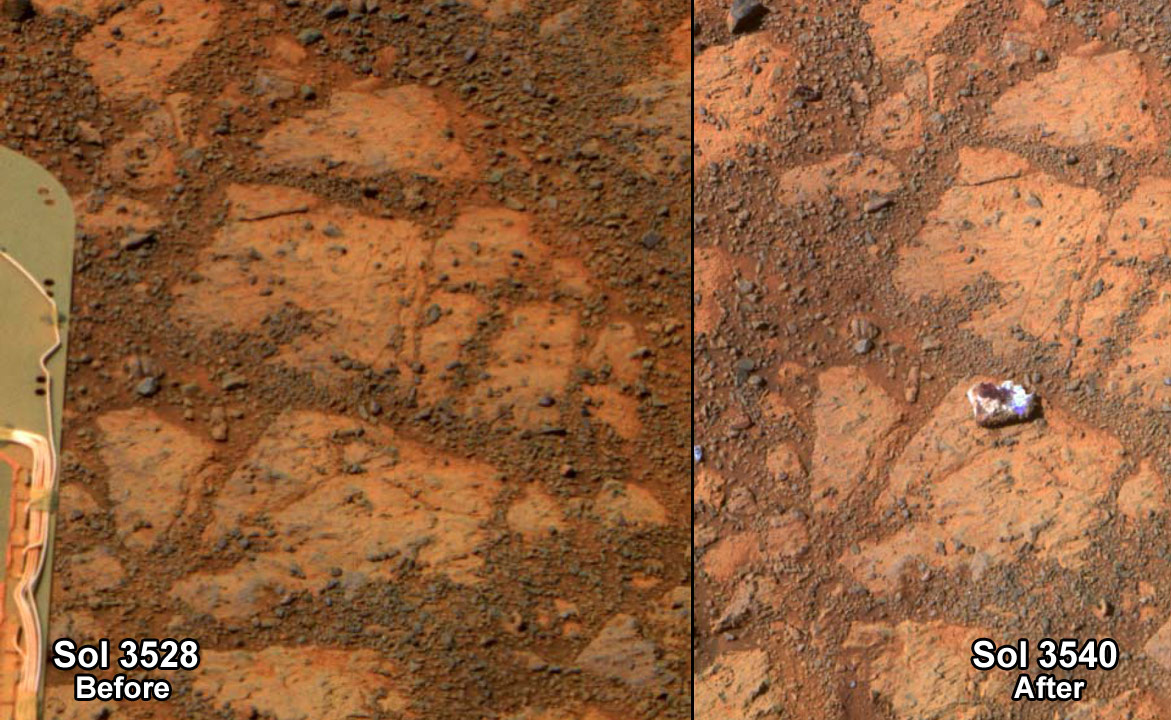
    Image of the Rock that Appeared in Front of the Opportunity Rover
    Images taken 13 days apart show a bright rock, ‘Pinnacle Island,’ which likely landed here after one of Opportunity’s wheels knocked it into position. The rock is roughly the size of a doughnut. Credit: NASA/JPL-Caltech/Cornell Univ./Arizona State Univ.

    This before and after view from NASA’s Mars Exploration Rover Opportunity shows the rock that scientists believe was likely knocked into position from one of Opportunity’s wheels.

    This before-and-after pair of images of the same patch of ground in front of NASA’s Mars Exploration Rover Opportunity 13 days apart documents the arrival of a bright rock onto the scene. The rover had completed a short drive just before taking the second image, and one of its wheels likely knocked the rock — dubbed “Pinnacle Island” — to this position. The rock is about the size of a doughnut.

    The images are from Opportunity’s panoramic camera (Pancam). The one on the left is from the 3,528th Martian day, or sol, of the rover’s work on Mars (December 26, 2013). The one on the right, with the newly arrived rock, is from Sol 3540 (January 8, 2014). Much of the rock is bright-toned, nearly white. A portion is deep red in color. Pinnacle Island may have been flipped upside down when a wheel dislodged it, providing an unusual circumstance for examining the underside of a Martian rock.

    The site is on “Murray Ridge,” a section of the rim of Endeavour Crater where Opportunity is working on north-facing slopes during the rover’s sixth Martian winter.

    Never miss a breakthrough: Join the SciTechDaily newsletter.
    Follow us on Google and Google News.

    JPL Mars NASA Planetary Science
    Share. Facebook Twitter Pinterest LinkedIn Email Reddit

    Related Articles

    Curiosity Finds Ancient Streambed on Mars

    NASA’s Opportunity Discovers Geological Mystery on Mars

    NASA Data Suggests “Dry Ice” Snowfall on Mars

    NASA’s Curiosity Prepares for Use of Its Arm and Tools

    Curiosity Sends Back Radioed Words and New Telephoto View of Mars

    NASA’s Curiosity Readies for First Drive on Mars

    Color HiRISE Image of Curiosity Rover on Mars

    First 360-Degree Color Panorama From NASA’s Curiosity Mars Rover

    First Full-Resolution Images From Curiosity’s Navigation Cameras

    3 Comments

    1. Rev. Tom Stuart on January 22, 2014 11:36 am

      Looks like to me that you have the Photos reversed as far as before and after.
      There is a shape in the soil of the rock before it left that spot. Either it was moved by a part or extension of the vehicle of wind possibly. Reexamine the photos. The photos look like they were not taken by the same camera or lens
      aperture/distance as well.

      Reply
    2. Alex on January 22, 2014 3:00 pm

      This almost looks like a chemical reaction… there is a depression in the first where the object lays. it almost looks like it was not solid rock, but there was something under the rock there which oozed up from underneath as the rover drove over this.

      Reply
    3. Madanagopal.V.C on January 23, 2014 1:04 am

      Hello! Tom! The two photos were taken 13 days apart between Sol 3528 and Sol 3540 of Martian days. Don’t you notice the bright tinge on the removed stone by Rover’s wheel? You can see another tiny piece of rock on the left edge of the second photo. The rover was ascending the rim of a crater and hence could have displaced these stones when it cirles around. If it is otherwise as spoken by you the martian dust would have settled on it making it a little red and not this much white. Thank You.

      Reply
    Leave A Reply Cancel Reply

    • Facebook
    • Twitter
    • Pinterest
    • YouTube

    Don't Miss a Discovery

    Subscribe for the Latest in Science & Tech!

    Trending News

    Mezcal “Worm” in a Bottle Mystery: DNA Testing Reveals a Surprise

    New Research Reveals That Your Morning Coffee Activates an Ancient Longevity Switch

    This Is What Makes You Irresistible to Mosquitoes

    Shockingly Powerful Giant Octopuses Ruled the Seas 100 Million Years Ago

    Scientists Stunned by New Organic Molecules Found on Mars

    Rewriting Dinosaur Evolution: Scientists Unearth Remarkable 150-Million-Year-Old Stegosaur Skull

    Omega-3 Supplements Linked to Cognitive Decline in Surprising New Study

    First-of-Its-Kind Discovery: Homer’s Iliad Found Embedded in a 1,600-Year-Old Egyptian Mummy

    Follow SciTechDaily
    • Facebook
    • Twitter
    • YouTube
    • Pinterest
    • Newsletter
    • RSS
    SciTech News
    • Biology News
    • Chemistry News
    • Earth News
    • Health News
    • Physics News
    • Science News
    • Space News
    • Technology News
    Recent Posts
    • These Simple Daily Habits Can Quickly Improve Blood Pressure and Heart Risk Factors
    • A Common Nutrient May Play a Surprising Role in Anxiety
    • Doing This After 9 p.m. Could Double Your Risk of Gut Issues
    • New Research Challenges Long-Held Beliefs About How the Brain Makes Decisions
    • Breakthrough Technology Reveals New Treatment Targets for Cancer
    Copyright © 1998 - 2026 SciTechDaily. All Rights Reserved.
    • Science News
    • About
    • Contact
    • Editorial Board
    • Privacy Policy
    • Terms of Use

    Type above and press Enter to search. Press Esc to cancel.