
Close Menu
    Facebook X (Twitter) Instagram
    SciTechDaily
    • Biology
    • Chemistry
    • Earth
    • Health
    • Physics
    • Science
    • Space
    • Technology
    Facebook X (Twitter) Pinterest YouTube RSS
    SciTechDaily
    Home»Science»Pi Day Challenge: Can You Solve These NASA Math Problems?
    Science

    Pi Day Challenge: Can You Solve These NASA Math Problems?

    By Jet Propulsion LaboratoryMarch 12, 2022No Comments2 Mins Read
    Facebook Twitter Pinterest Telegram LinkedIn WhatsApp Email Reddit
    Share
    Facebook Twitter LinkedIn Pinterest Telegram Email Reddit
    NASA Pi Day Challenge 2022
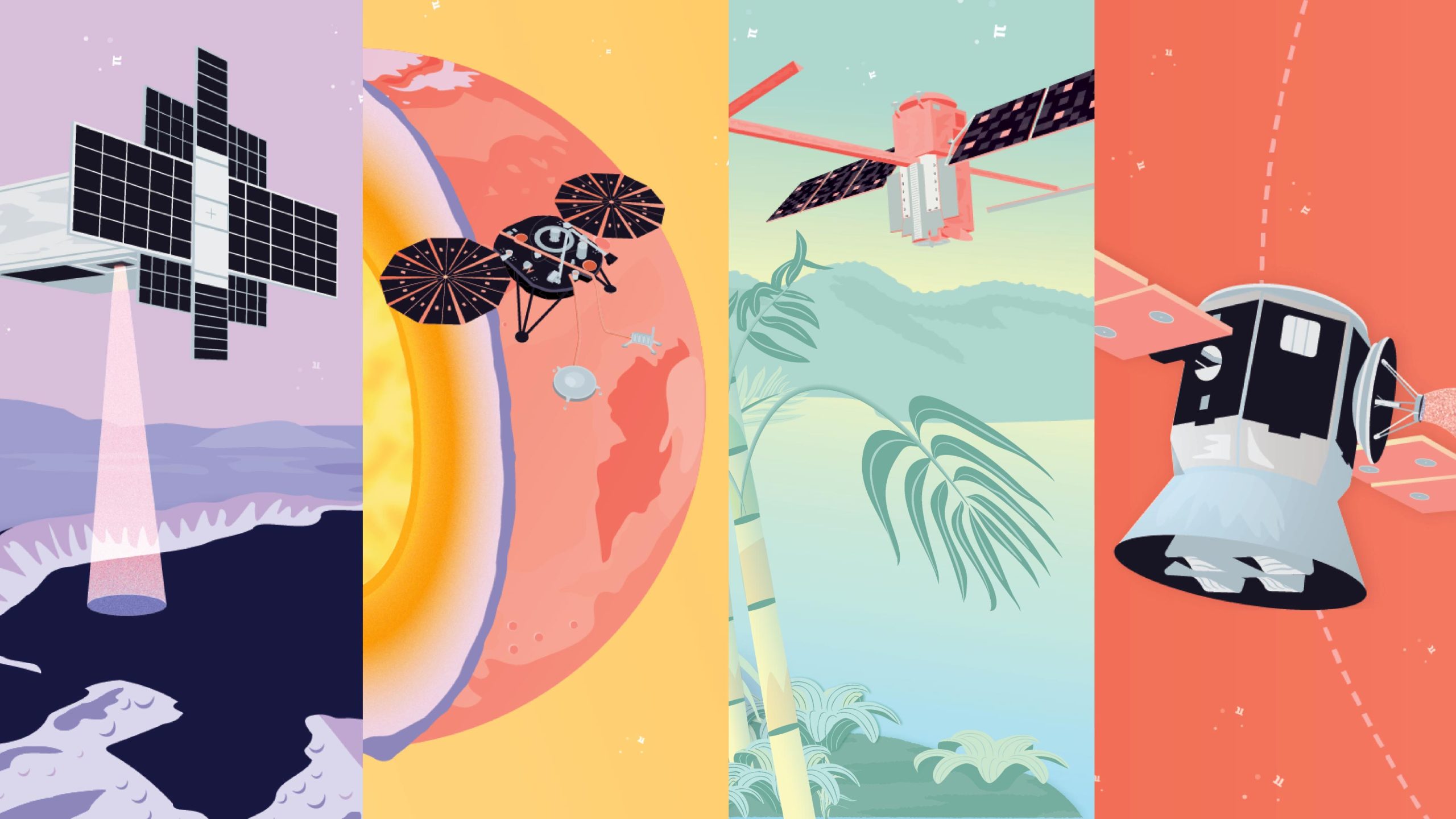
    NASA’s Pi Day Challenge includes the release of four science and engineering questions related to NASA missions. Answers will be made public on March 15. Credit: NASA-JPL/Caltech

    To celebrate Pi Day, NASA’s Jet Propulsion Laboratory is serving up a series of science and engineering questions related to some of the agency’s Earth and space missions.

    It’s deliciously reliable, like cherry pie: Divide the circumference of any circle in the universe by its diameter, and you will always get the same number, pi, aka the Greek letter π. In fact, NASA relies on pi for all sorts of applications.

    Though it has an infinite number of decimals, the mathematical constant is usually abbreviated to 3.14, which is why Pi Day is celebrated on March 14. To mark the occasion this year, the STEM engagement office at NASA’s Jet Propulsion Laboratory in Southern California has released a quartet of illustrated science and engineering questions related to NASA missions: the upcoming Lunar Flashlight and SWOT (Surface Water and Ocean Topography) missions, along with InSight and TESS (Transiting Exoplanet Survey Satellite).

    For example, one problem concerns Lunar Flashlight’s mission to look for water ice in permanently shadowed craters on the Moon – an important resource for future crewed missions to the lunar surface. The small spacecraft will send infrared laser pulses to the Moon’s surface and measure how much light is reflected back. For the NASA Pi Day Challenge, problem-solvers can use pi to find out how much surface area will be measured in a single pulse of Lunar Flashlight’s lasers.

    Answers to all four challenge questions will be made public on March 15.

    Need another serving? Previous years’ challenge questions are online as well.

    Now in its ninth year, the NASA Pi Day Challenge is accompanied by other pi-related resources for educators, K-12 students and parents, including lessons and teachable moments, articles, downloadable posters, and web/mobile backgrounds.

    Never miss a breakthrough: Join the SciTechDaily newsletter.
    Follow us on Google and Google News.

    JPL Mathematics NASA
    Share. Facebook Twitter Pinterest LinkedIn Email Reddit

    Related Articles

    NASA Pi Day Challenge: Celebrate the Mathematical Marvel With Stellar Math Problems

    Mystery Solved: NASA’s Dawn Spacecraft Close-Up of Ceres Reveals Origin of Mysterious Bright Regions on Dwarf Planet

    ATTN: NASA’s Mars Curiosity Rover Drivers Need Your Help

    How Many Decimals of Pi Do We Really Need? NASA Answers

    NASA’s 10 Ways to Celebrate Pi Day on March 14

    Why NASA Attached Sensors With Antennas to Elephant Seals

    Spitzer Reveals That Asteroid Don Quixote is a Comet

    Century-Old HMS Challenger Expedition Data Helps Confirm Ocean Warming

    Airborne NASA Radar to Study Kilauea Volcano in Hawaii

    Leave A Reply Cancel Reply

    • Facebook
    • Twitter
    • Pinterest
    • YouTube

    Don't Miss a Discovery

    Subscribe for the Latest in Science & Tech!

    Trending News

    Doctors May Need To Rethink Calcium and Vitamin D Recommendations After Major Review

    Scientists Discover a Hidden Cause of Cellular Aging That Can Be Reversed

    Archaeologists Have Found Something Unexpected Inside a 1,600-Year-Old Egyptian Mummy

    Scientists May Have Found a Completely New Way To Treat Depression

    New 7-Dimensional Theory May Finally Solve the Black Hole Information Paradox

    Scientists Made Older Mice Biologically Younger Using Gut Microbes

    Scientists Finally Uncover Why Ozempic Stops Working for Some People

    Wasp Colonies Explode Into Violence After Losing Their Queen

    Follow SciTechDaily
    • Facebook
    • Twitter
    • YouTube
    • Pinterest
    • Newsletter
    • RSS
    SciTech News
    • Biology News
    • Chemistry News
    • Earth News
    • Health News
    • Physics News
    • Science News
    • Space News
    • Technology News
    Recent Posts
    • A Cannibal Star Finally Solves One of Astronomy’s Biggest Mysteries
    • Researchers Solve the Mystery Behind a Billion-Dollar Dental Implant Disease
    • Scientists Finally Uncover How a “Forever Chemical” Causes Birth Defects
    • Scientists Uncover the Earliest Brain Changes That May Predict Alzheimer’s Decades Before Symptoms
    • Mystery Solved: The Decades-Old Secret Lurking Beneath North Carolina’s Blueberry Farms
    Copyright © 1998 - 2026 SciTechDaily. All Rights Reserved.
    • Science News
    • About
    • Contact
    • Editorial Board
    • Privacy Policy
    • Terms of Use

    Type above and press Enter to search. Press Esc to cancel.