
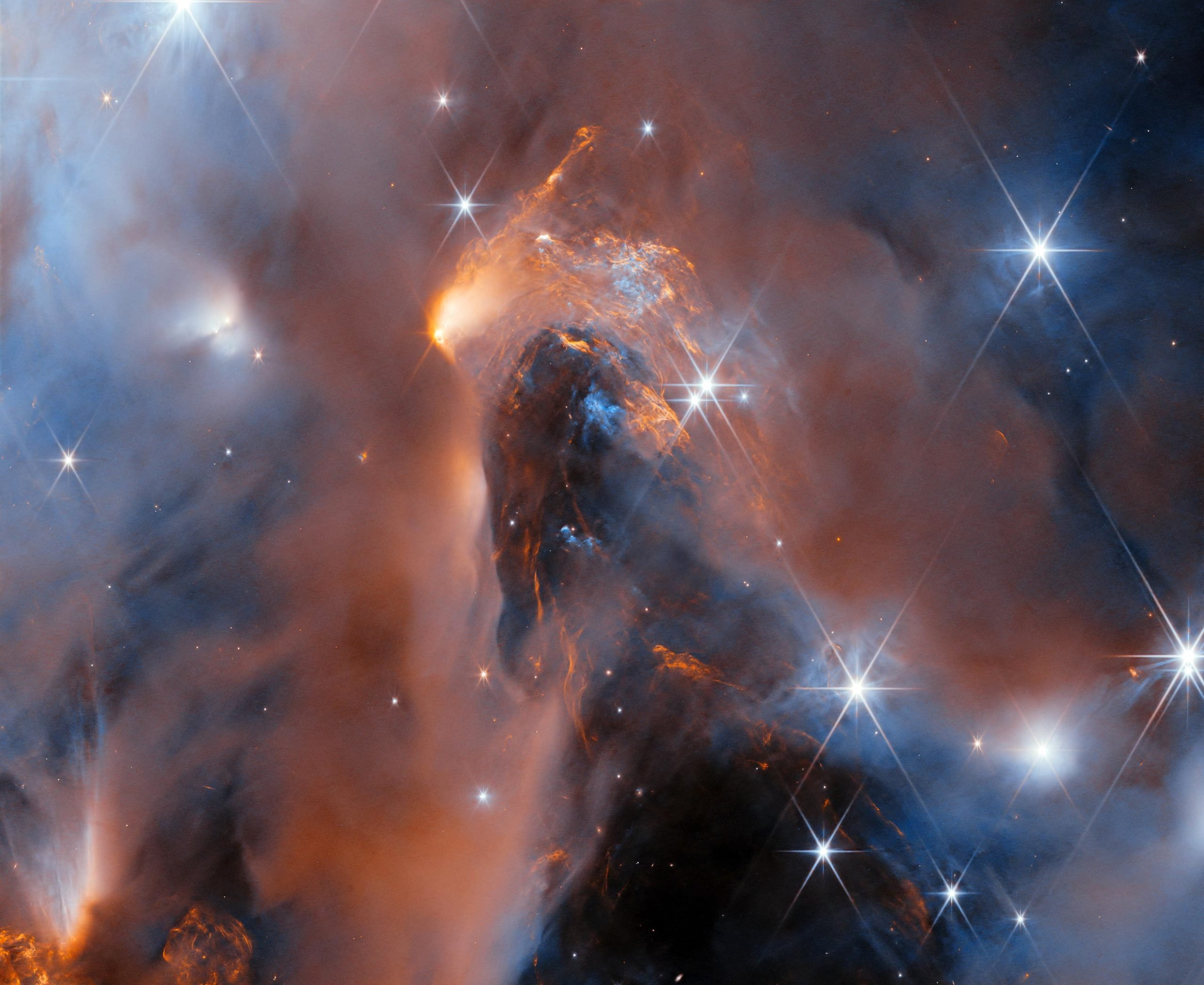
The James Webb Space Telescope has uncovered six rogue worlds, including the lightest ever found with a dusty disk, in a detailed survey of the NGC 1333 nebula.
These findings challenge traditional theories about star and planet formation, revealing that objects just larger than Jupiter might form in a similar way to stars. The data also indicate that these celestial bodies, often gas giants many times the mass of Jupiter, blur traditional classifications and could potentially harbor their own mini planetary systems.
Discovery of Rogue Worlds
Six likely rogue worlds, including the lightest ever identified with a dusty disk around it, have been spotted by the James Webb Space Telescope. Rogue worlds are objects with planetlike masses but untethered from any star’s gravity.
The elusive objects offer new evidence that the same cosmic processes that give birth to stars may also play a common role in making objects only slightly bigger than Jupiter.
“We are probing the very limits of the star-forming process,” said lead author Adam Langeveld, an astrophysicist at Johns Hopkins University. “If you have an object that looks like a young Jupiter, is it possible that it could have become a star under the right conditions? This is important context for understanding both star and planet formation.”
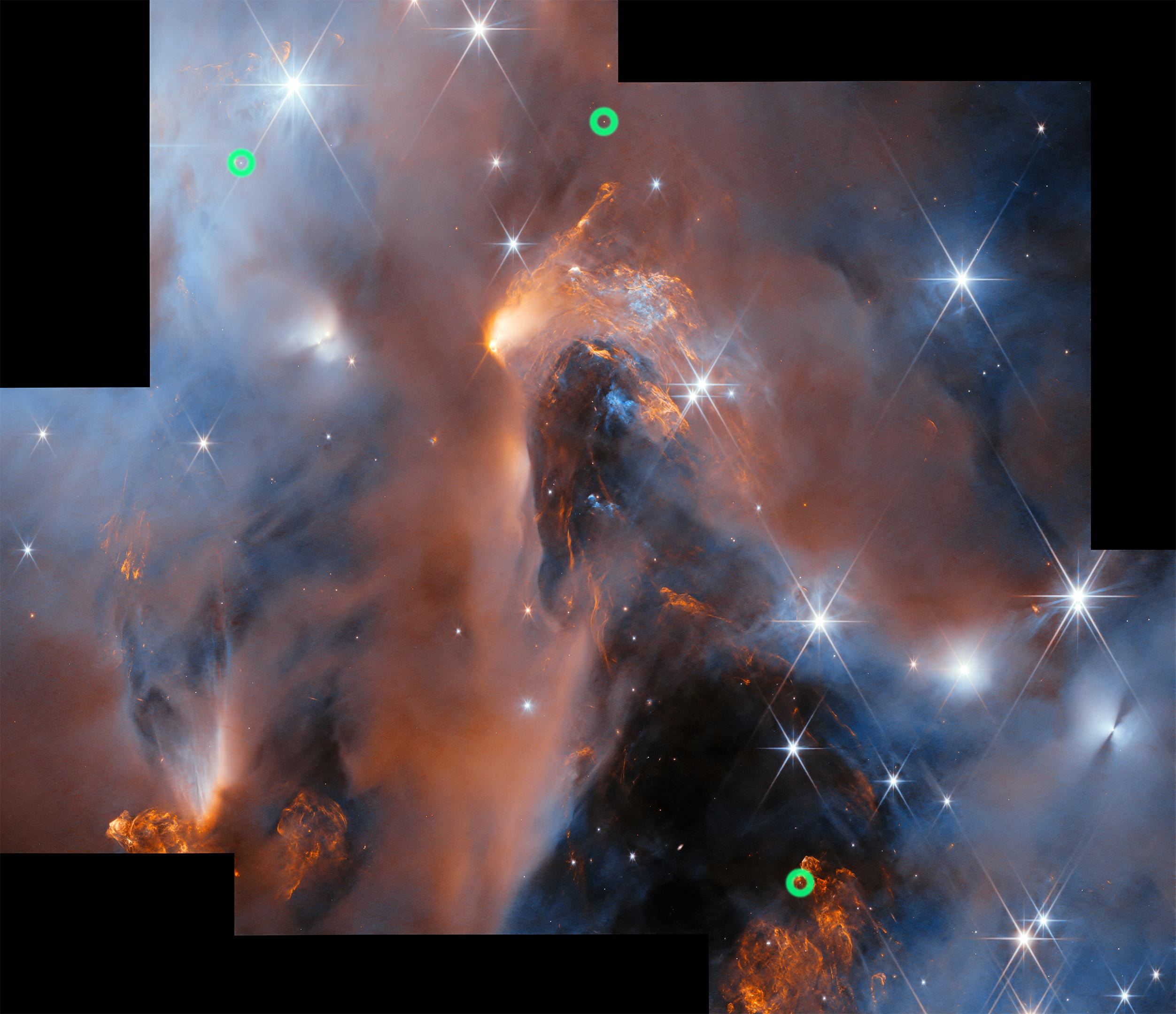
Observations From the NGC1333 Nebula
The findings come from Webb’s deepest survey of the young nebula NGC 1333, a star-forming cluster about a thousand light-years away in the Perseus constellation. A new image from the survey released today by the European Space Agency (ESA) shows NGC 1333 glowing with dramatic displays of interstellar dust and clouds. A paper detailing the survey’s findings has been accepted for publication in The Astronomical Journal.
Webb’s data suggest the discovered worlds are gas giants 5-10 times more massive than Jupiter. That means they are among the lowest-mass objects ever found to have grown from a process that would generally produce stars and brown dwarfs, objects straddling the boundary between stars and planets that never ignite hydrogen fusion and fade over time.
“We used Webb’s unprecedented sensitivity at infrared wavelengths to search for the faintest members of a young star cluster, seeking to address a fundamental question in astronomy: How light an object can form like a star?” said Johns Hopkins Provost Ray Jayawardhana, an astrophysicist and senior author of the study. “It turns out the smallest free-floating objects that form like stars overlap in mass with giant exoplanets circling nearby stars.”
Implications for Mini Planetary Systems
The telescope’s observations revealed no objects lower than five Jupiter masses despite possessing sufficient sensitivity to detect such bodies. That’s a strong indication that any stellar objects lighter than this threshold are more likely to form the way planets do, the authors concluded.
“Our observations confirm that nature produces planetary mass objects in at least two different ways—from the contraction of a cloud of gas and dust, the way stars form, and in disks of gas and dust around young stars, as Jupiter in our own solar system did,” Jayawardhana said.
Potential for Miniature Planetary Systems
The most intriguing of the starless objects is also the lightest, having an estimated mass of five Jupiters (about 1,600 Earths). The presence of a dusty disk means the object almost certainly formed like a star, as space dust generally spins around a central object in the early stages of star formation, said Langeveld, a postdoctoral researcher in Jayawardhana’s group.
Disks are also a prerequisite for the formation of planets, suggesting the observations may also have important implications for potential “mini” planets.
“Those tiny objects with masses comparable to giant planets may themselves be able to form their own planets,” said co-author Aleks Scholz, an astrophysicist at the University of St Andrews. “This might be a nursery of a miniature planetary system, on a scale much smaller than our solar system.”
Research on Brown Dwarfs and Binary Systems
Using the NIRISS instrument on Webb, the astronomers measured the infrared light profile (or spectrum) of every object in the observed portion of the star cluster and reanalyzed 19 known brown dwarfs. They also discovered a new brown dwarf with a planetary-mass companion, a rare finding that challenges theories of how binary systems form.
“It’s likely that such a pair formed the way binary star systems do, from a cloud fragmenting as it contracted,” Jayawardhana said. “The diversity of systems that nature has produced is remarkable and pushes us to refine our models of star and planet formation.”
Significance of Free-Floating Celestial Bodies
Rogue worlds may originate from collapsing molecular clouds that lack the mass for the nuclear fusion that powers stars. They can also form when gas and dust in disks around stars coalesce into planetlike orbs that are eventually ejected from their star systems, probably because of gravitational interactions with other bodies.
These free-floating objects blur classifications of celestial bodies because their masses overlap with gas giants and brown dwarfs. Even though such objects are considered rare in the Milky Way galaxy, the new Webb data show they account for about 10% of celestial bodies in the targeted star cluster.
In the coming months, the team will study more of the faint objects’ atmospheres and compare them to heavier brown dwarfs and gas giant planets. They have also been awarded time on the Webb telescope to study similar objects with dusty disks to explore the possibility of forming mini planetary systems resembling Jupiter’s and Saturn’s numerous moons.
Reference: “The JWST/NIRISS Deep Spectroscopic Survey for Young Brown Dwarfs and Free-floating Planets” by Adam B. Langeveld, Aleks Scholz, Koraljka Mužić, Ray Jayawardhana, Daniel Capela, Loïc Albert, René Doyon, Laura Flagg, Matthew de Furio, Doug Johnstone, David Lafrèniere and Michael Meyer, 27 September 2024, The Astronomical Journal.
DOI: 10.3847/1538-3881/ad6f0c
Other authors are Koraljka Mužić and Daniel Capela of Universidade de Lisboa; Loïc Albert, René Doyon, and David Lafrèniere of Université de Montréal; Laura Flagg of Johns Hopkins; Matthew de Furio of University of Texas at Austin; Doug Johnstone of Herzberg Astronomy and Astrophysics Research Centre; and Michael Meyer of University of Michigan, Ann Arbor.
The Deep Spectroscopic Survey for Young Brown Dwarfs and Free-Floating Planets used the Near Infrared Imager and Slitless Spectrograph (NIRISS) instrument on the James Webb Space Telescope, a collaboration between NASA, the European Space Agency, and the Canadian Space Agency.
The authors acknowledge support from the UKRI Science and Technology Facilities Council, the Fundação para a Ciência e a Tecnologia (FCT), the U.S. National Science Foundation, and the National Research Council of Canada.
Never miss a breakthrough: Join the SciTechDaily newsletter.
Follow us on Google and Google News.