
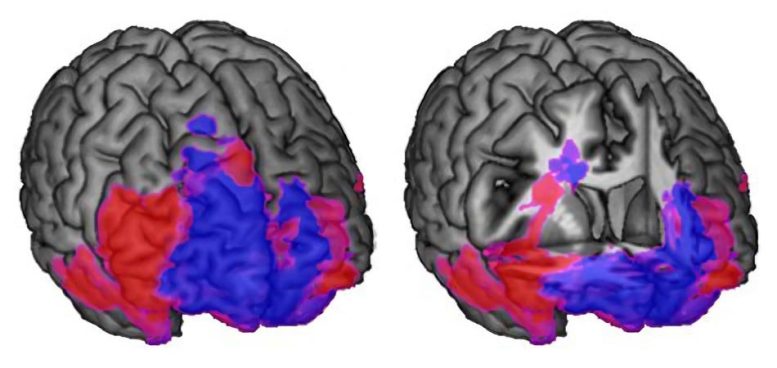
A team of neuroscientists studied data from roughly 350 patients to gain a better understanding about what different parts of the frontal lobes do, seeing exactly which parts of the frontal lobes are critical for tasks like behavioral control and decision-making.
The frontal lobes are the largest part of the human brain and are thought to be the part that expanded most during human evolution. Damage to the frontal lobes—which are located just behind and above the eyes—can result in profound impairments in higher-level reasoning and decision-making. To find out more about what different parts of the frontal lobes do, neuroscientists at the California Institute of Technology (Caltech) recently teamed up with researchers at the world’s largest registry of brain-lesion patients. By mapping the brain lesions of these patients, the team was able to show that reasoning and behavioral control are dependent on different regions of the frontal lobe than the areas called upon when making a decision.
Their findings are described online this week in the early edition of the Proceedings of the National Academy of Sciences (PNAS).
The team analyzed data that had been acquired over a 30-plus-year time span by scientists from the University of Iowa’s Department of Neurology—which has the world’s largest lesion patient registry. They used that data to map brain activity in nearly 350 people with damage, or lesions, in their frontal lobes. The records included data on the performances of each patient while doing certain cognitive tasks.
By examining these detailed files, the researchers were able to see exactly which parts of the frontal lobes are critical for tasks like behavioral control and decision-making. The intuitive difference between these two types of processing is something we encounter in our lives all the time. Behavioral control happens when you don’t order an unhealthy chocolate sundae you desire and go running instead. Decision-making based on reward, on the other hand, is more like trying to win the most money in Vegas—or indeed choosing the chocolate sundae.
“These are really unique data that could not have been obtained anywhere else in the world,” explains Jan Glascher, lead author of the study and a visiting associate in psychology at Caltech. “To address the question that we were interested in, we needed both a large number of patients with very well-measured lesions in the brain, and also a very thorough assessment of their reasoning and decision-making abilities across a battery of tasks.”
That quantification of the lesions as well as the different task measurements came from several decades of work led by two coauthors on the study: Hanna Damasio, Dana Dornsife Chair in Neuroscience at the University of Southern California (USC); and Daniel Tranel, professor or neurology and psychology at the University of Iowa.
“The patterns of lesions that impair specific tasks showed a very clear separation between those regions of the frontal lobes necessary for controlling behavior, and those necessary for how we give value to choices and how we make decisions,” says Tranel.
Ralph Adolphs, Bren Professor of Psychology and Neuroscience at Caltech and a co-author of the study, says that aspects of what the team found had been observed previously using fMRI methods in healthy people. But, he adds, those previous studies only showed which parts of the brain are activated when people think or choose, but not which are the most critical areas, and which are less important.
“Only lesion mapping, like we did in the present study, can show you which parts of the brain are actually necessary for a particular task,” he says. “This information is crucial, not only for basic cognitive neuroscience, but also for linking these findings to clinical relevance.”
For example, several different parts of the brain might be activated when you are making a particular type of decision, explains Adolphs. If there is a lesion in one of these areas, the rest of your brain might be able to compensate, leaving little or no impairment. But if a lesion occurs in another area, you might wind up with a lifelong disability in decision-making. Knowing which lesion leads to which outcome is something only this kind of detailed lesion study can provide, he says.
“That knowledge will be tremendously useful for prognosis after brain injury,” says Adolphs. “Many people suffer injury to their frontal lobes—for instance, after a head injury during an automobile accident—but the precise pattern of the damage will determine their eventual impairment.”
According to Tranel, the team is already working on their next project, which will use lesion mapping to look at how damage to particular brain regions can impact mood and personality. ” There are so many other aspects of human behavior, cognition, and emotion to investigate here, that we’ve barely begun to scratch the surface,” he says.
Reference: “Lesion mapping of cognitive control and value-based decision making in the prefrontal cortex” by Jan Gläscher, Ralph Adolphs, Hanna Damasio, Antoine Bechara, David Rudrauf, Matthew Calamia, Lynn K. Paul and Daniel Tranel, 20 August 2012, Proceedings of the National Academy of Sciences.
DOI: 10.1073/pnas.1206608109
Other collaborators on the PNAS paper were Lynn Paul, a senior research scientist at Caltech; David Rudrauf and Matt Calamia from the University of Iowa; and Antoine Bechara from USC. The study was supported by grants from the German Ministry of Research and Education, the National Institutes of Health, the Kiwanis Foundation, and the Gordon and Betty Moore Foundation.
Never miss a breakthrough: Join the SciTechDaily newsletter.
Follow us on Google and Google News.
5 Comments
Left frontal brain is the logical brain. It can also make decisions. Probably we are all right handed because of this since left lobe controls right limbs and it is more dominant generally. The right lobe of the frontal brain is storing pictures of the persons we meet and also quite imaginative. It is dominant during sleep when we dreaming and causing all the illogical colourful dreams seat of imaginations. It is steered by hormones secreted mostly in nights and shapes the dreams accordingly. We can`t draw any logic in dreams. This beautiful aspect of brain is clearly photographed in the said MRI scan of the brain in the experiment cited in the article. In autism also , since the connection between left lobe and right lobe is poor they cannot learn language which involves logicals. They will also live in their own world ignoring the world around them. When we see a person his photo stored in the right brain is recognized but the profile should be brought from the left brain through corpus colassum. If the neurons don`t respond properly, we forget his name or stuggle to recollect any word which is in our memory file.
The role of frontal lobes are clearly demonstrated by scientists in this experiment. I thank them for validating the theory we have. Thank You.
Think about puppies……. now kills those puppies
Think about puppies……….now kill those puppies. cut there heads off and your mom doesnt love you
okay so your lacking understanding of self and dreams one has like you know you must go to work in the am and a dream pops and your at work while u sleep, humm the illusive black hole.
I cling on to listening to the newscast talk about getting free online grant applications so I have been looking around for the top site to get one. Could you tell me please, where could i acquire some?