

DRI scientists analyzed Arctic ice core records to reconstruct historical atmospheric lead pollution from Ancient Rome, uncovering a link between lead exposure and cognitive decline.
Lead exposure is a significant public health concern, with even low levels posing risks, particularly to children’s cognitive development. Researchers at the Desert Research Institute (DRI) have previously used Arctic ice cores to trace atmospheric pollution back to the Roman Empire. A new study builds on this work, exploring how lead pollution from that era may have affected the European population.
Published on January 6 in the Proceedings of the National Academy of Sciences, the study analyzed three Arctic ice core records to measure lead pollution levels from 500 BC to 600 AD. This timeframe encompasses the rise of the Roman Republic and the fall of the Roman Empire, with a focus on the Pax Romana, a roughly 200-year period when the Empire was at its zenith.
By analyzing lead isotopes, the researchers pinpointed mining and smelting activities across Europe as the primary sources of the pollution during this time.

Advanced computer modeling of atmospheric movement then produced maps of atmospheric lead pollution levels across Europe. Combined with research linking lead exposure to cognitive decline, the research team also identified likely reductions in IQ levels of at least 2 to 3 points among the European population.
“This is the first study to take a pollution record from an ice core and invert it to get atmospheric concentrations of pollution and then assess human impacts,” says Joe McConnell, research professor of hydrology at DRI and lead author of the study. “The idea that we can do this for 2,000 years ago is pretty novel and exciting.”
Records of the Past Preserved in Ice
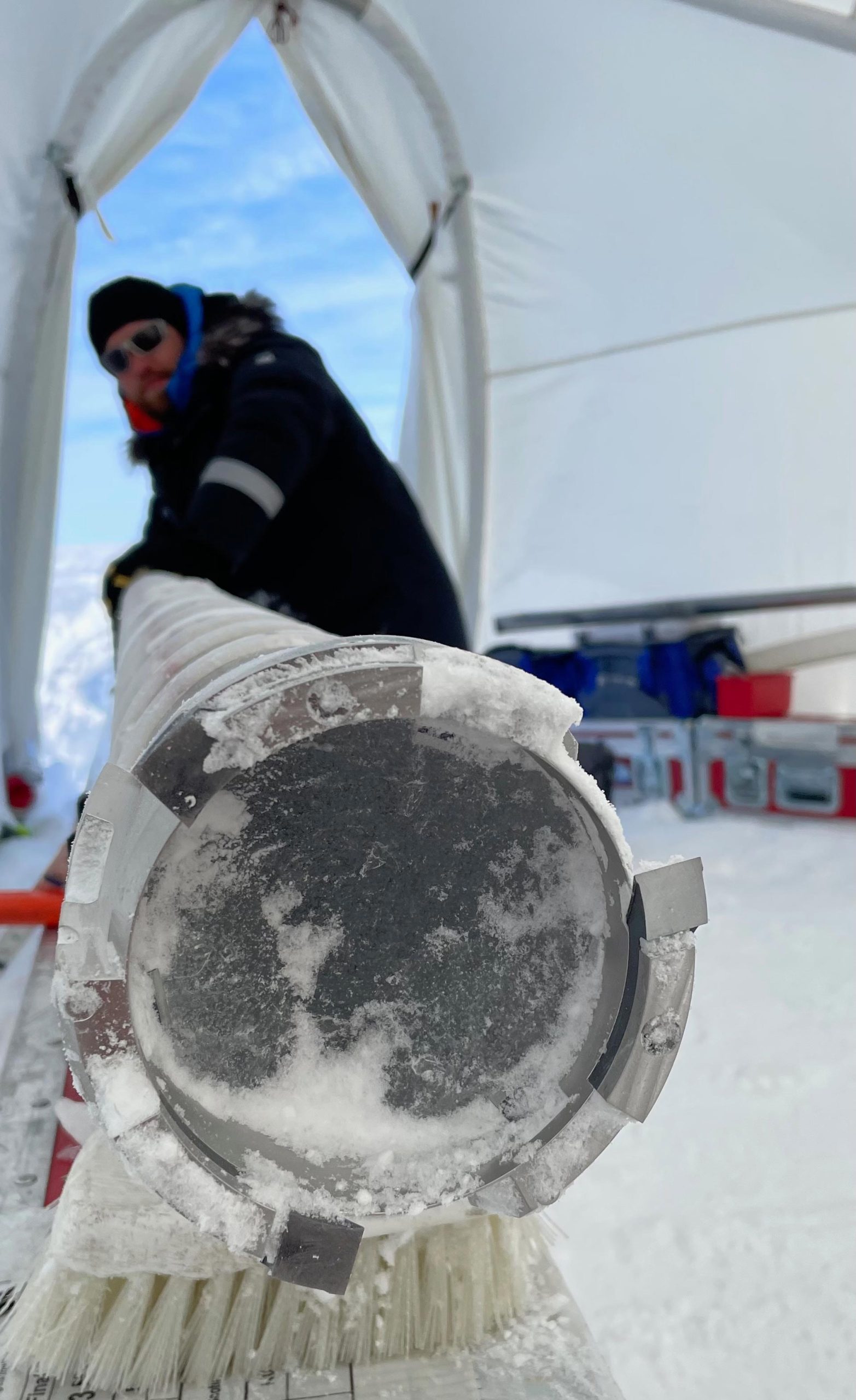
McConnell’s Ice Core Laboratory at DRI has spent decades examining ice cores from places like Greenland and Antarctica, where sheets of ice have built up over millennia. Using enormous drills, they painstakingly extract columns of ice as much as 11,000 feet (3,400 meters) long, reaching more distant depths of Earth’s history with each inch.
McConnell’s team creates precise timelines using records of well-dated volcanic eruptions, which stamp the ice record like postcards from the past. Gas bubbles trapped in the ice offer insight into the atmosphere of past eras, while pollutants like lead can be used to interpret mining and industrial activity.

McConnell began developing methods to create very detailed lead records in ice more than twenty years ago, when he applied them to more recent history. When archeologists and historians learned of this work, they approached him hoping to apply these new techniques to the Roman period, seeking answers to lingering historical questions. “The resulting research changed our understanding of the era by finding precise linkages between the lead pollution records and historical events such as population declines associated with periodic plagues and pandemics,” adds coauthor and ancient historian Andrew Wilson of Oxford University.
A Growing Understanding of the Harms of Lead Pollution
Ancient lead pollution stemmed largely from silver mining, whereby the lead-rich mineral galena was melted down to extract silver. For every ounce of silver obtained, this process produced thousands of ounces of lead—much of which was released to the atmosphere.

In the 20th century, lead pollution predominantly came from the emissions of vehicles burning leaded gasoline. Following the passing of the Clean Air Act in the U.S. in 1970, which restricted the use of leaded gasoline, researchers have tracked the sharp decline of lead in human blood. However, the nationwide exposure, particularly for children born between 1950 and 1985, allowed scientists to track lead’s impact on health and cognitive development.
“As lead pollution has declined during the last 30 years, it has become more and more apparent to epidemiologists and medical experts just how bad lead is for human development,” McConnell says.
In adults, high levels of lead exposure are linked to infertility, anemia, memory loss, cardiovascular disease, cancer, and reduced immune response, among other impacts. In children, even low levels of exposure have been connected to reduced IQ, concentration challenges, and reduced academic success. While the U.S. Centers for Disease Control and Prevention (CDC) considers a blood lead level of 3.5 µg/dl the point for medical intervention for children, they have stated that there is no level of lead exposure without risk.

“Lead is known to have a wide range of human health impacts, but we chose to focus on cognitive decline because it’s something we can put a number on,” says study coauthor Nathan Chellman, assistant research professor of snow and ice hydrology at DRI. “An IQ reduction of 2 to 3 points doesn’t sound like much, but when you apply that to essentially the entire European population, it’s kind of a big deal.”
The study found that atmospheric lead pollution began during the Iron Age and reached a peak during the late 2nd century BC at the height of the Roman Republic. It then declined sharply during the 1st century BC, during the crisis of the Roman Republic, before increasing around 15 BC following the rise of the Roman Empire. Lead pollution remained high until the Antonine Plague from 165 to the 180s AD, which severely affected the Roman Empire. It wasn’t until the High Middle Ages in the early 2nd millennium AD that lead pollution in the Arctic exceeded the sustained high levels of the Roman Empire. According to the research, more than 500 kilotons of lead were released to the atmosphere during the nearly 200-year height of the Roman Empire.
Although ice core records show that Arctic lead pollution was up to 40-fold higher during the highest historical peak in the early 1970s, the insight gained from this study demonstrates how “humans have been impacting their health for thousands of years through industrial activity,” McConnell says.
Reference: “Pan-European atmospheric lead pollution, enhanced blood lead levels, and cognitive decline from Roman-era mining and smelting” by Joseph R. McConnell, Nathan J. Chellman, Andreas Plach, Sophia M. Wensman, Gill Plunkett, Andreas Stohl, Nicole-Kristine Smith, Bo Møllesøe Vinther, Dorthe Dahl-Jensen, Jørgen Peder Steffensen, Diedrich Fritzsche, Sandra O. Camara-Brugger, Brandon T. McDonald and Andrew I. Wilson, 6 January 2025, Proceedings of the National Academy of Sciences.
DOI: 10.1073/pnas.2419630121
Never miss a breakthrough: Join the SciTechDaily newsletter.
Follow us on Google and Google News.
6 Comments
Lead was the poison of that era , I wonder if Microplastics is going to be the 21st centuries ignored poison .
“According to the research, more than 500 kilotons of lead were released to the atmosphere during the nearly 200-year height of the Roman Empire.”
It isn’t directly comparable to modern times because the Romans used lead vessels for their wine, and I have read, even added lead acetate to their wine to sweeten it. Therefore, the atmospheric component is a poor measure of the clinical impact.
…not to mention their water pipes in their urban environments were lead, as well. Shades of Flint, Michigan, USA, anyone?
Three IQ points is a small fraction of the standard deviation for IQ. What is the uncertainty (margin of error) for its measurement? I have read that the apparent IQ can vary several points from day to day (bad hair day) and decline over the years. Are 2.5-3.0 points statistically significant? It is generally considered that those with an IQ between 90 and 110 are normal and don’t have significant impairment or advantage in cognitive abilities. Wine played an important role in Greek and Roman cultures, and it wasn’t just the urban ‘elites’ that consumed wine. Perhaps those living in the silver-mining areas were at greater risk, but mining was dangerous work, mostly performed by slaves, who had short life-spans, and little direct influence on society.
The theory of “Linear, No Threshold” toxicity is controversial and at odds with the meme from Paracelsus that “The poison is in the dose.” Sub-lethal doses of toxins are excreted by the human body and the accumulation is dependent on the solubility and rate of ingestion. Miners exposed to mercury vapors in Madrid (Spain) were retired when their tremors prevented them from signing their checks. That was usually after about 30 years of exposure to something more toxic than lead. There is still a lot we don’t know about the neurological effects of heavy metals.
Correlation in not causality…haven’t you heard?
Paracelsus that “The poison is in the dose.”
Paracelsus was not a modern researcher in the field of biomedical science and no doubt there is a certain degree of error in that statement.