

Recent studies reveal that the Greenland ice sheet could recover from melting, even after surpassing critical global warming levels, with prompt and extensive climate action.
Climate researchers around the world are sounding the alarm about exceeding critical temperature values on the Earth. If temperatures pass what are called tipping points, the results could be catastrophic. An international team of researchers, including members from the Technical University of Munich (TUM), has now demonstrated in simulations that the temperature tipping point for the Greenland ice sheet can be exceeded in certain cases for a short time, as long as extreme countermeasures are taken afterward. If the ice mass should melt entirely, the result would be a massive rise in the sea level.
The Threat to Greenland’s Ice Sheet
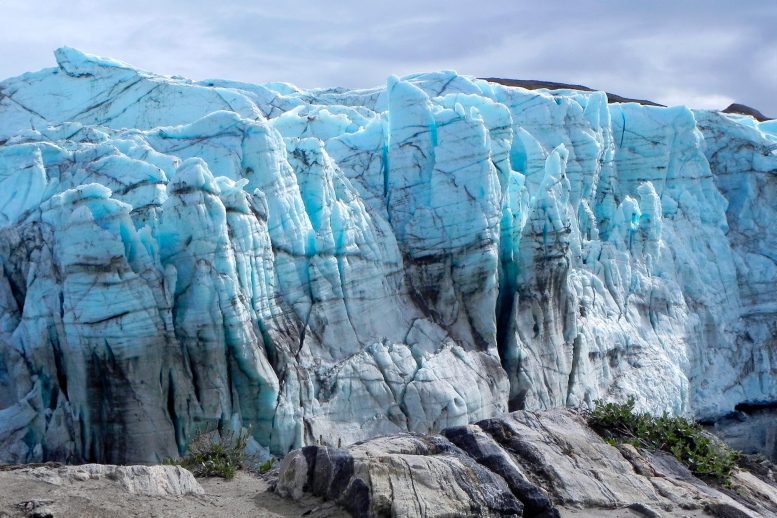
Greenland is the second largest permanently ice-covered surface on the Earth; only Antarctica is larger. The Greenland ice sheet is drastically impacted by the effects of climate change.
If the ice sheet melts completely it would cause a sea level rise of more than seven meters (23 feet) – a catastrophe for coastal regions worldwide and for the people who live there. The critical threshold for the worst-case scenario is between 1.7 and 2.3 degrees Celsius (3.1 and 4.1 degrees Fahrenheit) of global warming above the preindustrial level on an annual average.
Until now climate research has assumed that if this point is exceeded, the Greenland ice sheet would be lost forever. However, the international research team has now been able to show in a large set of simulations that there would be a way back after passing the tipping point.
Irreversible Damage to the Ice Sheet Is Avoidable
Niklas Boers is Professor of Earth System Modelling at TUM and member of the Potsdam Institute for Climate Impact Research (PIK). Together with scientists from UiT The Arctic University of Tromsø and the Complutense University of Madrid, he has succeeded in proving that the tipping point for the Greenland ice sheet can temporarily be exceeded without irreversible damage.
“Our simulations have shown us that it is possible to stop the melting of Greenland’s ice sheet in spite of failure to meet climate goals and to even reverse the process. Here the important thing is that if the tipping point is exceeded, massive countermeasures would be necessary and the Earth would have to be cooled down to below the critical values,” says Prof. Niklas Boers.
A Warning Against Complacency
However, the new findings do not mean that society can be satisfied with its climate protection achievements to date. Instead, the findings are to be seen much more as a second chance and an outlook for the future. In the simulation, the researchers used two different ice sheet models.
A large number of scenarios were run, with global warming between 1.5 and 6.5 degrees Celsius until 2100 and a subsequent cooling phase of between 100 to 10,000 years.
“Using super-computers we were able to calculate this enormous number of scenarios reaching 100,000 years into the future so that we could be completely certain that the Greenland ice sheet is in balance. However, in both ice sheet models we were able to show that the ice sheet can recover, as long as the critical temperature threshold value is only exceeded for a limited period of time of several centuries,” says Nils Bochow, scientist at UiT and also member of PIK.
The Path to Recovery: Urgent and Extensive Measures
The prerequisite for recovery of the ice sheet is the prompt correction of the temperature on the Earth in a time frame of about 500 years, depending on how far the maximum temperatures rise above the critical values. The speed, drastic nature, effort, and expense of the countermeasures necessary for cooling the Earth will increase with the time the tipping point is exceeded and the increase in temperature during that time. Drastic measures include massive reduction in atmospheric CO2 concentrations on the entire planet and thereby reducing global temperatures, using technologies like wide-scale re- and aforestation and carbon capture and storage.
The scientists’ calculations indicate that countermeasures will not have to be as extreme if global warming only slightly exceeds the targets defined in the Paris Climate Accord. The new findings are thus a sign of hope in the search for a way to stop climate change before our last chance is gone.
Reference: “Overshooting the critical threshold for the Greenland ice sheet” by Nils Bochow, Anna Poltronieri, Alexander Robinson, Marisa Montoya, Martin Rypdal and Niklas Boers, 18 October 2023, Nature.
DOI: 10.1038/s41586-023-06503-9
Never miss a breakthrough: Join the SciTechDaily newsletter.
Follow us on Google and Google News.
2 Comments
Dark matter phase transitions could be a primary climate driver. If the solar system passes through an area of higher liquid dark matter content the planets cores would all receive more heat due to increased phase transitions thus heating the earth from the inside out.
Heating of the planet from the inside out would result in :
Increased ground temperatures
Increased sea temperatures
Increased nighttime temperatures
Increased seismic activity
Increased earthquakes
We are currently passing through the S1 dark Matter stream
June 3 2020 Venus Earth conjunction
July 2020 Siberian heatwave and Antarctica temperature spike
Aug 2 2021 Saturn opposition
Aug 19 2021 Jupiter opposition
Jan 9 2022 Venus Earth conjunction
March 18 2022 Concordia Station spiked 39 C degrees due to unusual air patterns near Australia
North Pole regions hit 30C above normal
Aug 14 2022 Saturn opposition
Sept 16 2022 Jupiter opposition
Aug 13 2023 Venus Earth conjunction
Aug 25 2023 Saturn opposition
Oct 28 predict a major heat release in the Arctic and Antarctic due to combined tidal affects on the dark matter sphere around the sun in combination with the movement of the barycentre of the Earths location
Nov 2 2023 Jupiter opposition
Venus atmospheric temperatures from 2009-2017 also were higher after conjunctions
NASA issued a climate change warning for Mars after Mariner 9
Neptune has been heating up since 2018
Climate alarmism. Let nature take its course. Has happened long before we were here and will continue long after we’re gone.