
Close Menu
    Facebook X (Twitter) Instagram
    SciTechDaily
    • Biology
    • Chemistry
    • Earth
    • Health
    • Physics
    • Science
    • Space
    • Technology
    Facebook X (Twitter) Pinterest YouTube RSS
    SciTechDaily
    Home»Biology»Fingerprints Enhance Our Sense of Touch – Neurons Sensitive to Scale of a Single Fingerprint Ridge
    Biology

    Fingerprints Enhance Our Sense of Touch – Neurons Sensitive to Scale of a Single Fingerprint Ridge

    By Society for NeuroscienceMarch 15, 2021No Comments2 Mins Read
    Facebook Twitter Pinterest Telegram LinkedIn WhatsApp Email Reddit
    Share
    Facebook Twitter LinkedIn Pinterest Telegram Email Reddit
    Fingerprints Enhance Our Sense of Touch
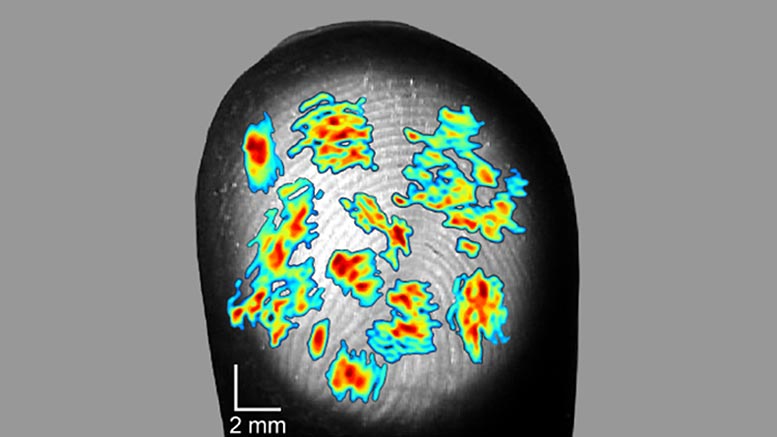
    Receptive fields of sensory neurons in the hand, mapped onto a fingertip. Credit: Jarocka et al., JNeurosci 2021

    Sensory neurons in the finger can detect touch on the scale of a single fingerprint ridge.

    Fingerprints may be more useful to us than helping us nab criminal suspects: they also improve our sense of touch. Sensory neurons in the finger can detect touch on the scale of a single fingerprint ridge, according to new research published in JNeurosci.

    The hand contains tens of thousands of sensory neurons. Each neuron tunes into a small surface area on the skin — a receptive field — and detects touch, vibration, pressure, and other tactile stimuli. The human hand possesses a refined sense of touch, but the exact sensitivity of a single sensory neuron has not been studied before.

    To address this, Jarocka et al. measured the electrical activity of the sensory neurons in human fingertips when they were stimulated with raised dots swept over the skin. The research team calculated the detection areas of the sensory neurons and mapped them onto the fingerprints. The width of the detection areas matched the width of a single fingerprint ridge. These areas stayed on the same fingerprint ridges during different scanning speeds and directions, indicating that they are anchored to the fingerprint ridges. The overlap of receptive fields with small detection areas explains how humans have such a sensitive and accurate sense of touch.

    Reference: “Human Touch Receptors Are Sensitive To Spatial Details on the Scale of Single Fingerprint Ridges” by Ewa Jarocka, J Andrew Pruszynski and Roland S Johansson, 15 March 2021, Journal of Neuroscience.
    DOI: 10.1523/JNEUROSCI.1716-20.2021

    Funding: Swedish Research Council, Human Frontier Science Program

    Never miss a breakthrough: Join the SciTechDaily newsletter.
    Follow us on Google and Google News.

    Neuroscience Society for Neuroscience
    Share. Facebook Twitter Pinterest LinkedIn Email Reddit

    Related Articles

    The Brain Networks Underlying Imagination – Separate Subnetworks Construct and Evaluate Imagined Scenarios

    Deep Inside the Brain: Neuroscientists Discover the Missing Piece of the Brain’s Multitasking Network

    Scientists Uncover Brain Mechanism That May Explain Why Sleep Helps You Learn

    Adult-Born Neurons Grow More Than Their Counterparts From Infancy – May Even Have Unique Functions

    Feeling Disconnected? Loneliness Alters Your Brain’s Social Network

    A Child’s Unique Brain Activity Reveals Their Memory Ability

    Unlocking the Neuroscience of How Experiencing Traumatic Stress Leads to Aggression

    Researchers Discover How Stress Restructures the Brain

    Functional Magnetic Resonance Imaging Shows How the Brain Repurposes Unused Regions

    Leave A Reply Cancel Reply

    • Facebook
    • Twitter
    • Pinterest
    • YouTube

    Don't Miss a Discovery

    Subscribe for the Latest in Science & Tech!

    Trending News

    1.4-Million-Year-Old Footprints Reveal a Giant Human Relative

    Astronomers May Have Found the First Moon Beyond Our Solar System

    Underwater Cameras Expose the Secret Lives of Whale Sharks

    Why Dreaming Leaves the Brain Running Low on Energy

    CERN Experiments Detect Signs of the Universe’s Primordial Matter

    Study Finds a Surprising Link Between Gut Microbes and Aging

    Frequent Cannabis Users Wake Up With More “Stress Hormone”

    Scientists Reveal Hidden DNA Traces in the Shroud of Turin

    Follow SciTechDaily
    • Facebook
    • Twitter
    • YouTube
    • Pinterest
    • Newsletter
    • RSS
    SciTech News
    • Biology News
    • Chemistry News
    • Earth News
    • Health News
    • Physics News
    • Science News
    • Space News
    • Technology News
    Recent Posts
    • Spain’s Largest Wildfire on Record Burned an Area the Size of New York City
    • Meet the 30-Million-Year-Old Dog That Climbed Trees Instead of Chasing Sticks
    • Two Mysterious ‘Ghost’ Ancestors Are Hiding in Our DNA
    • Gut Bacteria May Leave a Lasting “Protective Memory” in the Intestine
    • New Antivenom Strategy Is 10 Times More Potent Than a Current Treatment
    Copyright © 1998 - 2026 SciTechDaily. All Rights Reserved.
    • Science News
    • About
    • Contact
    • Editorial Board
    • Privacy Policy
    • Terms of Use

    Type above and press Enter to search. Press Esc to cancel.