
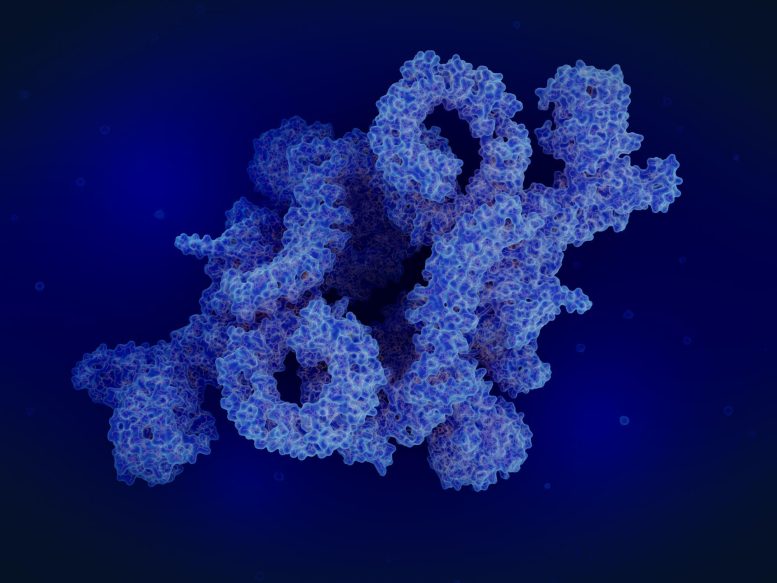
Researchers have identified N-terminal acetylation as a crucial process that protects proteins from degradation, influencing longevity and mobility.
Proteins are key to all processes in our cells and understanding their functions and regulation is of major importance.
“For many years, we have known that nearly all human proteins are modified by a specific chemical group, but its functional impact has remained undefined,” says Professor Thomas Arnesen at the Department of Biomedicine, University of Bergen.
He explains: “One of the most common protein modifications in human cells is N-terminal acetylation, which is an addition of a small chemical group (acetyl) at the starting tip (N-terminus) of a protein. The modification is launched by a group of enzymes called N-terminal acetyltransferases (NATs).” Despite being “everywhere” in human cells, the functional role of this modification remains mysterious, Arnesen explains.
He is an investigator of a new study that reveals that a core function of this protein modification is to protect proteins from degradation, and this is essential for normal longevity and motility.
CRISPR-Cas9 Technology Sheds New Light on N-Terminal Acetylation
To address this question, molecular biologist and researcher Sylvia Varland spent two years at the Donnelly Centre for Cellular & Biomolecular Research, University of Toronto, Canada, supported by a FRIPRO mobility grant from the Research Council of Norway.
Here, she used the established CRISPR-Cas9 technology and powerful screening platforms available in one of the best scientific environments to define the functional roles of the human NAT enzymes. Sylvia focused on one of the major human NAT enzymes, NatC, and the genome-wide screening of human NatC KO cells revealed many human genes likely to be involved in the function of N-terminal acetylation.
“Without the inspiring scientific environment at the Donnelly Center combined with financial support from Marie Skłodowska-Curie Actions this study would not have seen the light of day,” says Varland.
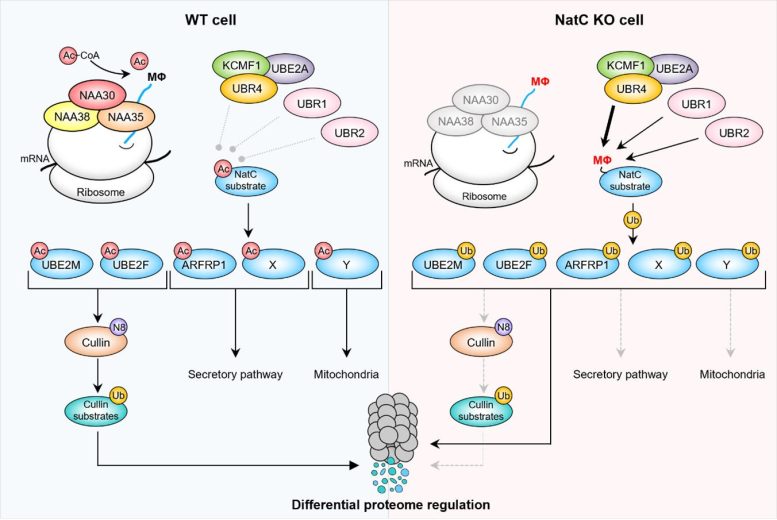
Back in the Arnesen lab at UiB, Sylvia explored the molecular implications of her genetic findings with the help of PhD student Ine Kjosås and other lab members. Biochemical, cell biology and proteomics experiments demonstrated that N-terminal acetylation acts as a shield to protect many proteins from protein degradation. Proteins lacking N-terminal acetylation were recognized by the cellular degradation machinery.
“N-terminal acetylation has the power to dictate a protein’s lifetime and affects our cells in numerous ways,” says Varland. “This is true for humans, and it is also true in fruit flies, which is a very useful model to study this protein modification,” she continues.
N-Terminal Acetylation Can Affect Aging
In parallel, a research group by investigator Rui Martinho at the University of Aveiro in Portugal was working on the organismal impact of NatC-mediated N-terminal acetylation using a fruit fly model (Drosophila).
Postdoctoral researcher Rui Silva and fellow students carried out studies with flies lacking N-terminal acetylation. The two teams decided to merge their efforts and have for the last two years coordinated their experiments. Flies lacking NatC were viable, but these flies displayed decreased longevity and decreased motility with age. These effects could be partially reversed by expressing a protein conserved between flies and humans found to be a key target of NatC protection.
Decoding the NatC Puzzle
In conclusion, using an unbiased and global genetic screen combined with cellular phenotyping, the team uncovered a general function for N-terminal acetylation in protecting proteins from degradation in human cells.
The molecular investigations defined the cellular components (ubiquitin ligases) responsible for degrading a major class of human proteins when lacking N-terminal acetylation. The role of NatC-mediated protection of specific proteins is evident both in human cells and in fruit fly. The impact of these pathways on longevity and motility in aged individuals underscores the vital role of protein N-terminal acetylation.
“This work untangles some of the secrets and shows how N-terminal acetylation shapes individual protein fate,” Thomas Arnesen concludes.
Reference: “N-terminal acetylation shields proteins from degradation and promotes age-dependent motility and longevity” by Sylvia Varland, Rui Duarte Silva, Ine Kjosås, Alexandra Faustino, Annelies Bogaert, Maximilian Billmann, Hadi Boukhatmi, Barbara Kellen, Michael Costanzo, Adrian Drazic, Camilla Osberg, Katherine Chan, Xiang Zhang, Amy Hin Yan Tong, Simonetta Andreazza, Juliette J. Lee, Lyudmila Nedyalkova, Matej Ušaj, Alexander J. Whitworth, Brenda J. Andrews, Jason Moffat, Chad L. Myers, Kris Gevaert, Charles Boone, Rui Gonçalo Martinho and Thomas Arnesen, 27 October 2023, Nature Communications.
DOI: 10.1038/s41467-023-42342-y
The Norwegian part of this work was supported by research grants from the Research Council of Norway, the Norwegian Health Authorities of Western Norway, the Norwegian Cancer Society, and the European Research Council (ERC).
Never miss a breakthrough: Join the SciTechDaily newsletter.
Follow us on Google and Google News.