
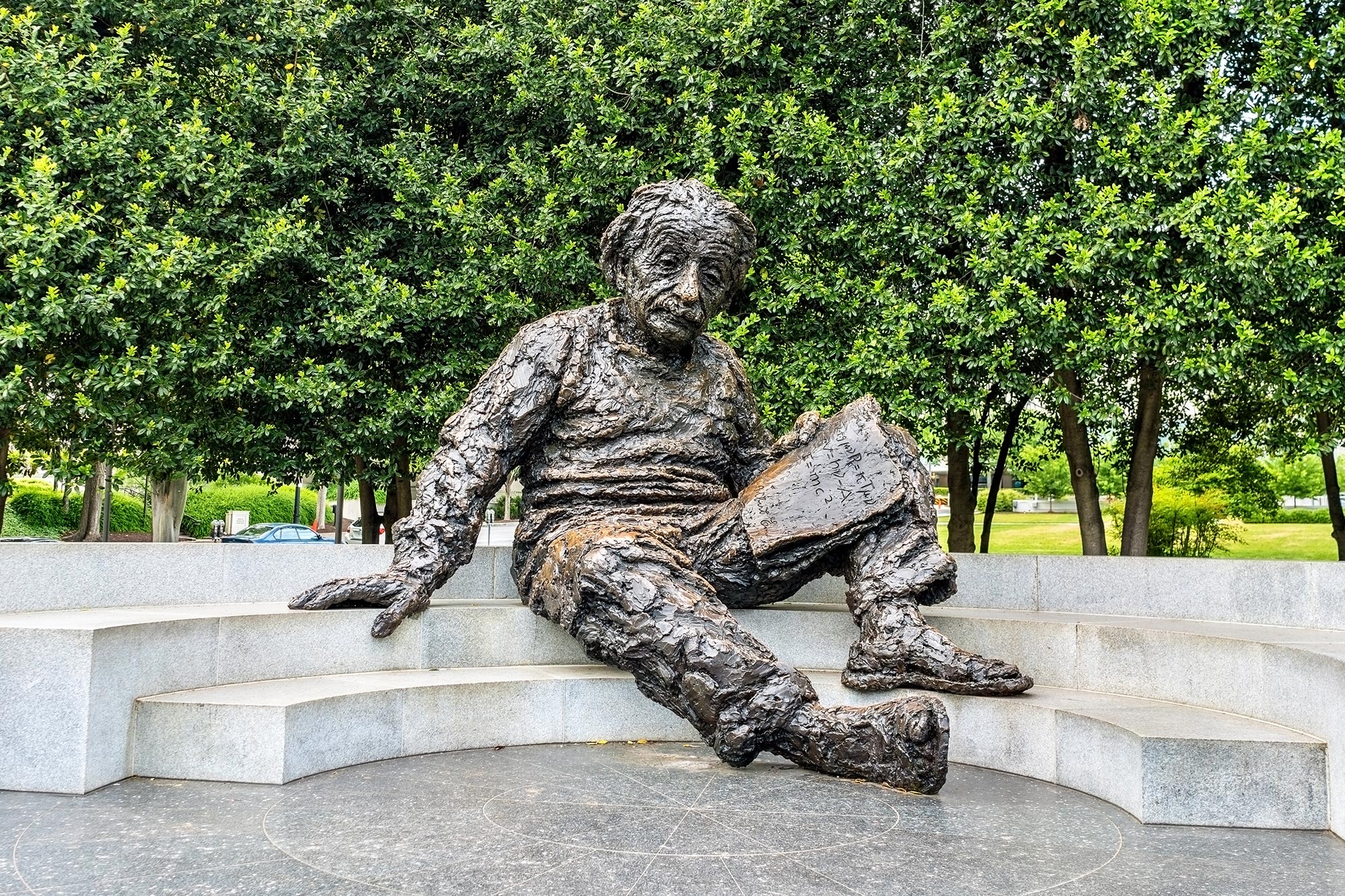
Hard workers may make better role models than geniuses.
Role models are important for aspiring scientists, but new research suggests that scientists who are known for their hard work — like Thomas Edison — are more motivating than scientists who are viewed as naturally brilliant, like Albert Einstein.
In a series of studies, researchers found that young people were more motivated by scientists whose success was associated with effort than those whose success was attributed to innate, exceptional intelligence, even if that scientist was Albert Einstein.
Danfei Hu, a doctoral student at Penn State, and Janet N. Ahn, an assistant professor of psychology at William Paterson University, said the findings — recently published in the journal Basic and Applied Social Psychology — will help dispel certain myths about what it takes to succeed in science.
“There’s a misleading message out there that says you have to be a genius in order to be a scientist,” Hu said. “This just isn’t true and may be a big factor in deterring people from pursuing science and missing out on a great career. Struggling is a normal part of doing science and exceptional talent is not the sole prerequisite for succeeding in science. It’s important we help spread this message in science education.”
According to the researchers, there is a concern in the science community with the number of students who pursue careers in science during school only to drop out from those career paths once they graduate from college. Researchers have coined this phenomenon as the “leaking STEM pipeline.”
To help solve the problem, Hu and Ahn wanted to research role modeling, which gives aspiring scientists specific goals, behaviors, or strategies they can mimic. But while previous studies have examined qualities that make role models effective, Hu and Ahn were curious about whether the aspiring scientists’ own beliefs about potential role models had an effect on their motivation.
“The attributions people make of others’ success are important because those views could significantly impact whether they believe they, too, can succeed,” Ahn said. “We were curious about whether aspiring scientists’ beliefs about what contributed to the success of established scientists would influence their own motivation.”
The researchers performed three studies with 176, 162, and 288 participants in each, respectively. In the first study, all participants read the same story about common struggles a scientist encountered in their science career. However, half were told the story was about Einstein, while half believed it was about Thomas Edison.
Despite the stories being the same, participants were more likely to believe natural brilliance was the reason for Einstein’s success. Additionally, the participants who believed the story was about Edison were more motivated to complete a series of math problems.
“This confirmed that people generally seem to view Einstein as a genius, with his success commonly linked to extraordinary talent,” Hu said. “Edison, on the other hand, is known for failing more than 1,000 times when trying to create the light bulb, and his success is usually linked to his persistence and diligence.”
In the second study, participants once again read a story about a struggling scientist, but while one half of the sample was told it was about Einstein, the other half was told it was about a fabricated scientist whose name — Mark Johnson — was previously unfamiliar to them. Compared to those believing they were reading about Einstein, participants who read about Mark Johnson were less likely to think exceptional talent was necessary for success and more likely to perform better on a series of math problems.
Finally, the researchers wanted to perform a final study to see if people simply felt demotivated in comparison to Einstein or if Edison and an unknown scientist could boost participants’ motivation.
In the third study, the researchers followed the same procedure as the previous two experiments with one change: The participants were randomly assigned to read a story about an unknown scientist, Einstein, or Edison. Compared to the unknown scientist, Edison motivated participants while Einstein demotivated them.
“The combined results suggest that when you assume that someone’s success is linked to effort, that is more motivating than hearing about a genius’s predestined success story,” Hu said. “Knowing that something great can be achieved through hard work and effort, that message is much more inspiring.”
Hu and Ahn both believe that in addition to providing insight for how to enhance scientists’ effectiveness as role models, the findings can also be used to help optimize science education for students of all ages.
“This information can help shape the language we use in textbooks and lesson plans and the public discourse regarding what it takes to succeed in science,” Hu said. “Young people are always trying to find inspiration from and mimic the people around them. If we can send the message that struggling for success is normal, that could be incredibly beneficial.”
Reference: “Not All Scientists Are Equal: Role Aspirants Influence Role Modeling Outcomes in STEM” by Danfei Hu, Janet N. Ahn, Melissa Vega and Xiaodong Lin-Siegler, 6 March 2020, Basic and Applied Social Psychology.
DOI: 10.1080/01973533.2020.1734006
Melissa Vega, New York University, and Xiaodong Lin-Siegler, Columbia University, also participated in this work.
The National Science Foundation helped support this research as well as a research stipend from William Paterson University.
Never miss a breakthrough: Join the SciTechDaily newsletter.
Follow us on Google and Google News.
1 Comment
I am sorry, but the authors of this paper have it all wrong when it comes to Albert Einstein. Experts in the field of education say that he had learning disabilities, dyslexia, and high-functioning autism or Asperger’s Syndrome. He did not speak until he was at least 3 years old. He struggled with reading and with math. So I have to completely disagree with the title of this article and making Albert Einstein look like he didn’t work so hard because he was “a gifted genius”. He is by far a better role model for overcoming his challenges than Thomas Edison who to quote Forbes, “Modern biographers of Edison reveal a picture of a man far different than the larger-than-life “Wizard of Menlo Park” we all learned about in school.” You can read this article: https://www.forbes.com/sites/michaelschein/2018/10/02/thomas-edison-was-a-cranky-dude-and-other-reasons-you-should-follow-his-lead/#3a9d32911305. Edison was no role model. He did a great job of using people and the media to take credit for others inventions and make himself look good. Also read this, http://theconversation.com/thomas-edison-visionary-genius-or-fraud-99229. I’ll take Einstein over Edison as my inspiration for science and technology.