
Close Menu
    Facebook X (Twitter) Instagram
    SciTechDaily
    • Biology
    • Chemistry
    • Earth
    • Health
    • Physics
    • Science
    • Space
    • Technology
    Facebook X (Twitter) Pinterest YouTube RSS
    SciTechDaily
    Home»Health»Portable Smartphone Lab Can Diagnose Illnesses Like Coronavirus & HIV – Delivers Test Results in ‘Spit’ Second
    Health

    Portable Smartphone Lab Can Diagnose Illnesses Like Coronavirus & HIV – Delivers Test Results in ‘Spit’ Second

    By University of CincinnatiFebruary 6, 20201 Comment3 Mins Read
    Facebook Twitter Pinterest Telegram LinkedIn WhatsApp Email Reddit
    Share
    Facebook Twitter LinkedIn Pinterest Telegram Email Reddit
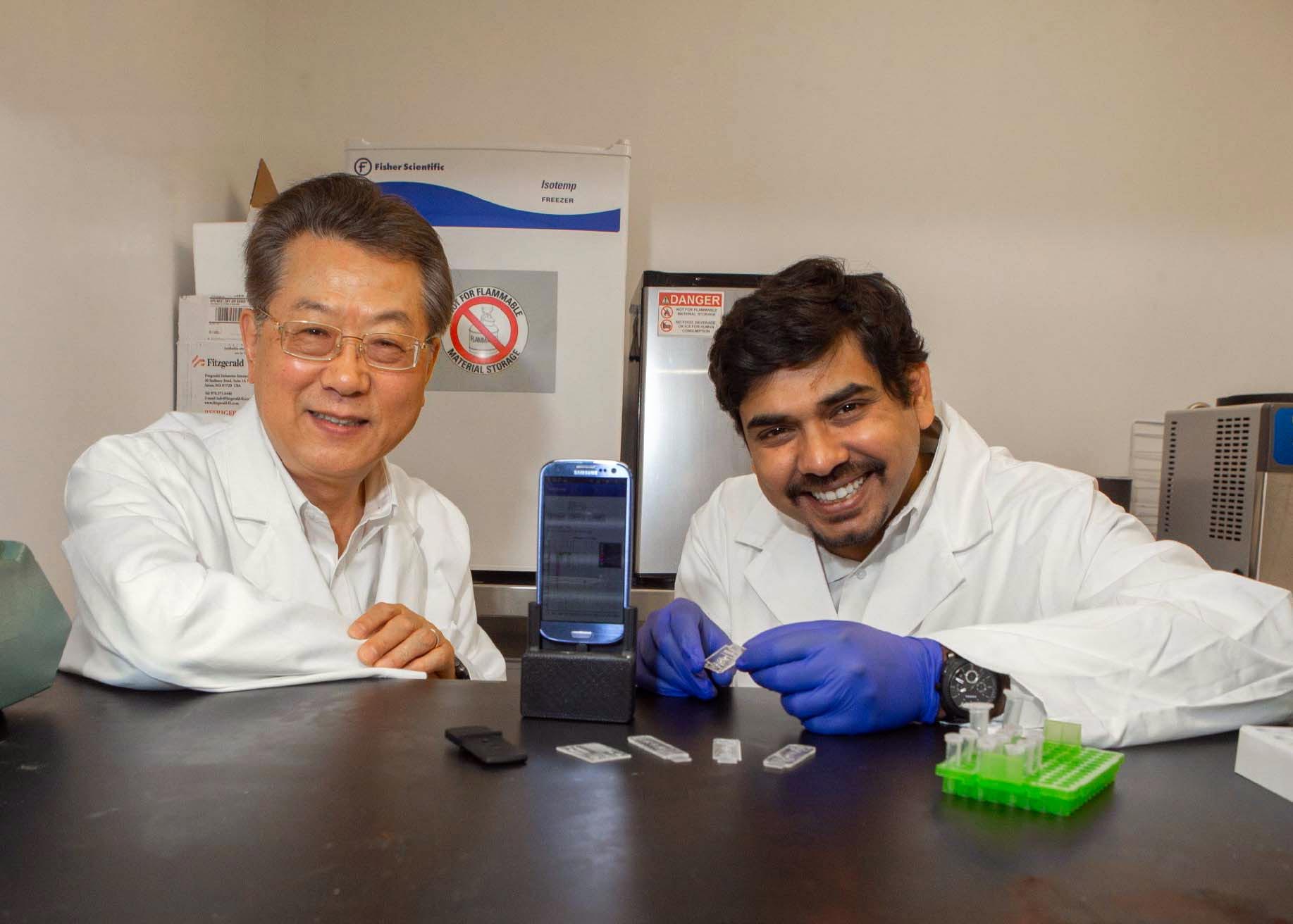
    Chong Ahn Sthitodhi Ghosh
    University of Cincinnati engineering professor Chong Ahn, left, and graduate student Sthitodhi Ghosh created a portable lab that plugs into your smartphone to provide point-of-care testing. The results are transmitted to your doctor via a custom app. Credit: Joseph Fuqua II/UC Creative Services

    Engineers with the University of Cincinnati have created a tiny portable lab that plugs into your phone, connecting it automatically to a doctor’s office through a custom app UC developed.

    The lab, which is the size of a credit card, can diagnose infectious diseases such as coronavirus, malaria, HIV, or Lyme disease or countless other health conditions like depression and anxiety.

    The patient simply puts a single-use plastic lab chip into his or her mouth and then plugs that into a slot in the box to test the saliva.

    The device automatically transmits results to the patient’s doctor through a custom app UC created for nearly instant results.
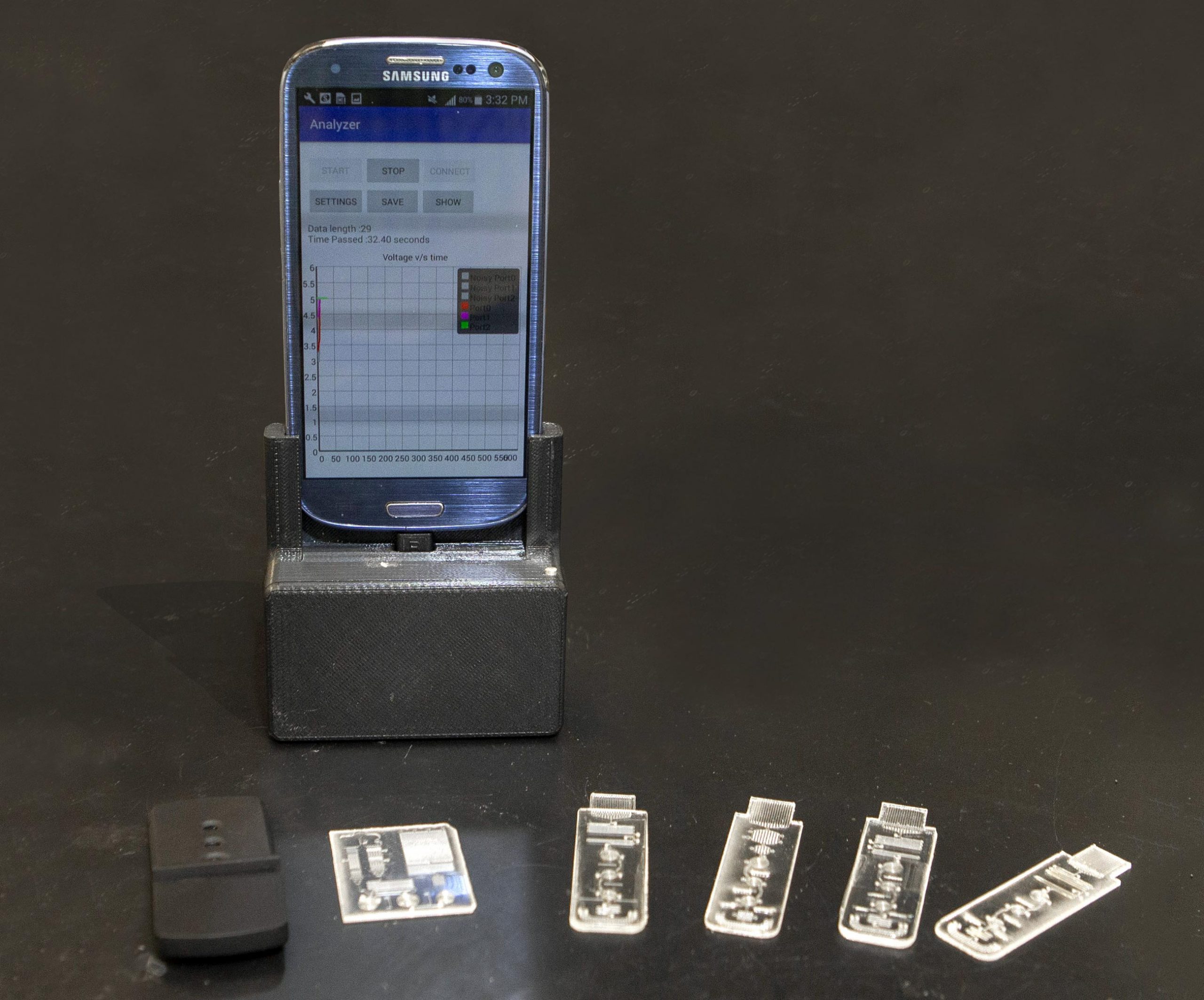
    Smartphone Lab
    UC professor Chong Ahn developed a portable lab that plugs into your smartphone to diagnose diseases like malaria or coronavirus. The results are transmitted to your doctor over a custom app UC developed. Credit: Joseph Fuqua II/UC Creative Services

    UC professor Chong Ahn and his research team used the smartphone device to test for malaria. But the device could be used for smart point-of-care testing for countless chronic or infectious diseases or to measure hormones related to stress.

    “Right now it takes several hours or even days to diagnose in a lab, even when people are showing symptoms. The disease can spread,” Ahn said.

    The study was published in the Nature journal Microsystems & Nanoengineering.

    His research team created a novel lab chip that uses natural capillary action, the tendency for a liquid to adhere to a surface, to draw a sample down two channels called a “microchannel capillary flow assay.” One channel mixes the sample with freeze-dried detection antibodies. The other contains a freeze-dried luminescent material to read the results when the split samples combine again on three sensors.

    Ahn said the device is accurate, simple to use, and inexpensive.
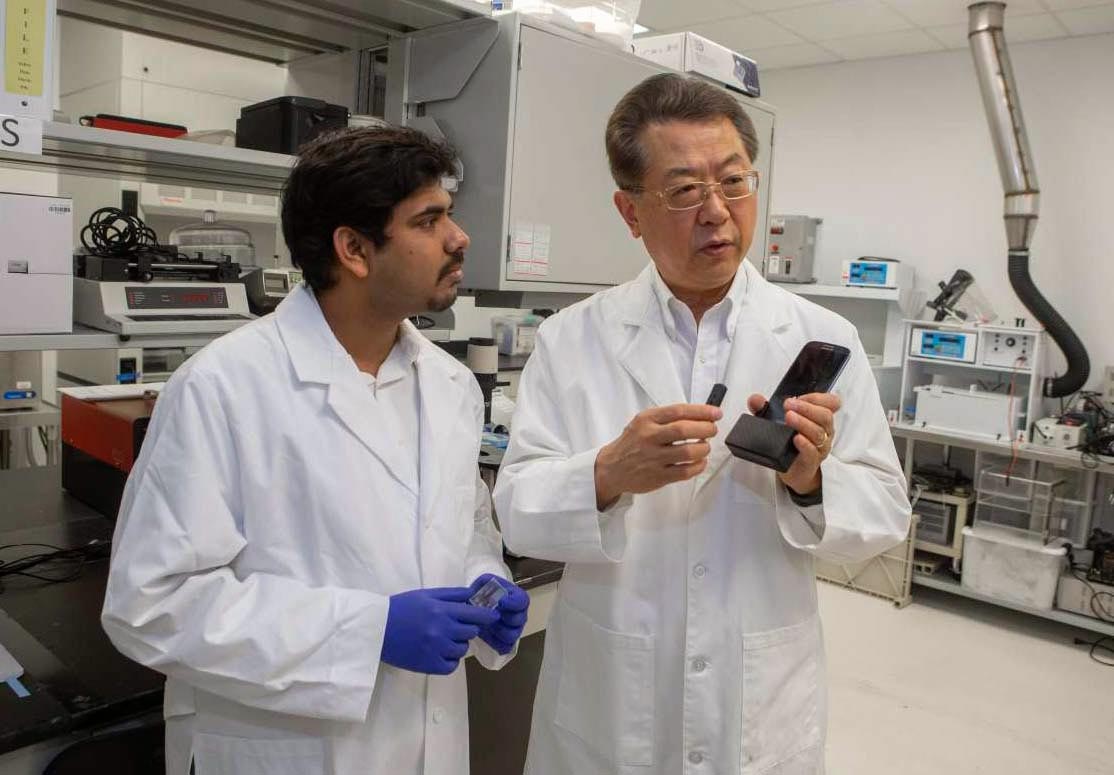
    Portable Smartphone Lab
    University of Cincinnati engineering professor Chong Ahn, right, and UC graduate student Sthitodhi Ghosh discuss the portable lab they created that plugs into a smartphone to test for infectious diseases or to track hormones related to anxiety or depression. The device sends test results to your doctor via a custom app UC developed. Credit: Joseph Fuqua II/UC Creative Services

    “The performance is comparable to laboratory tests. The cost is cheaper. And it’s user-friendly,” Ahn said. “We wanted to make it simple so anyone could use it without training or support.”

    UC doctoral student Sthitodhi Ghosh, the study’s lead author, said the biggest advancement in the device is in the novel design of its tiny channels that naturally draw the sample through the sensor arrays using capillary flow. Ahn is Ghosh’s Ph.D. advisor.

    “The entire test takes place on the chip automatically. You don’t have to do anything. This is the future of personal healthcare,” Ghosh said.

    While the device has applications for diagnosing or monitoring viruses or other diseases, Ahn said he sees potential in the field of mental health, where doctors already utilize smartphones to help track the wellness of patients.

    Reference: “A new microchannel capillary flow assay (MCFA) platform with lyophilized chemiluminescence reagents for a smartphone-based POCT detecting malaria” by Sthitodhi Ghosh, Kashish Aggarwal, Vinitha T. U., Thinh Nguyen, Jungyoup Han and Chong H. Ahn, 27 January 2020, Microsystems & Nanoengineering.
    DOI: 10.1038/s41378-019-0108-8

    Never miss a breakthrough: Join the SciTechDaily newsletter.
    Follow us on Google and Google News.

    Biomedical Engineering HIV University of Cincinnati Virology
    Share. Facebook Twitter Pinterest LinkedIn Email Reddit

    Related Articles

    Bioengineered Membrane to Capture Airborne COVID-19 Droplets – Inspired by Plant That Traps Insects

    Pioneering Method Track Molecules in Real Time to Reveal Dynamic Structure in HIV

    MIT Researchers Design Experimental Peptide That Targets and Destroys COVID-19

    Two Students Develop Interactive Dashboard to Keep Tabs on Coronavirus Pandemic

    New Portable Analyzer Can Detect Antivirus Antibody in Just 20 Minutes

    Promising New COVID-19 Vaccine Candidate Developed

    Technical Advances Provide Big Improvements in HIV Vaccine Production

    Scientists Turn HIV Against Itself, A Possible Step Towards a Cure

    New Class of Proteins Inhibit HIV Infection in Cell Cultures

    1 Comment

    1. Herman Brady on February 24, 2020 10:10 am

      Who is selling or manufacturing now this device??

      Reply
    Leave A Reply Cancel Reply

    • Facebook
    • Twitter
    • Pinterest
    • YouTube

    Don't Miss a Discovery

    Subscribe for the Latest in Science & Tech!

    Trending News

    Breakthrough Bowel Cancer Trial Leaves Patients Cancer-Free for Nearly 3 Years

    Natural Compound Shows Powerful Potential Against Rheumatoid Arthritis

    100,000-Year-Old Neanderthal Fossils in Poland Reveal Unexpected Genetic Connections

    Simple “Gut Reset” May Prevent Weight Gain After Ozempic or Wegovy

    2.8 Days to Disaster: Scientists Warn Low Earth Orbit Could Suddenly Collapse

    Common Food Compound Shows Surprising Power Against Superbugs

    5 Simple Ways To Remember More and Forget Less

    The Atomic Gap That Could Cost the Semiconductor Industry Billions

    Follow SciTechDaily
    • Facebook
    • Twitter
    • YouTube
    • Pinterest
    • Newsletter
    • RSS
    SciTech News
    • Biology News
    • Chemistry News
    • Earth News
    • Health News
    • Physics News
    • Science News
    • Space News
    • Technology News
    Recent Posts
    • After 37 Years, the World’s Longest-Running Soil Warming Experiment Uncovers a Startling Climate Secret
    • NASA Satellite Captures First-Ever High-Res View of Massive Pacific Tsunami
    • ADHD Isn’t Just a Deficit: Study Reveals Powerful Hidden Strengths
    • Scientists Uncover “Astonishing” Hidden Property of Light
    • Scientists Discover Stem Cells That Could Regrow Teeth and Bone
    Copyright © 1998 - 2026 SciTechDaily. All Rights Reserved.
    • Science News
    • About
    • Contact
    • Editorial Board
    • Privacy Policy
    • Terms of Use

    Type above and press Enter to search. Press Esc to cancel.