
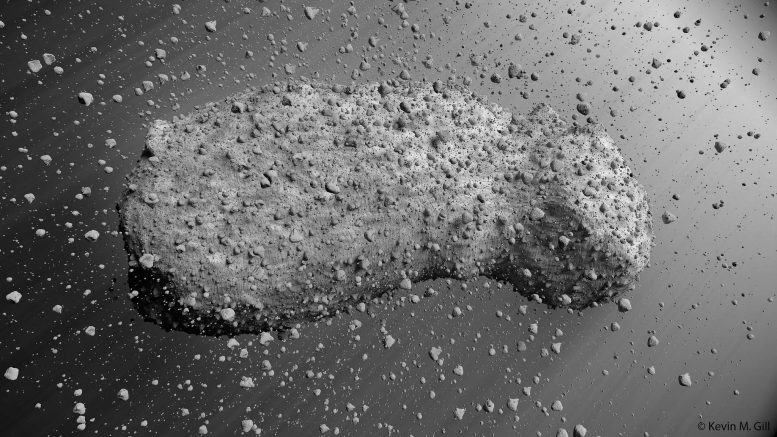
Rubble-pile asteroid Itokawa’s shock-absorbent structure makes it extremely durable, surviving over 4 billion years.
Curtin University-led research into the durability and age of an ancient asteroid made of rocky rubble and dust, revealed significant findings that could contribute to potentially saving the planet if one ever hurtled toward Earth.
The international team studied three tiny dust particles collected from the surface of an ancient 500-meter-long (1600-foot-long) rubble pile asteroid, Itokawa, returned to Earth by the Japanese Space Agency’s Hayabusa 1 probe.
The study’s results showed asteroid Itokawa, which is 2 million kilometers from Earth and around the size of Sydney Harbour Bridge, was hard to destroy and resistant to collision.
Lead author Professor Fred Jourdan, Director of the Western Australian Argon Isotope Facility, part of the John de Laeter Centre and the School of Earth and Planetary Sciences at Curtin, said the team also found Itokawa is almost as old as the solar system itself.
Unique Composition of Rubble-Pile Asteroids
“Unlike monolithic asteroids, Itokawa is not a single lump of rock, but belongs to the rubble pile family which means it’s entirely made of loose boulders and rocks, with almost half of it being empty space,” Professor Jourdan said.
“The survival time of monolithic asteroids the size of Itokawa is predicted to be only several hundreds of thousands of years in the asteroid belt.
“The huge impact that destroyed Itokawa’s monolithic parent asteroid and formed Itokawa happened at least 4.2 billion years ago. Such an astonishingly long survival time for an asteroid the size of Itokawa is attributed to the shock-absorbent nature of rubble pile material.
“In short, we found that Itokawa is like a giant space cushion, and very hard to destroy.”
The Curtin-led team used two complementary techniques to analyze the three dust particles. The first one is called Electron Backscattered Diffraction and can measure if a rock has been shocked by any meteor impact. The second method — argon-argon dating — is used to date asteroid impacts.
Implications for Planetary Defense
Co-author Associate Professor Nick Timms, also from Curtin’s School of Earth and Planetary Sciences, said the durability of rubble pile asteroids was previously unknown, jeopardizing the ability to design defense strategies in case one was hurtling toward Earth.
“We set out to answer whether rubble pile asteroids are resistant to being shocked or whether they fragment at the slightest knock,” Associate Professor Timms said.
“Now that we have found they can survive in the solar system for almost its entire history, they must be more abundant in the asteroid belt than previously thought, so there is more chance that if a big asteroid is hurtling toward Earth, it will be a rubble pile.
“The good news is that we can also use this information to our advantage — if an asteroid is detected too late for a kinetic push, we can then potentially use a more aggressive approach like using the shockwave of a close-by nuclear blast to push a rubble-pile asteroid off course without destroying it.”
Reference: “Rubble pile asteroids are forever” by Fred Jourdan, Nicholas E. Timms, Tomoki Nakamura, William D. A. Rickard, Celia Mayers, Steven M. Reddy, David Saxey, Luke Daly, Phil A. Bland, Ela Eroglu and Denis Fougerouse, 23 January 2023, Proceedings of the National Academy of Sciences.
DOI: 10.1073/pnas.2214353120
Curtin University co-authors include Associate Professor William Rickard, Celia Mayers, Professor Steven Reddy, Dr. David Saxey, and John Curtin Distinguished Professor Phil Bland, all from the School of Earth and Planetary Sciences.
Never miss a breakthrough: Join the SciTechDaily newsletter.
Follow us on Google and Google News.
1 Comment
Perhaps these asteroids are more resilient than we thought or perhaps they are not as old as we thought.