
Close Menu
    Facebook X (Twitter) Instagram
    SciTechDaily
    • Biology
    • Chemistry
    • Earth
    • Health
    • Physics
    • Science
    • Space
    • Technology
    Facebook X (Twitter) Pinterest YouTube RSS
    SciTechDaily
    Home»Space»Scattered Light Gaps in Protoplanetary Disks Don’t Always Signal Planets
    Space

    Scattered Light Gaps in Protoplanetary Disks Don’t Always Signal Planets

    By Harvard-Smithsonian Center for AstrophysicsNovember 3, 2015No Comments3 Mins Read
    Facebook Twitter Pinterest Telegram LinkedIn WhatsApp Email Reddit
    Share
    Facebook Twitter LinkedIn Pinterest Telegram Email Reddit
    Astronomers Show Disk Gaps Don't Always Signal Planets
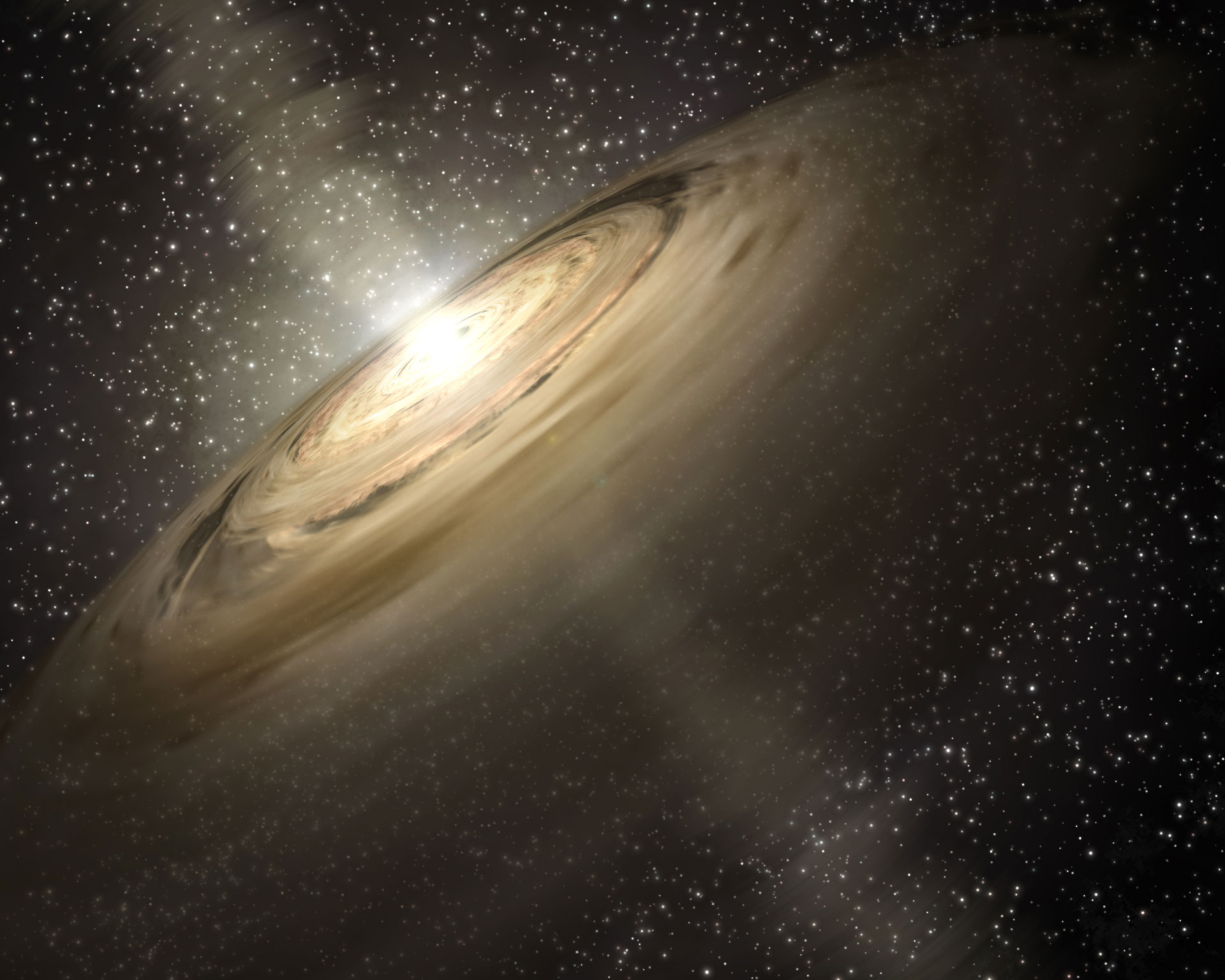
    This artist’s concept illustrates a solar system that is a much younger version of our own. Dusty disks, like the one shown here circling the star, are the breeding grounds of planets. When visible or near-infrared observations show a gap in a disk like this, it is often interpreted as evidence for an unseen planet. NASA/JPL-Caltech/T. Pyle (SSC)

    New research from the Harvard-Smithsonian Center for Astrophysics shows that a gap in the dusty disk circling a star could be a sort of cosmic illusion and not the sign of a hidden planet after all.

    Cambridge, Massachusetts – When astronomers study protoplanetary disks of gas and dust that surround young stars, they sometimes spot a dark gap like the Cassini division in Saturn’s rings. It has been suggested that any gap must be caused by an unseen planet that formed in the disk and carved out material from its surroundings. However, new research shows that a gap could be a sort of cosmic illusion and not the sign of a hidden planet after all.

    “If we don’t see light scattered from the disk, it doesn’t necessarily mean that nothing is there,” says lead author Til Birnstiel (Max Planck Institute for Astronomy), who conducted the research while at the Harvard-Smithsonian Center for Astrophysics (CfA).

    The researchers studied disks that shine in visible or near-infrared wavelengths due to scattered, or reflected, light. (In contrast, radio or millimeter telescopes pick up emission directly from the disk itself.)

    Scattered light comes from starlight that bounces off tiny particles about the size of cigarette smoke. Those particles initially suffuse the protoplanetary disk, but undergo changes over time.

    Small particles can clump together to form larger and larger objects, eventually growing into full-fledged planets. However, when particles collide they sometimes break apart instead of sticking together. Particles can also move closer to or farther from the star in a process called migration. The team modeled these processes using the Smithsonian’s Hydra supercomputer cluster.

    “Growth, migration, and destruction can have tangible, observable effects,” explains co-author Sean Andrews of the CfA. “Specifically, these processes can create an apparent gap in the disk when the small particles that scatter light are cleared away, even though larger particles still remain.”

    Birnstiel offers the analogy, “Throwing a stone in the air doesn’t obstruct my view, but throwing a handful of dust in the air does. Similarly, as small particles grow bigger in some areas of the disk, they don’t obstruct our view anymore and those regions appear empty.”

    So how can astronomers tell if a gap in a protoplanetary disk is real, or simply an area where pebbles reign and dust is gone? The key is to make observations at longer wavelengths of light that can pick up the pebbles.

    To that end, the team will conduct observations of a well-known example of a disk with a gap, TW Hydrae, with the Atacama Large Millimeter/submillimeter Array (ALMA). If they find large grains within the apparent gap, that will suggest there is no planet. However, if the gap appears empty in these observations as well, then the evidence will be stronger for the existence of an unseen planet.

    This work has been published in the Astrophysical Journal Letters.

    Reference: “Dust Evolution Can Produce Scattered Light Gaps in Protoplanetary Disks” by Tilman Birnstiel, Sean M. Andrews, Paola Pinilla and Mihkel Kama, 27 October 2015, The Astrophysical Journal Letters.
    DOI: 10.1088/2041-8205/813/1/L14
    arXiv:1510.05660

    Never miss a breakthrough: Join the SciTechDaily newsletter.
    Follow us on Google and Google News.

    Astronomy Astrophysics Harvard-Smithsonian Center for Astrophysics Max Planck Institute Planet Formation Planetary Science
    Share. Facebook Twitter Pinterest LinkedIn Email Reddit

    Related Articles

    Mysterious “Soot Planets” May Be Hiding in Plain Sight Among the Stars

    ALMA Reveals First Ever Snow Line Seen Around a Distant Star

    NASA Study Reveals Debris Disks Don’t Need Planets to Form Patterns

    Astronomers Discover Transiting Planets in Star Cluster NGC 6811

    Hubble Reveals Evidence of a Planet Forming 7.5 Billion Miles from Its Star

    Water Planets in the Habitable Zone: A Closer Look at Kepler 62e and 62f

    Earth-like Planets May Have Older and More Evolved Life

    Scientists View Changes in Venus’s Ionosphere

    Kepler Data Suggests 17 Billion Earth-Sized Worlds in the Milky Way

    Leave A Reply Cancel Reply

    • Facebook
    • Twitter
    • Pinterest
    • YouTube

    Don't Miss a Discovery

    Subscribe for the Latest in Science & Tech!

    Trending News

    The Universe Is Expanding Too Fast and Scientists Can’t Explain Why

    “Like Liquid Metal”: Scientists Create Strange Shape-Shifting Material

    Early Warning Signals of Esophageal Cancer May Be Hiding in Plain Sight

    Common Blood Pressure Drug Shows Surprising Power Against Deadly Antibiotic-Resistant Superbug

    Scientists Uncover Dangerous Connection Between Serotonin and Heart Valve Disease

    Scientists Discover a “Protector” Protein That Could Help Reverse Hair Loss

    Bone-Strengthening Discovery Could Reverse Osteoporosis

    Scientists Uncover Hidden Trigger Behind Stem Cell Aging

    Follow SciTechDaily
    • Facebook
    • Twitter
    • YouTube
    • Pinterest
    • Newsletter
    • RSS
    SciTech News
    • Biology News
    • Chemistry News
    • Earth News
    • Health News
    • Physics News
    • Science News
    • Space News
    • Technology News
    Recent Posts
    • Scientists Overcome Major Quantum Bottleneck, Potentially Transforming Teleportation and Computing
    • Quantum Physics’ Strangest Problem May Hold the Key to Time Itself
    • Scientists Create “Liquid Gears” That Spin Without Touching
    • The Simple Habit That Could Help Prevent Cancer
    • Forgotten Medicinal Plant Shows Promise in Fighting Dangerous Superbugs
    Copyright © 1998 - 2026 SciTechDaily. All Rights Reserved.
    • Science News
    • About
    • Contact
    • Editorial Board
    • Privacy Policy
    • Terms of Use

    Type above and press Enter to search. Press Esc to cancel.