
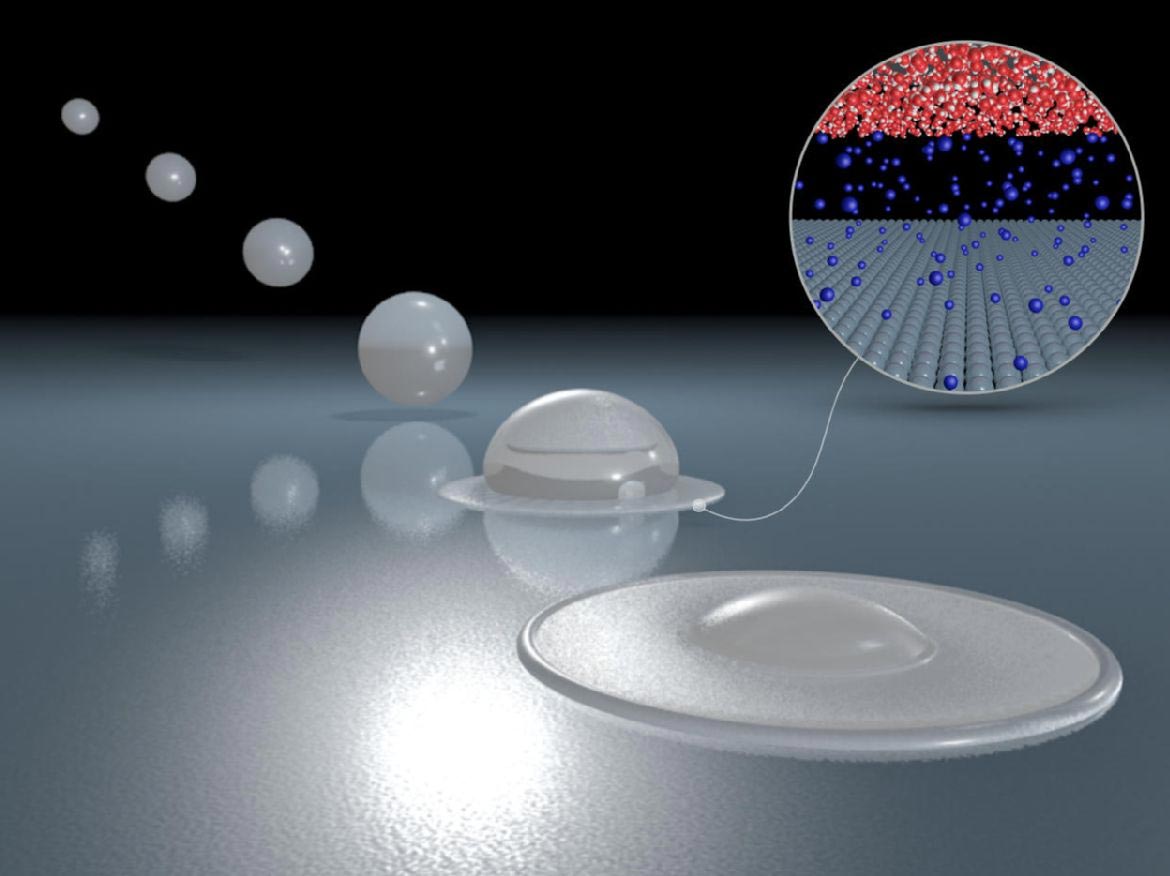
- When a water droplet lands on a surface it can splash, coat the surface cleanly, or in special conditions bounce off like a beach ball
- Droplets only bounce when the speed of collision with a surface is just right, creating a very thin nanoscale air cushion for it to rebound off
- Drop collision is integral to technology such as 3D printing and spray cooling of next-generation electronics, and understanding this can help future developments in these fields
University of Warwick researchers can now explain why some water droplets bounce like a beach ball off surfaces, without ever actually touching them. Now the design and engineering of future droplet technologies can be made more precise and efficient.
Collisions between liquid drops and surfaces, or other drops, happen all the time. For example, small water drops in clouds collide with each other to form larger drops, which can eventually fall and impact on a solid, like your car windscreen.
Drops can behave differently after the point of collision, some make a splash, some coat the surface cleanly, and some can even bounce like a beach ball.
In the article, published today in Physical Review Letters, researchers from the University of Warwick have found an explanation for experimental observations that some droplets bounce.
Remarkably, the fate of the drop is determined by the behavior of a tiny cushion of air whose height can reach the scale of nanometers. To get a sense of scale, think of something the size of the moon bouncing from a garden trampoline.
Even if the surface is perfectly smooth, like in laboratory conditions, an affinity between drop molecules and the wall molecules (known as van der Waals attraction), will mean that in most cases the drop will be pinched down onto the surface, preventing it from bouncing.
The research reveals, through highly detailed numerical simulations, that for a droplet to bounce the speed of collision must be just right. Too fast, and the momentum of the drop flattens the air cushion too thinly. Too slow, and it gives the van der Waals attraction time to take hold. At the perfect speed, though, the drop can perform a clean bounce, like a high jumper just clearing the bar.
Professor Duncan Lockerby from the School of Engineering at the University of Warwick comments:
“Drop collision is integral to technology we rely upon today, for example, in inkjet printing and internal combustion engines. Understanding better what happens to colliding droplets can also help the development of emerging technologies, such as 3D printing in metal, as their accuracy and efficiency will ultimately depend on what happens to drops post collision.”
Dr. James Sprittles from the Mathematics Institute at the University of Warwick adds:
“Importantly, the air cushion is so thin that molecules will often never encounter one another when crossing it, akin to the emptiness of outer space, and conventional theories fail to account for this. The new modeling approach we’ve developed will now have applications to droplet-based phenomena ranging from cloud physics for climate science through to spray cooling for next-generation electronics.”
Reference: “Bouncing off the Walls: The Influence of Gas-Kinetic and van der Waals Effects in Drop Impact” by Mykyta V. Chubynsky, Kirill I. Belousov, Duncan A. Lockerby and James E. Sprittles, 26 February 2020, Physical Review Letters.
DOI: 10.1103/PhysRevLett.124.084501
Never miss a breakthrough: Join the SciTechDaily newsletter.
Follow us on Google and Google News.