
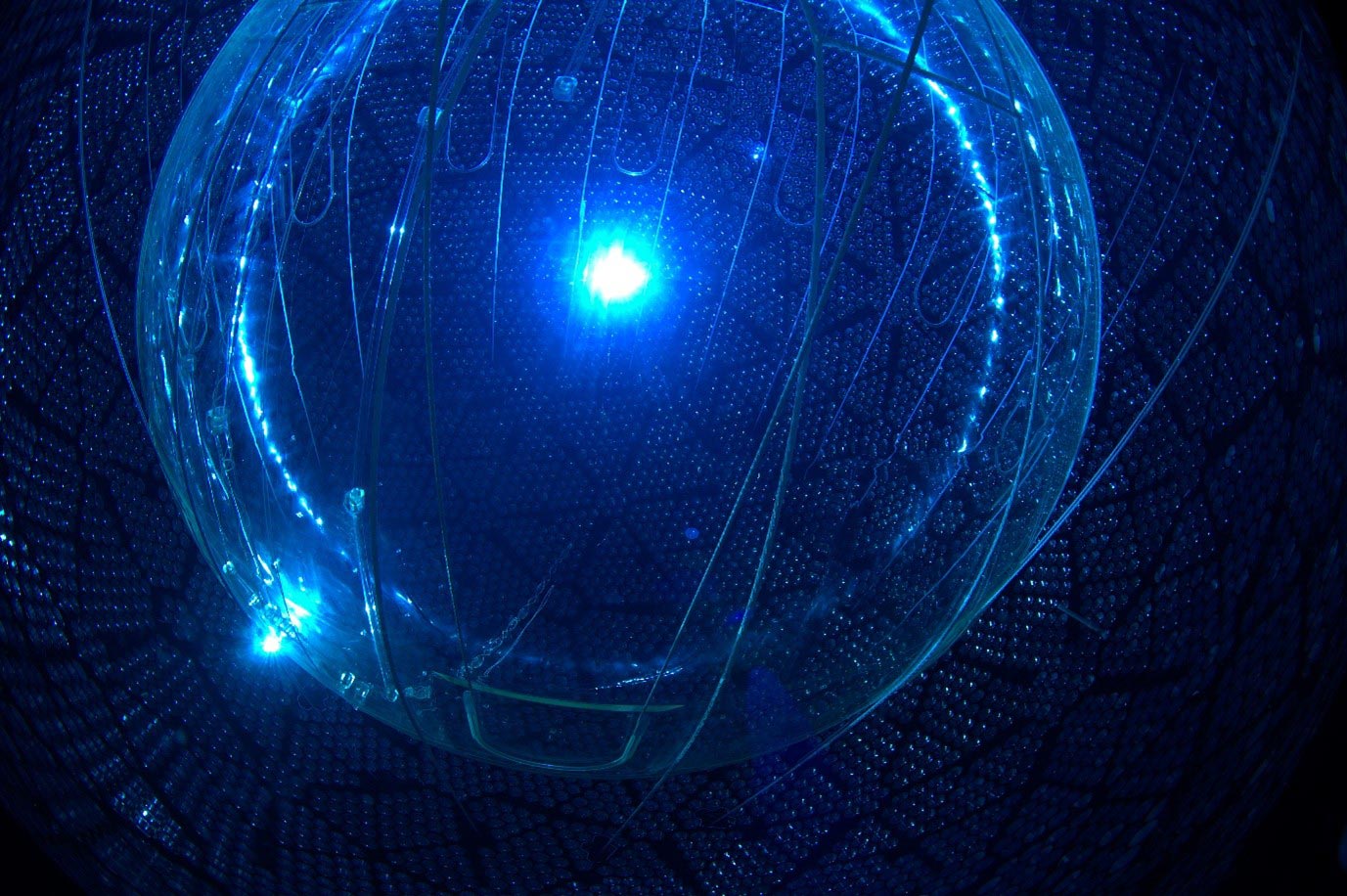
A handful of incredibly rare solar neutrino events were detected turning carbon-13 into nitrogen-13 deep underground.
The finding confirms a long-anticipated reaction and provides a new tool for probing the universe’s smallest and strangest particles.
Ghost Particles and a New Kind of Interaction
Neutrinos rank among the most puzzling particles known to science. Often described as ‘ghost particles’, they almost never interact with ordinary matter. Trillions move through each of us every second without leaving any trace behind. These particles emerge from nuclear processes, including those happening at the heart of our Sun, yet they are extremely difficult to detect because they so rarely collide with anything.
Until now, solar neutrinos have only been observed interacting with a limited number of materials. Researchers have now achieved a first: they have documented neutrinos converting carbon atoms into nitrogen inside a massive underground detector.
A Deep Underground Facility Built to Catch Rare Signals
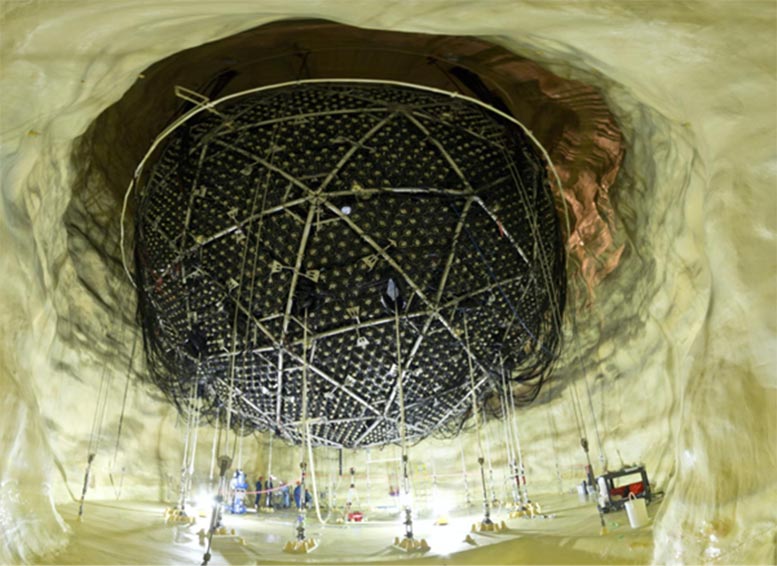
This advance was achieved by an Oxford-led team using the SNO+ detector, situated two kilometres beneath the surface at SNOLAB in Sudbury, Canada. SNOLAB operates within an active mine and is designed to block out cosmic rays and radiation that would otherwise overwhelm the faint neutrino signals the team is trying to measure.
Tracking a Two-Step Reaction in Carbon-13
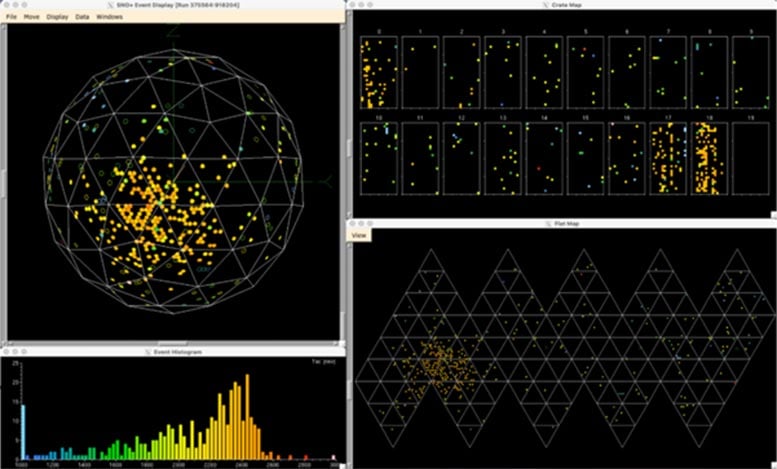
The researchers focused on events in which a high-energy neutrino strikes a carbon-13 nucleus, producing nitrogen-13. This newly formed nitrogen-13 is radioactive and decays after roughly ten minutes. To identify the process, the team relied on a technique known as a ‘delayed coincidence’ method. It searches for two related flashes of light: the first when the neutrino hits the carbon-13 nucleus, and the second several minutes later when the nitrogen-13 decays. This pattern makes it possible to distinguish genuine neutrino interactions from unrelated background activity.
During a 231-day window spanning May 4, 2022, to June 29, 2023, the analysis revealed 5.6 observed events. This number aligns with the prediction that 4.7 such events would be produced by solar neutrinos during the same period.
Why These Interactions Matter for Understanding the Universe
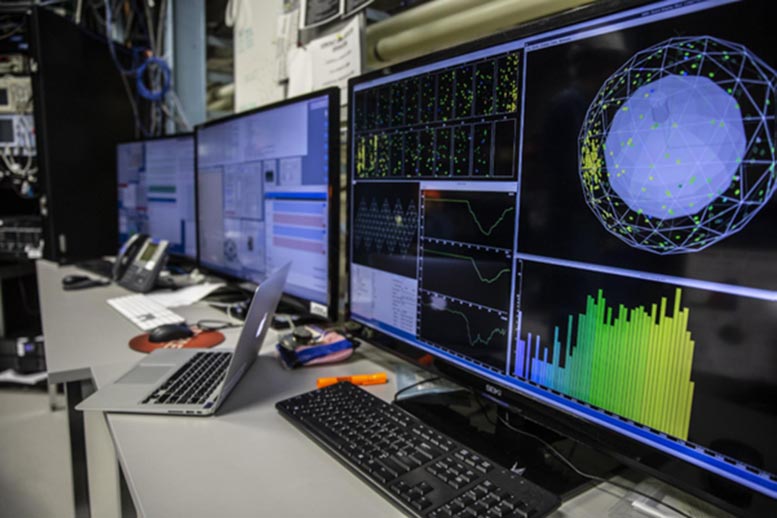
Neutrinos play a crucial role in scientific attempts to understand how stars function, how nuclear fusion operates, and how the universe evolves. Researchers say that this new observation sets the stage for future investigations into other low-energy neutrino reactions.
Lead author Gulliver Milton, a PhD student at the University of Oxford’s Department of Physics, said: “Capturing this interaction is an extraordinary achievement. Despite the rarity of the carbon isotope, we were able to observe its interaction with neutrinos, which were born in the Sun’s core and travelled vast distances to reach our detector.”
Co-author Professor Steven Biller (Department of Physics, University of Oxford) added: “Solar neutrinos themselves have been an intriguing subject of study for many years, and the measurements of these by our predecessor experiment, SNO, led to the 2015 Nobel Prize in physics. It is remarkable that our understanding of neutrinos from the Sun has advanced so much that we can now use them for the first time as a ‘test beam’ to study other kinds of rare atomic reactions!”
Building on the Legacy of SNO and Exploring New Frontiers
SNO+ is an updated version of the earlier SNO experiment, which demonstrated that neutrinos shift between three types known as electron, muon, and tau neutrinos during their journey from the Sun to Earth. According to SNOLAB staff scientist Dr. Christine Kraus, SNO’s original findings, led by Arthur B. McDonald, helped solve the long-standing solar neutrino problem and contributed to the 2015 Nobel Prize in Physics. These results opened the way for broader investigations into the nature of neutrinos and their cosmic importance.
“This discovery uses the natural abundance of carbon-13 within the experiment’s liquid scintillator to measure a specific, rare interaction,” Kraus said. “To our knowledge, these results represent the lowest energy observation of neutrino interactions on carbon-13 nuclei to date and provides the first direct cross-section measurement for this specific nuclear reaction to the ground state of the resulting nitrogen-13 nucleus.”
Reference: “First Evidence of Solar Neutrino Interactions on 13C” by M. Abreu, A. Allega, M. R. Anderson, S. Andringa, D. M. Asner, D. J. Auty, A. Bacon, T. Baltazar, F. Barão, F. Barão, N. Barros, R. Bayes, E. W. Beier, A. Bialek, S. D. Biller, E. Caden, M. Chen, S. Cheng, B. Cleveland, D. Cookman, J. Corning, S. DeGraw, R. Dehghani, J. Deloye, M. M. Depatie, F. Di Lodovico, C. Dima, J. Dittmer, K. H. Dixon, M. S. Esmaeilian, E. Falk, N. Fatemighomi, R. Ford, S. Gadamsetty, A. Gaur, O. I. González-Reina, D. Gooding, C. Grant, J. Grove, S. Hall, A. L. Hallin, D. Hallman, M. R. Hebert, W. J. Heintzelman, R. L. Helmer, C. Hewitt, B. Hreljac, P. Huang, R. Hunt-Stokes, A. S. Inácio, C. J. Jillings, S. Kaluzienski, T. Kaptanoglu, J. Kladnik, J. R. Klein, L. L. Kormos, B. Krar, C. Kraus, C. B. Krauss, T. Kroupová, C. Lake, L. Lebanowski, C. Lefebvre, V. Lozza, M. Luo, S. Maguire, A. Maio, S. Manecki, J. Maneira, R. D. Martin, N. McCauley, A. B. McDonald, G. Milton, D. Morris, M. Mubasher, S. Naugle, L. J. Nolan, H. M. O’Keeffe, G. D. Orebi Gann, S. Ouyang, J. Page, S. Pal, K. Paleshi, W. Parker, L. J. Pickard, B. Quenallata, P. Ravi, A. Reichold, S. Riccetto, J. Rose, R. Rosero, J. Shen, J. Simms, P. Skensved, M. Smiley, R. Tafirout, B. Tam, J. Tseng, E. Vázquez-Jáuregui, C. J. Virtue, F. Wang, M. Ward, J. D. Wilson, J. R. Wilson, A. Wright, S. Yang, Z. Ye, M. Yeh, S. Yu, Y. Zhang, K. Zuber and A. Zummo, 10 December 2025, Physical Review Letters.
DOI: 10.1103/1frl-95gj
Never miss a breakthrough: Join the SciTechDaily newsletter.
Follow us on Google and Google News.
4 Comments
Neutrinos rank among the most puzzling particles known to science. Often described as ‘ghost particles’, they almost never interact with ordinary matter.
why? why? why?
Please ask the researchers to think deeply:
1. If neutrinos almost never interact with ordinary matter, are you detecting neutrinos?
2. Are neutrinos high-dimensional spacetime matter or low dimensional spacetime matter?
3. Can low dimensional spacetime matter be the basis of high-dimensional spacetime matter?
4. Why can mathematics become the language of science?
5. How do you understand the geometric shape of an object?
6. Why can point defects be the core of dynamic and thermodynamic processes?
7. What should physics use to interpret the hierarchical structure of matter?
and so on.
When we pursue the ultimate truth of all things, the space in which our bodies and all things exist may itself be the final and deepest puzzle we need to explore. This is not only the pursuit of physics, but also the most magnificent exploration of the origin of the universe by human reason.
Based on the Topological Vortex Theory (TVT), space is an uniformly incompressible physical entity. Space-time vortices are the products of topological phase transitions of the tipping points in space, are the point defects in spacetime. Point defects do not only impact the thermodynamic properties, but are also central to kinetic processes. They create all things and shape the world through spin and self-organization.
In today’s physics, some so-called peer-reviewed journals—including Physical Review Letters, Nature, Science, and others—stubbornly insist on and promote the following:
1. Even though θ and τ particles exhibit differences in experiments, physics can claim they are the same particle. This is science.
2. Even though topological vortices and antivortices have identical structures and opposite rotational directions, physics can define their structures and directions as entirely different. This is science.
3. Even though two sets of cobalt-60 rotate in opposite directions and experiments reveal asymmetry, physics can still define them as mirror images of each other. This is science.
4. Even though vortex structures are ubiquitous—from cosmic accretion disks to particle spins—physics must insist that vortex structures do not exist and require verification. Only the particles that like God, Demonic, or Angelic are the most fundamental structures of the universe. This is science.
5. Even though everything occupies space and maintains its existence in time, physics must still debate and insist on whether space exists and whether time is a figment of the human mind. This is science.
6. Even though space, with its non-stick, incompressible, and isotropic characteristics, provides a solid foundation for the development of physics, physics must still insist that the ideal fluid properties of space do not exist. This is science.
and go on.
Is this the counterintuitive science they widely promote? Compromising with pseudo academic publications and peer review by pseudo scholars is an insult to science and public intelligence. Some so-called scholars no longer understand what shame is. The study of Topological Vortex Theory (TVT) reminds us that the most profound problems in physics often lie at the intersection of different theories. By exploring these border regions, we can not only resolve contradictions in existing theories but also discover new physical phenomena and application possibilities.
Under the topological vortex architecture, it is highly challenging for even two hydrogen atoms or two quarks to be perfectly symmetrical, let alone counter-rotating two sets of cobalt-60. Contemporary physics and so-called peer-reviewed publications (including Physical Review Letters, Science, Nature, etc.) stubbornly believe that two sets of counter rotating cobalt-60 are two mirror images of each other, constructing a more shocking pseudoscientific theoretical framework in the history of science than the “geocentric model”. This pseudo scientific framework and system have seriously hindered scientific progress and social development.
For nearly a century, physics has been manipulated by this pseudo scientific theoretical system and the interest groups behind it, wasting a lot of manpower, funds, and time. A large amount of pseudo scientific research has been conducted, and countless pseudo scientific papers have been published, causing serious negative impacts on scientific and social progress, as well as humanistic development.
Complexity does not necessarily mean that there is no logical and architectural framework to follow. Mathematics is the language and tool that reveals the motion of spacetime, rather than the motion itself. Although the physical form of spacetime vortices is extremely simple, their interaction patterns are highly complex, and we must develop more and richer mathematical languages to describe and understand them.
The development of the Topological Vortex Theory (TVT) reflects a progression from concrete physical phenomena to abstract mathematical modeling and, ultimately, to interdisciplinary unification. Its core innovation lies in forging the continuous spacetime geometry of general relativity with the discrete interactions of quantum field theory within the same topological dynamical system.
——Excerpted from https://scitechdaily.com/microscope-spacecrafts-most-precise-test-of-key-component-of-the-theory-of-general-relativity/#comment-909171.
B Memo 2512111330_Source 1. Reinterpretation []
Source 1.
https://scitechdaily.com/scientists-catch-ghost-particles-changing-an-atom-deep-underground/
1.
_Scientists have caught ghost particles changing atoms deep underground.
[I’ve been busy with other things all morning, so I haven’t been able to focus on my notes, so it’s a bit messy. I just decided to summarize. 1442]
_Several extremely rare solar neutrino events have been detected deep underground, where carbon-13 is converted to nitrogen-13.
_This discovery confirms a long-anticipated reaction and provides a new tool for exploring the smallest and most bizarre particles in the universe.
1-1. A New Type of Interaction with Ghost Particles
_Neutrinos are among the most enigmatic particles known to science. Neutrinos, commonly called “ghost particles,” rarely interact with ordinary matter.
Trillions of neutrinos pass through our bodies every second, leaving no trace. These particles are produced in nuclear processes, including the core of the Sun, but their collisions with other matter are extremely rare, making them extremely difficult to detect.
[Neutrinos, which are considered candidates for dark matter, do not interact with ordinary matter.
It is said that they are produced in small quantities during stellar nuclear fusion in response to gravitational waves emitted by msoss.dark_matter.1031]
msbase.galaxy is a system with numerous stars, and the frequent collapse and birth of stars by black holes and gravitational lenses increases the abundance of nuclear matter.
The generation of neutrinos causes diverse and unpredictable interparticle excitations in nuclear-mode systems.
Particles smaller than neutrinos are incredibly abundant in the multiverse and appear roughly in qqcells. Hmm.
, that neutrino>.tsps_dentro.susqer has instantaneous particles that travel through the entire multiverse, entangled with the path of Newton’s pendulum, and traverse 10 billion dimensions as pms. Oh my. Awesome! 2512111506]
, Anyway, the elementary particles of ordinary matter in that multiverse, tsps, have a path name of qqcell.nqvix.eqpms.dark_energy. I’m even writing a novel about it. With neutrinos… Hehe. Very good. This is fun!
,1428, 31,1459,1509,11]
, These seem to be particles that entangle with the vixer.field from susqer.dentro.rs… If they somehow enter the nucleus, they violently repel and decay with protons, emitting electromagnetic waves, gamma rays, X-rays, and even microgravity waves. ,1025, 1432]
1-2.
_So far, solar neutrinos have been observed interacting with only a limited number of materials.
_However, researchers have observed and recorded, for the first time, the phenomenon of neutrinos transforming carbon atoms into nitrogen inside a massive underground detector.
_Deep underground facility built to capture rare signals
_The research team focused on the phenomenon of high-energy neutrinos colliding with carbon-13 nuclei to produce nitrogen-13.
[Radioactive decay appears to be a phenomenon caused by the displacement of neutrons. 1219]
For reference,
radiation and neutrons are closely related. Neutron rays are a type of radiation (particle rays)** that are produced as a result of nuclear reactions such as nuclear fission and nuclear fusion, and are the primary source of additional radiation (such as gamma rays) when they collide with matter. Neutrinos, in particular, have no charge and are highly penetrating. They react with sodium in the human body, making them radioactive and damaging cells. They are shielded by substances containing hydrogen (water).
2.
_This method detects two related flashes: the first occurs when a neutrino collides with a carbon-13 nucleus, and the second occurs a few minutes later when nitrogen-13 decays. These patterns allow us to distinguish real neutrino interactions from unrelated background activity.
2-1.
_Why are these interactions important for understanding the universe?
_Neutrinos play a crucial role in scientific efforts to understand how stars work, how nuclear fusion reactions work, and how the universe evolved. The researchers stated that this observation sets the stage for future research on other low-energy neutrino reactions.
[Star formation is a massive plasma sea of nuclear fusion and fission in the fundamental mode of atomic nucleus rivery.dentro. I see stars as msbase.nk. NK2 is a massive star. ,0713]
,The massive galaxy is msbase. Just as stars are trapped in rivery.dentro, msbase also has a nuclear mode. Hehe.
2-2.
_Gulliver Milton, a PhD student in physics at Oxford University and lead author of this study, said, “Capturing this interaction is a remarkable achievement. Despite the rarity of this carbon isotope, we were able to observe its interaction with neutrinos, which are produced in the solar core and have traveled enormous distances to reach our detector.”
[Isotopes are elements formed when there are more neutrons with a charge of 0 than protons with a charge of 1 in the nucleus.
;nuclear.rivery.proton1+00000000…oss..neutrino.zerosum. Hehe. ,0659]
For reference,
neutrinos (neutrinos) are emitted during the beta decay process of radioactive isotopes, and these are closely related to each other through the weak interaction. Neutrinos themselves interact with matter only through the weak interaction and gravity, but when unstable isotopes decay, neutrinos are created or annihilated, playing a key role in altering the nuclear structure. ]
[2512110624
>>>, I noted this morning that neutrinos are emitted from the rivery.dentro region within the nucleus during stellar fission.
, Neutrinos are of the susqer.dentro series, with ±rr, ±ss, and ±rs.baron (*). ,42]
, According to qpeoms theory, vixer belongs to the rivery.dentro.area and vixxa belongs to the susqer.dentro.area. Therefore, light subatomic particles, such as neutrinos, are mostly close to msoss.dark_matter in the susqer region.
, These subatomic particles mostly reside on the msbase.side. For a subatomic particle or an atom to form a nucleus, it must be on the vixer.line. ,48]
It seems that msoss gravitons or qpeoms. w.z_bosons act on msbase.nk2.Higgs. Hmm.
For reference. According to AI Search,
neutrinos are fundamental particles with no charge and very small mass, rarely interacting with matter. They primarily interact solely with the weak force and gravity. They are “ghost particles” that permeate the universe, particularly those created in nuclear reactions such as beta decay. The reason these particles are closely related to the weak force is that the weak force drives the conversion of neutrons and protons within the nucleus, producing or absorbing neutrinos. Because the type (flavor) of neutrinos is transformed (vibrated) by the weak force, the study of neutrinos is crucial to understanding the fundamental principles of the weak force.
“Weak neutrino” appears to refer to the particle that mediates the weak interaction (weak force). In the Standard Model of physics, this refers to the W and Z bosons.
Reference 2.
The Higgs boson is highly unstable and decays (fissions) into other particles almost immediately after its creation. The major particles into which the Higgs boson can decay are:
Bottom quarks (b quarks) and anti-bottom quarks: According to the Standard Model, approximately 57.7% of the Higgs bosons produced are predicted to decay into bottom quark-anti-bottom quark pairs, a phenomenon that has been experimentally confirmed.
Muons and anti-muons: The decay of muons, second-generation fermions, has also been confirmed in CERN experiments. This is a very rare occurrence (approximately one in 5,000 Higgs bosons).
W or Z bosons: The Higgs boson can also decay into heavier gauge bosons, the W or Z boson.
Tau bosons, charm quarks, etc.: The Higgs boson can also decay into other fermion particles with mass.
The Higgs boson imparts mass to interacting particles, and particles with greater mass interact more strongly with the Higgs field. Therefore, the Higgs boson tends to decay primarily into particles with greater mass.
<<<<<,0626, 39]
What is 0.6 of an observed event? That’s what the detector is all about – an observation. Not talking averages here. “During a 231-day window spanning May 4, 2022, to June 29, 2023, the analysis revealed 5.6 observed events.”