

For decades, fusion researchers struggled with neutron isotropy, a key indicator of scalable plasma stability. Zap Energy’s latest results show its FuZE device avoids the pitfalls of past Z pinch failures, generating isotropic neutrons that confirm thermal fusion is occurring.
A Major Milestone for Zap’s Fusion Technology
In physics, “isotropy” refers to a system where properties remain the same in all directions. In fusion research, neutron energy isotropy is a key measurement that assesses how evenly neutrons are emitted from a device. This uniformity is crucial — when fusion plasmas are isotropic, they indicate a stable, thermal plasma that can be scaled up for greater energy production. In contrast, anisotropic plasmas, which emit neutrons unevenly, suggest instability and may not support sustainable fusion.
A recent Zap Energy study, published in Nuclear Fusion, presents the most compelling evidence yet that its sheared-flow-stabilized Z-pinch method produces stable, thermal fusion. The research, conducted on the FuZE device, marks a significant milestone in proving that Zap’s approach can be scaled to higher energy outputs, strengthening confidence in the performance potential of the next-generation FuZE-Q device.
“Essentially, this measurement indicates that the plasma is in a thermodynamic equilibrium,” explains Uri Shumlak, Zap’s Chief Scientist and Co-Founder. “That means we can double the size of the plasma and expect the same sort of equilibrium to exist.”
Reading the Neutrons
Inside a Zap core, hydrogen nuclei are fused into helium, a process that kicks out a neutron at high energies. These neutrons carry 80% of the energy that comes from the fusion reaction, so, in general, the more neutrons, the better.
However, not all kinds of fusion reactions are created equal. Thermal fusion is Zap’s goal — when nuclei are fused together by the extreme heat and pressure inside its plasmas. Thermal fusion produces energetic neutrons that scale exponentially (at around 10 to the eleventh power) as the amount of current conducting through the plasma is dialed up to reach the levels necessary for fusion to yield net energy.
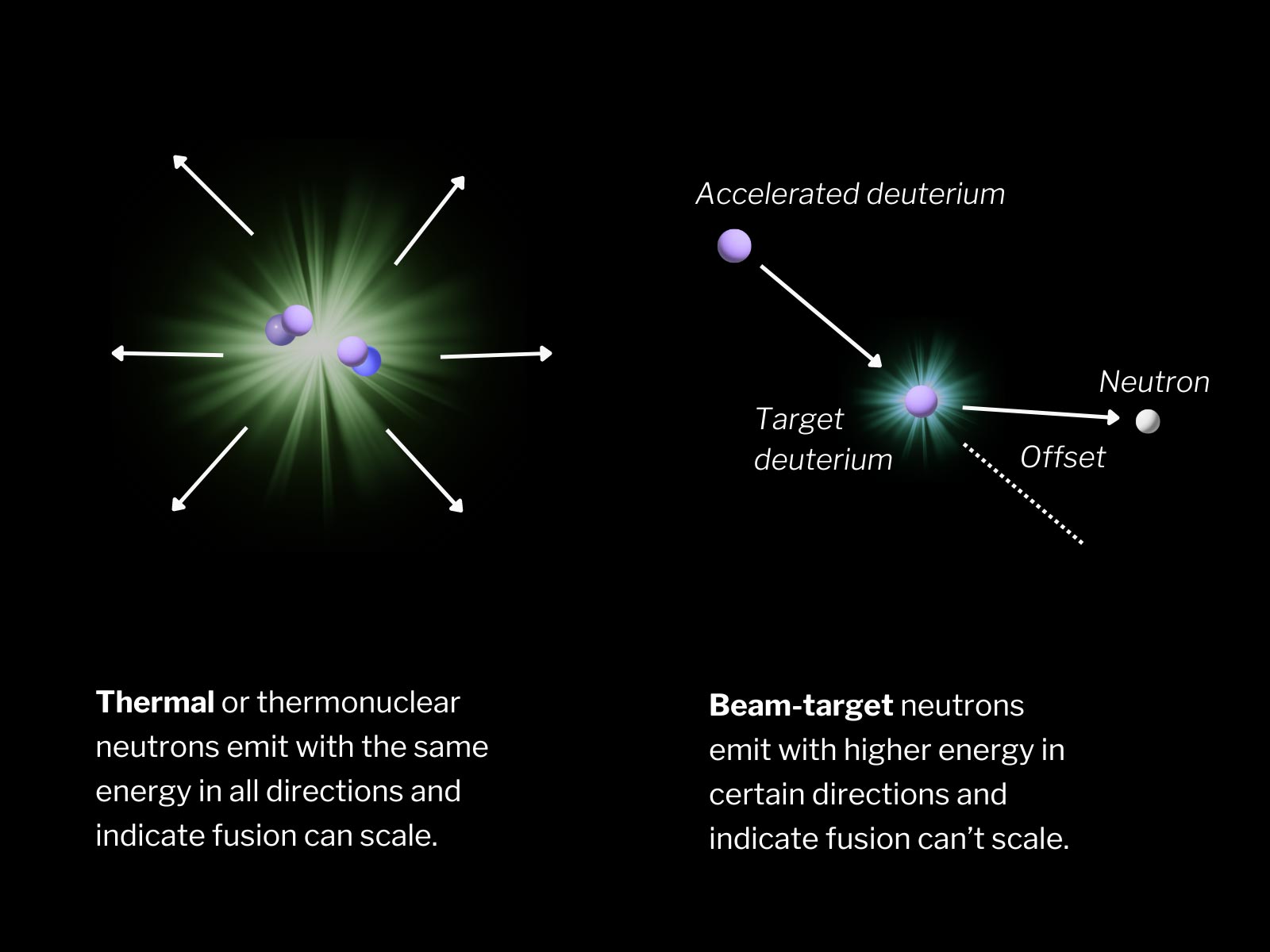
Less desirable is what’s known as beam-target fusion, which happens when a hydrogen nucleus is accelerated to high velocity and strikes a stationary nucleus. Unlike in thermal fusion, beam-target fusion indicates the plasma is out of equilibrium, and therefore doesn’t scale as strongly, making a working energy source much more difficult.
Thermal fusion produces neutrons with isotropic velocities, or with the same energy in all directions, while beam-target fusion produces them anisotropically, or such that neutrons in certain directions have higher energies. So, comparing measurements of the neutron energy at different locations is a simple way to see how much of the fusion in the FuZE device is non-thermal.
“If we saw neutrons primarily from a beam-target source, it would mean that our machine wouldn’t be scalable. We couldn’t get to net energy production,” says Rachel Ryan, a senior scientist at Zap and lead author of the new research.
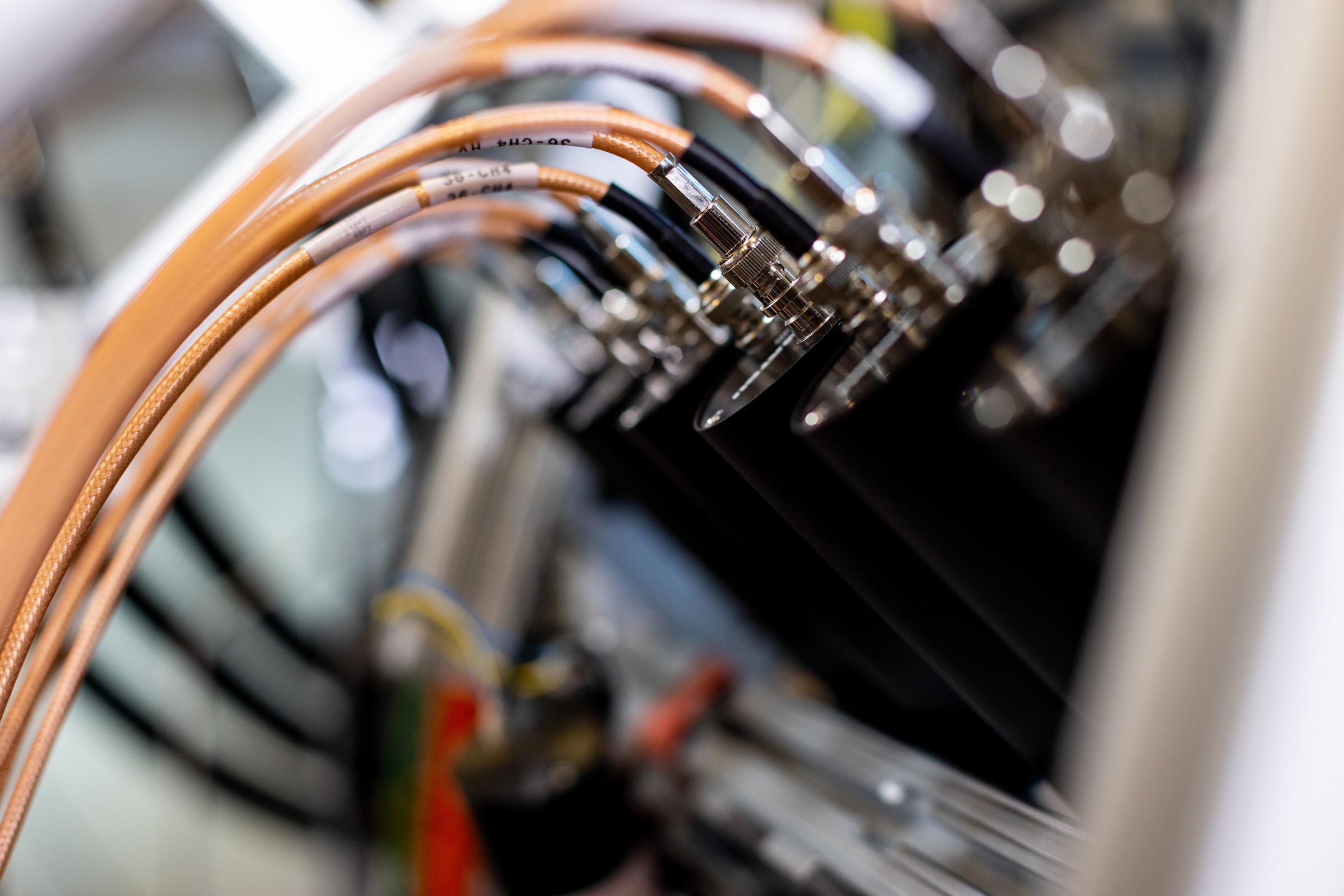
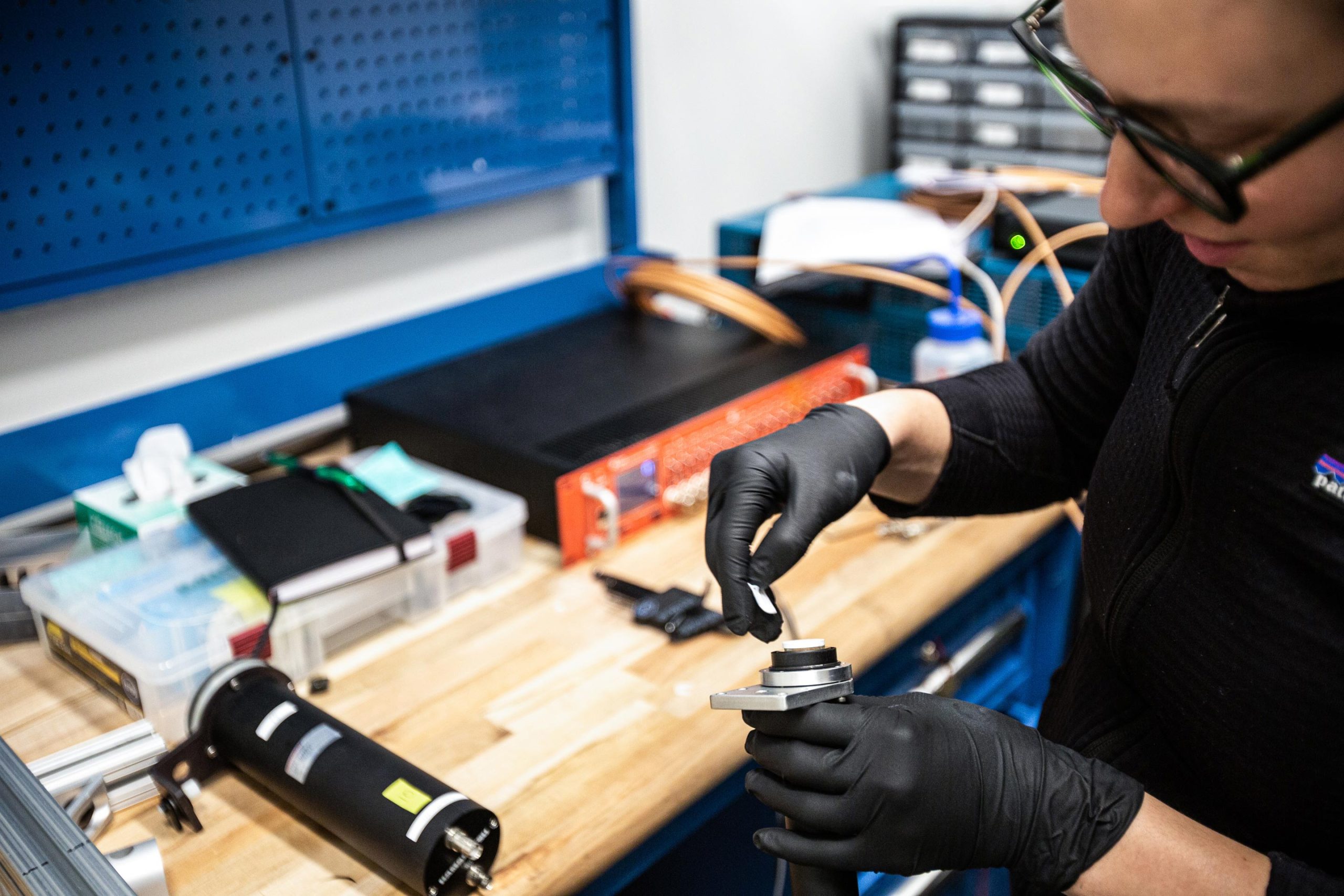
To test the neutron isotropy in FuZE, Zap scientists and engineers ran a series of tests using neutron detectors placed around the device. Measuring 433 plasma shots generated with the same machine settings, the neutrons were found to be almost totally isotropic.
A Meaningful Measurement, in More Ways Than One
Besides being a key benchmark for physics progress, neutron isotropy holds extra historical significance for Zap’s fusion approach.
The Z pinch is one of fusion’s oldest approaches and dates back to the 1950s. When scientists working on the Zero Energy Thermonuclear Assembly (ZETA) device in the United Kingdom began using magnetic fields to “pinch” a plasma strongly enough to create fusion, they thought they had succeeded. But that success didn’t come in the way they had hoped. Their device turned out to be creating almost entirely beam-target fusion through the creation of instabilities in the magnetic field. That meant they could never generate net-energy-gain fusion. What had been a hopeful moment for the physics community turned out to be a disappointment and a PR disaster.
And while isotropy became a particular black mark for pinch-based approaches, all fusion technologies risk measuring false positives from beam-target neutrons. For example, a device known as a dense plasma focus (DPF) has also been largely dismissed as a practical path to a fusion power plant. Though they are similar in some ways to Zap’s devices and are considered an effective means of generating neutrons, DPF neutrons come primarily from beam-target interactions.
A Step Toward Scalable Fusion Power
In the shadow of those experiments, Zap is extra conscious of the story its neutrons tell. The company first measured thermal fusion in 2018 and these new tests, done with higher sensitivity and at higher energies, are the latest confirmation that sheared flows can postpone the instabilities that doomed previous Z pinch efforts. Scalable thermal Z-pinch fusion, without requiring any external magnets for confinement, remains promising.
The paper represents a major physics consideration, Shumlak says. “This is why we put so much effort into making these precise measurements,” he says.
Preparing for the Future
Since joining Zap in 2023, Ryan has played the lead role in planning and carrying out neutron measurements at Zap, building on work previously done by collaborators and co-authors from Lawrence Livermore National Lab. Next up for the team is running the same set of tests at higher energies on Zap’s FuZE-Q device. Initial results look promising.
“As we continue to scale up, it’s important for us to keep taking this measurement and keep checking whether beam-target fusion is contributing to our yields,” Ryan says.
Interestingly, the paper also notes that the neutrons became less isotropic and lost uniformity near the end of each shot. The researchers suggest this is likely a phase where the pinch becomes unstable before it breaks down and stops generating fusion entirely. Understanding that phase may give a better understanding of how to keep the instabilities from cutting fusion short and further increase the duration and performance of the plasma.
Reference: “Time-resolved measurement of neutron energy isotropy in a sheared-flow-stabilized Z pinch” by R.A. Ryan, P.E. Tsai, A.R. Johansen, A.E. Youmans, D.P. Higginson, J.M. Mitrani, C.S. Adams, D.A. Sutherland, B. Levitt and U. Shumlak, 31 January 2025, Nuclear Fusion.
DOI: 10.1088/1741-4326/ada8bf
Never miss a breakthrough: Join the SciTechDaily newsletter.
Follow us on Google and Google News.
5 Comments
When fusion plasmas are isotropic, they indicate a stable, thermal plasma that can be scaled up for greater energy production. In contrast, anisotropic plasmas, which emit neutrons unevenly, suggest instability and may not support sustainable fusion.
GOOD!
Stars and radioactive elements are one of the most active topological nodes in spacetime. Utilizing them is more valuable and meaningful than simulating them. Small and micro power topology intelligent batteries have more practical value and significance.
As the background of various material interactions and movements, space exhibits isotropic physical characteristics. It may form various forms of spacetime vortices through topological phase transitions. Hence, vortex phenomena are ubiquitous in cosmic space, from vortices of quantum particles and living cells to tornados and black holes.
According to the Topological Vortex Theory (TVT), spins create everything, spins shape the world. There are substantial distinctions between Topological Vortex Theory (TVT) and traditional physical theories. Grounded in the inviscid and absolutely incompressible spaces, TVT introduces the concept of topological phase transitions and employs topological principles to elucidate the formation and evolution of matter in the universe, as well as the impact of interactions between topological vortices and anti-vortices on spacetime dynamics and thermodynamics.
Within TVT, low-dimensional spacetime matter serves as the foundation for high-dimensional spacetime matter, and the hierarchical structure of matter and its interaction mechanisms challenge conventional macroscopic and microscopic interpretations. The conflict between Quantum Physics and Classical Physics can be attributed to their differing focuses: Quantum Physics emphasizes low-dimensional spacetime matter, whereas Classical Physics centers on high-dimensional spacetime matter.
Subatomic particles in the quantum world often defy the familiar rules of the physical world. The fact repeatedly suggests that the familiar rules of the physical world are pseudoscience. In the familiar rules of the physical world, two sets of cobalt-60 can form the mirror image of each other by rotating in opposite directions, and should receive the Nobel Prize for physics.
Please witness the grand performance of some so-called peer review publications (including PRL, PNAS, Nature, Science, etc.). https://scitechdaily.com/microscope-spacecrafts-most-precise-test-of-key-component-of-the-theory-of-general-relativity/#comment-854286. Some so-called academic publications (including PRL, PNAS, Nature, Science, etc.) are addicted to their own small circles and have deviated from science for a long time.
If the researchers are truly interested in time, please read: The Challenge of Topological Vortex Theory (TVT) to Traditional Time Concepts (https://scitechdaily.com/microscope-spacecrafts-most-precise-test-of-key-component-of-the-theory-of-general-relativity/#comment-869260).
In the topological vortex architecture, the distinction between science and pseudoscience becomes evident. Topological Vortex Theory (TVT) can play a crucial role in elucidating the foundations of physics, establishing its principles, and combating pseudoscience. TVT may encounter significant opposition and resistance from traditional peer review publications. The field of physics faces an ongoing challenge in maintaining scientific rigor and integrity in the face of pervasive pseudoscientific claims. Fighting against rampant pseudoscience, physics still has a long way to go.
Small or Micro Power Topology Intelligent Batteries Have More Practical Value and Significance.
Under the topological vortex architecture, science and pseudoscience are clear at a glance. Topological Vortex Theory (TVT) can play a crucial role in elucidating the foundations of physics, establishing its principles, and combating pseudoscience. Therefore, TVT has been strongly opposed and boycotted by traditional so-called peer review publications (such as PRL, PNAS, Nature, Science, etc.). These so-called peer review publications hardly know what is dirty and ugly. The field of physics faces an ongoing challenge in maintaining scientific rigor and integrity in the face of pervasive pseudoscientific claims.
Fighting against rampant pseudoscience, physics still has a long way to go.
Good luck, science still believes in things as incredibly stupid as evolution and a universe billions of years old, two ridiculous concepts, and both unprovable.
Science still believes that “forensic science” isn’t an oxymoron…that we can call something unobservable such as the origins of the universe…science.
Until we can train AI to judge between fact and fiction and not hallucinate in the process, we are at the mercy of egotistical, emotional humans who continuously are hungering for funding.
Intelligence intrrast