
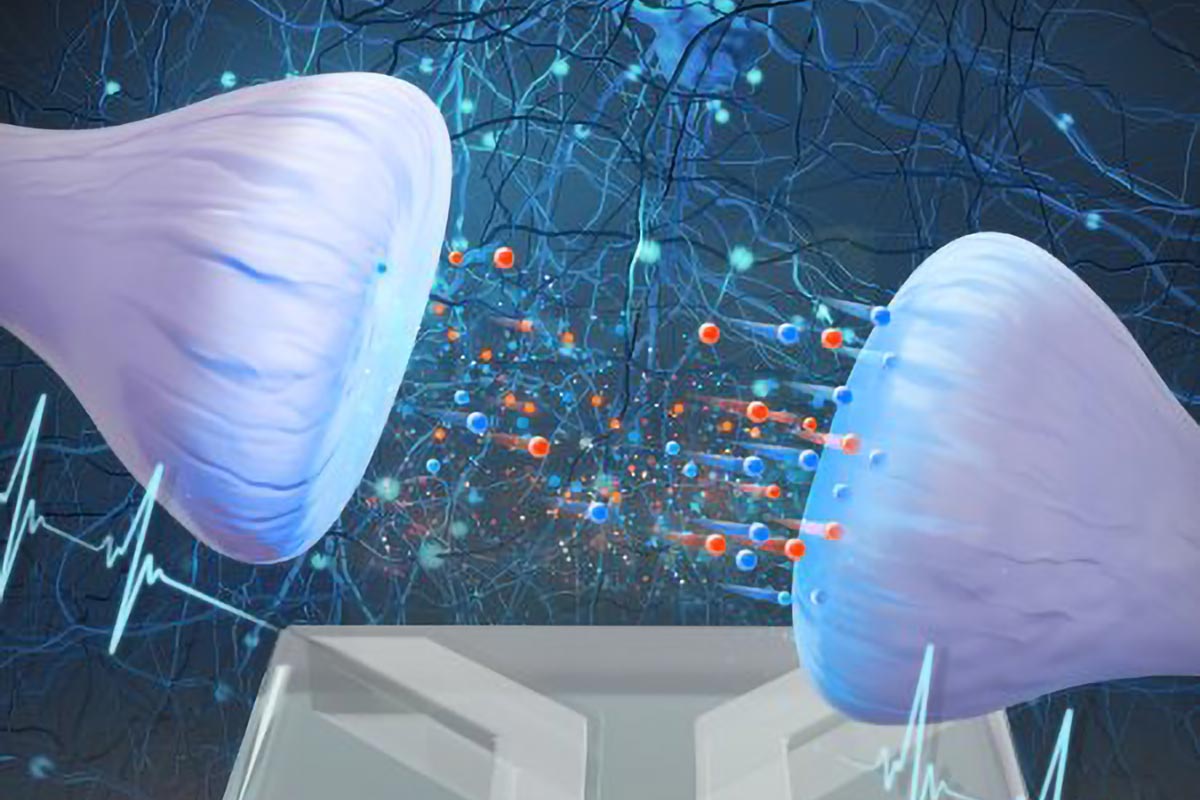
Theoretical physicists at Utrecht University, together with experimental physicists at Sogang University in South Korea, have succeeded in building an artificial synapse. This synapse works with water and salt and provides the first evidence that a system using the same medium as our brains can process complex information. The results were published in the scientific journal Proceedings of the National Academy of Sciences.
In the pursuit of enhancing the energy efficiency of conventional computers, scientists have long turned to the human brain for inspiration. They aim to emulate its extraordinary capacity in various ways. These efforts have led to the development of brain-like computers, which diverge from traditional binary processing to embrace analog methods akin to our brains. However, while our brains operate using water and dissolved salt particles called ions as their medium, most current brain-inspired computers rely on conventional solid materials.
This raises the question: could we not achieve a more faithful replication of the brain’s workings by adopting the same medium? This intriguing possibility lies at the heart of the burgeoning field of iontronic neuromorphic computing.
Artificial Synapse
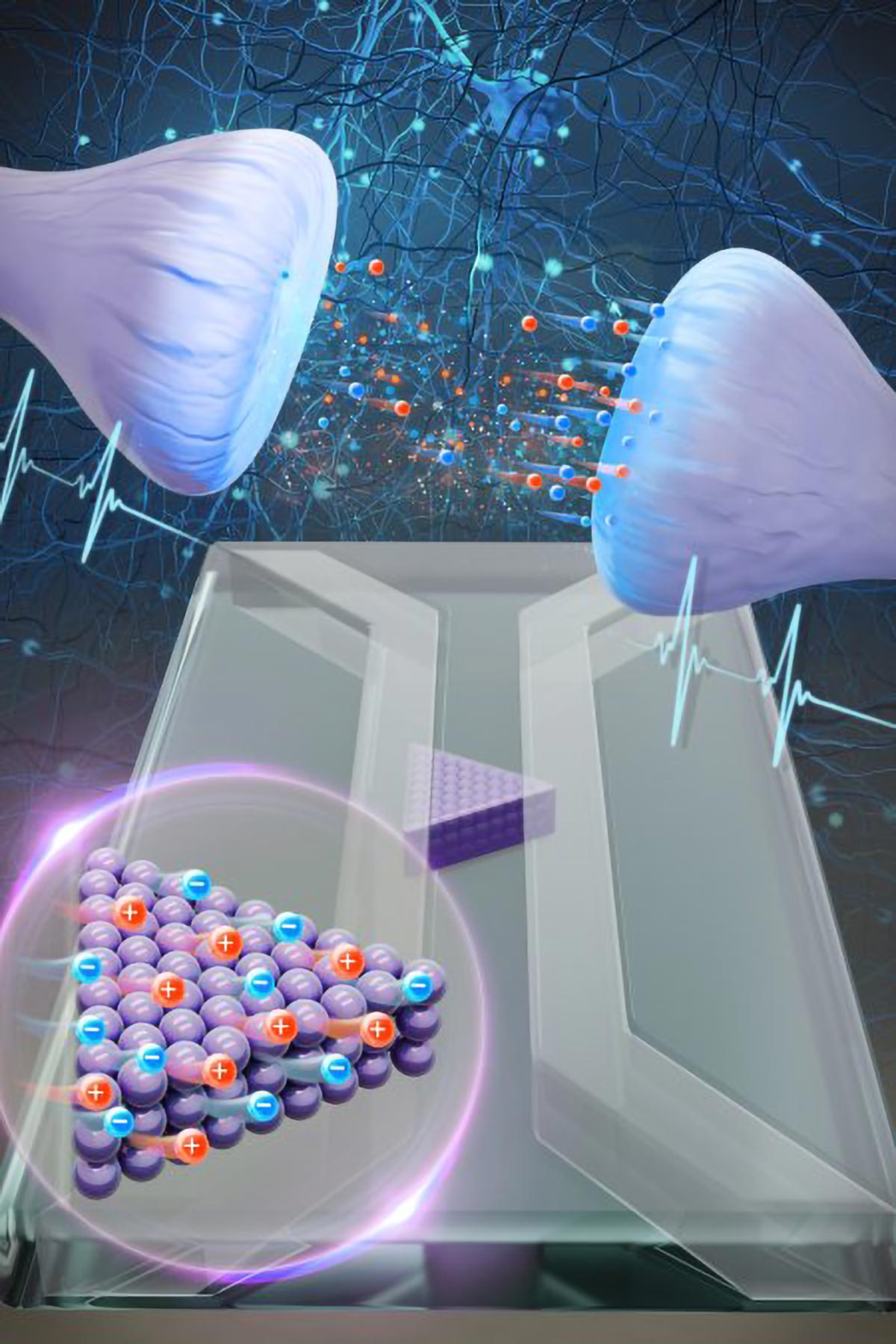
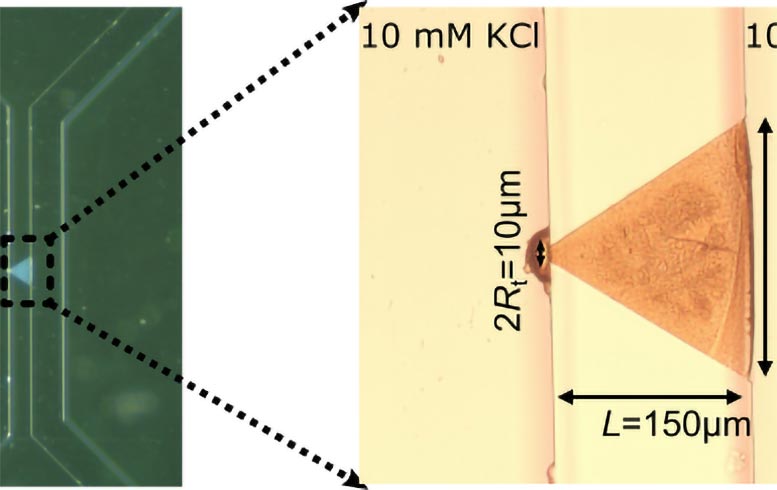
In the latest study published in PNAS, scientists have, for the very first time, demonstrated a system reliant on water and salt exhibiting the ability to process intricate information, mirroring the functionality of our brains. Central to this discovery is a minute device measuring 150 by 200 micrometers, which mimics the behavior of a synapse—an essential component in the brain responsible for transmitting signals between neurons.
Tim Kamsma, a PhD candidate at the Institute for Theoretical Physics and the Mathematical Institute of Utrecht University, and the lead author of the study, expresses his excitement, stating, “While artificial synapses capable of processing complex information already exist based on solid materials, we now show for the first time that this feat can also be accomplished using water and salt.” He emphasizes, “We are effectively replicating neuronal behavior using a system that employs the same medium as the brain.”
“Perhaps this will pave the way for computing systems that replicate the extraordinary capabilities of the human brain more faithfully.”
Tim Kamsma, PhD candidate and lead author
Ion Migration
The device, developed by scientists in Korea and referred to as an iontronic memristor, comprises a cone-shaped microchannel filled with a solution of water and salt. Upon receiving electrical impulses, ions within the liquid migrate through the channel, leading to alterations in ion concentration. Depending on the intensity (or duration) of the impulse, the conductivity of the channel adjusts accordingly, mirroring the strengthening or weakening of connections between neurons. The extent of change in conductance serves as a measurable representation of the input signal.
An additional finding is that the length of the channel impacts the duration required for concentration changes to dissipate. “This suggests the possibility of tailoring channels to retain and process information for varying durations, again akin to the synaptic mechanisms observed in our brains,” elaborates Kamsma.
Wow!
The genesis of this discovery can be traced back to an idea conceived by Kamsma, who began his doctoral research not long ago. He transformed this concept—centered around the utilization of artificial ion channels for classification tasks—into a robust theoretical model.
“Coincidently, our paths crossed with the research group in South Korea during that period,” recalls Kamsma.”They embraced my theory with great enthusiasm and swiftly initiated experimental work based on it.” Remarkably, the initial findings materialized just three months later, closely aligning with the predictions outlined in Kamsma’s theoretical framework. “I thought wow!” he reflects. “It’s incredibly gratifying to witness the transition from theoretical conjecture to tangible real-world outcomes, ultimately resulting in these beautiful experimental results.”
A Significant Step Forward
Kamsma underscores the fundamental nature of the research, highlighting that iontronic neuromorphic computing, while experiencing rapid growth, is still in its infancy. The envisioned outcome is a computer system vastly superior in efficiency and energy consumption compared to present-day technology. However, whether this vision will materialize remains speculative at this juncture. Nevertheless, Kamsma views the publication as a significant step forward.
“It represents a crucial advancement toward computers not only capable of mimicking the communication patterns of the human brain but also utilizing the same medium,” he asserts. “Perhaps this will ultimately pave the way for computing systems that replicate the extraordinary capabilities of the human brain more faithfully.”
Reference: “Brain-inspired computing with fluidic iontronic nanochannels” by Tim M. Kamsma, Jaehyun Kim, Kyungjun Kim, Willem Q. Boon, Cristian Spitoni, Jungyul Park and René van Roij, 24 April 2024, Proceedings of the National Academy of Sciences.
DOI: 10.1073/pnas.2320242121
Tim Kamsma’s doctoral research receives funding from Utrecht University’s Science for Sustainability community. Through its doctoral programme, the community fosters interdisciplinary, fundamental research in sustainability.
Never miss a breakthrough: Join the SciTechDaily newsletter.
Follow us on Google and Google News.