

What if living organisms could perform some of the tasks handled by silicon chips? New research suggests fungal systems can exhibit memory-like electrical behavior, opening the door to unconventional, low-energy computing architectures.
Fungal networks could offer an alternative to the tiny metal components commonly used to process and store digital information, according to a new study.
Mushrooms are known for their extreme resilience and distinctive biological traits. These natural qualities make them strong candidates for bioelectronics, a growing area of research that aims to develop new materials for future computing technologies.
Turning edible mushrooms into memory devices
Researchers at The Ohio State University have shown that familiar edible fungi, including shiitake mushrooms, can be cultivated and conditioned to function as organic memristors. Memristors are electronic components that process information by retaining a memory of previous electrical signals.
The team found that devices made from shiitake mushrooms produced repeatable memory effects comparable to those seen in conventional semiconductor chips. The results also suggest these fungal systems could serve as the foundation for other inexpensive, environmentally friendly computing components inspired by how the brain works.
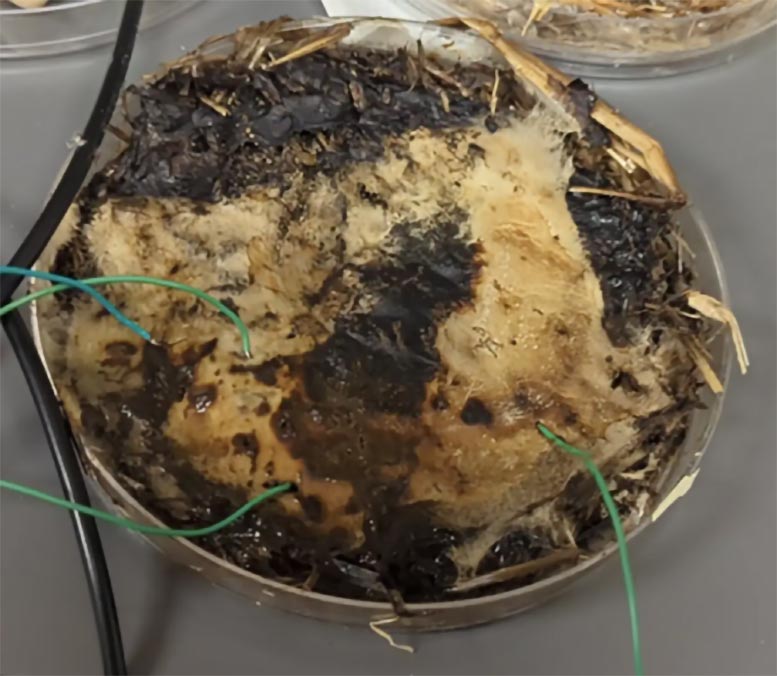
“Being able to develop microchips that mimic actual neural activity means you don’t need a lot of power for standby or when the machine isn’t being used,” said John LaRocco, lead author of the study and a research scientist in psychiatry at Ohio State’s College of Medicine. “That’s something that can be a huge potential computational and economic advantage.”
Sustainability drives renewed interest in fungal electronics
Fungal electronics have been explored before, but LaRocco says they are now especially attractive for building more sustainable computing systems. Because fungi are biodegradable and relatively simple to grow, they generate less electronic waste and cost less to produce than traditional memristors and semiconductors, which often depend on rare earth minerals and energy intensive data centers.
“Mycelium as a computing substrate has been explored before in less intuitive setups, but our work tries to push one of these memristive systems to its limits,” he said.
The study was recently published in the journal PLOS One.
Testing how mushroom memristors perform
To test how these new memristors perform, the research team grew cultures of shiitake and button mushrooms. After the mushrooms reached maturity, they were dehydrated to support long-term stability, attached to specialized electronic circuits, and exposed to electrical stimulation across a range of voltages and frequencies.
“We would connect electrical wires and probes at different points on the mushrooms because distinct parts of it have different electrical properties,” said LaRocco. “Depending on the voltage and connectivity, we were seeing different performances.”

After two months, the team discovered that when used as RAM – the computer memory that stores data – their mushroom memristor was able to switch between electrical states at up to 5,850 signals per second, with about 90% accuracy. However, performance dropped as the frequency of the electrical voltages increased, but much like an actual brain, it could be fixed by connecting more mushrooms to the circuit.
Environmental motivation and broader implications
Overall, their research details how surprisingly easy it is to program and preserve mushrooms to behave in unexpected and useful ways, said Qudsia Tahmina, co-author of the study and an associate professor in electrical and computer engineering at Ohio State. Moreover, it’s an example of how technology can advance when it relies on the natural world.
“Society has become increasingly aware of the need to protect our environment and ensure that we preserve it for future generations,” said Tahmina.“So that could be one of the driving factors behind new bio-friendly ideas like these.”
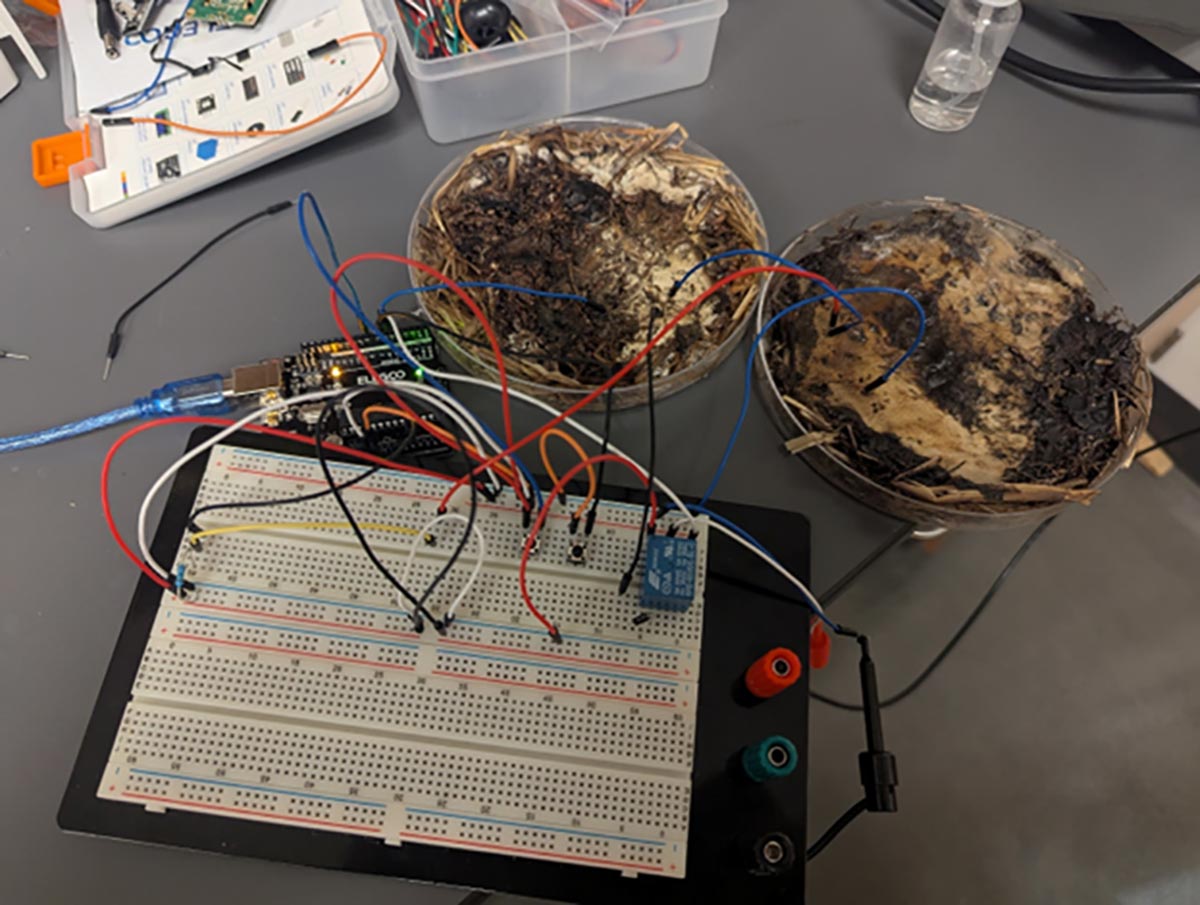
Building on the flexibility mushrooms offer also suggests there are possibilities for scaling up fungal computing, said Tahmina. For instance, larger mushroom systems may be useful in edge computing and aerospace exploration; smaller ones in enhancing the performance of autonomous systems and wearable devices.
Organic memristors are still in early development, but future work could optimize the production process by improving cultivation techniques and miniaturizing the devices, as viable fungal memristors would need to be far smaller than what researchers achieved in this work.
“Everything you’d need to start exploring fungi and computing could be as small as a compost heap and some homemade electronics, or as big as a culturing factory with pre-made templates,” said LaRocco. “All of them are viable with the resources we have in front of us now.”
Reference: “Sustainable memristors from shiitake mycelium for high-frequency bioelectronics” by John LaRocco, Qudsia Tahmina, Ruben Petreaca, John Simonis and Justin Hill, 10 October 2025, PLOS ONE.
DOI: 10.1371/journal.pone.0328965
This study was supported by the Honda Research Institute.
Never miss a breakthrough: Join the SciTechDaily newsletter.
Follow us on Google and Google News.
4 Comments
What a headline, and this from a science page. Wow.
Are fungi part of the NHI world? Maybe we shouldn’t be eating them…
I never eat mushrooms, little fairies sit on them in the forest without any clothes on.
I wanna see the Psilocybin computer!